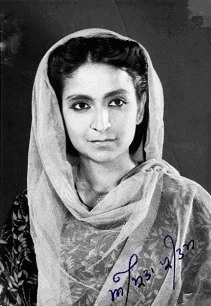
File:Amrita_Pritam_(1919_–_2005)_,_in_1948.jpg · Wikimedia Commons · See Wikimedia Commons
OverviewAI-generated
Amrita Pritam was a female poet, writer, politician, and autobiographer who wrote in Hindi and Punjabi. Born in Gujranwala in 1919, she was a citizen of the British Raj, the Dominion of India, and India. She served as a member of the Rajya Sabha and was associated with the Romanticism and Progressive Writers' Movement movements. Her notable work includes the novel Pinjar.
She received the Jnanpith Award, the Punjab Rattan Award, and was a Fellow of the Sahitya Akademi. Her other works include Uncāsa dina, ايک اداس کتاب, Yatri, Pinjara, Eka khālī jagaha, and The revenue stamp. She died in Delhi on 31 October 2005.
Synthesized by Vinony from 23 facts across 3 sources: Wikidata, Open Library, TMDb. Generated from structured data (not the Wikipedia text) and checked against those facts — may still contain errors.
Person · Open Library
- Born
- 1919
- Died
- 2005
- Works
- 406
Top works
- Uncāsa dina
- ايک اداس کتاب
- Yatri
- Pinjara [and] Eka khālī jagaha
- The revenue stamp
via Open Library + Wikidata
Wikidata facts
- Instance of
- human
- Gender
- female
- Citizenship
- India
- Place of birth
- Gujranwala
- Place of death
- Delhi
- Occupation
- novelist
- Position held
- member of Rajya Sabha
- Languages spoken
- Punjabi
- Genre
- poetry
- Movement
- Progressive Writers' Movement
- Image
- Amrita Pritam (1919 – 2005) , in 1948.jpg
Show 5 more facts
- Commons category
- Amrita Pritam
- date of birth
- 1919-08-31
- date of death
- 2005-10-31
- name in native language
- Amrita Pritam!
- writing language
- Punjabi
Sources (7)
via Wikidata · CC0
~12 min read
Encyclopedic overview
Amrita Pritam ([əm.mɾɪt̪ɑː pɾiːt̪əm] ; 31 August 1919 – 31 October 2005) was an Indian novelist, essayist and poet, who wrote in Punjabi and Hindi. A prominent figure in Punjabi literature, she is the recipient of the 1956 Sahitya Akademi Award. Her body of work comprised over 100 books of poetry, fiction, biographies, essays, a collection of Punjabi folk songs and an autobiography that were all translated into several Indian and foreign languages.
Pritam is best remembered for her poignant poem, Ajj aakhaan Waris Shah nu (Today I invoke Waris Shah – "Ode to Waris Shah"), an elegy to the 18th-century Punjabi poet, and an expression of her anguish over massacres during the partition of British India. As a novelist, her most noted work was Pinjar ("The Skeleton", 1950), in which she created her memorable character, Puro, an epitome of violence against women, loss of humanity and ultimate surrender to existential fate; the novel was made into an award-winning film, Pinjar (2003).
Excerpted from Wikipedia’s “Amrita Pritam” article, available under the CC BY-SA 4.0 licence.