
Andorre
Also known as Principality of Andorra, Principality of the Valleys of Andorra
principauté d'Europe
AI overview
Andorra is a small landlocked country nestled in the Pyrenees mountains between France and Spain, with a unique governing structure in which it is jointly ruled by two co-princes: the Bishop of Urgell in Spain and the President of France. Its distinctive political arrangement stems from medieval arrangements dating back to 1278, when Andorra was formally established as a lordship, and it has maintained this dual-leadership system into the modern era.
AI-generated from the Wikipedia summary — may contain errors.
Weather now
cached 2h ago11°clear sky
53% 2.2 m/s OpenWeatherMap
7-day forecast
via Open-Meteo
Country

- Capital
- Andorra la Vella
- Population
- 88,406
- Region
Travel guide
Get in
thumb|Scenery is the country's greatest treasure. thumb|Església de Sant Miquel d'Engolasters, a 12th-century church
Due mainly to the mountainous nature of Andorra, there is only one road entering Andorra from France, and only one widely-used road entering Andorra from Spain. Almost all entry into the country happens at one of these two points.
Citizens of all European Union member states may enter Andorra using only their ID cards, but all other foreigners, including citizens of non-EU Schengen countries, are required to have a passport.
Andorra doesn't require a visa from any visitors, but because the country can only be entered from Spain or France, you'll need to enter the Schengen Area first in order to get to Andorra. See the Schengen Area entry requirements. If you intend to stay in Andorra for more than 90 days, you will need to obtain a residence permit.
As Andorra is not a member of the EU, everyone entering Andorra is required to go through customs controls. See the Visit Andorra web-site for more information on your duty-free allowances.
Visitors from outside the EU should note that Andorra is not a Schengen member, and exiting France or Spain into Andorra would theoretically terminate a single-entry visa. In practice, though, immigration does not enforce this. If you have a multiple-entry Schengen visa, or can visit the Schengen Area visa-free, you can request French or Spanish border officials to stamp you out so your time spent in Andorra does not count a…
Get around
thumb|300px|The Envalira mountain pass thumb| Andorra bus lines map (2022)
See
thumb|The 9th-century church of Santa Coloma is the oldest one in the country. thumb|Gentle slopes make Andorra a favourite winter sports destination for beginners.
Threatened by seemingly unchecked development, the country's main draw is still its magnificent mountainous landscapes, offering spectacular vistas in every season. At these heights, summers are cool, making for excellent hiking conditions through the romantic green valleys. Challenging day long hikes can be had on even higher grounds, and will take you through truly memorable scenery. Don't overlook the Madriu-Perafita-Claror Valley, Andorra's only UNESCO World Heritage site. Only reachable on foot, this undeveloped area is an important wildlife sanctuary and consists of forest and fields, dotted with the odd shepherd's hut. In winter, snow covers large parts of the country, changing the Alpine character into an equally beautiful stage for various winter sports. Check the Andorra national parks page for more info on parks.
Article · Français
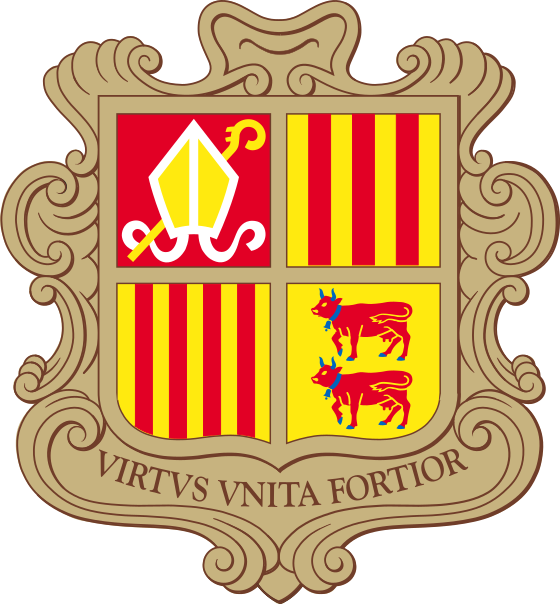
L'Andorre, en forme longue la principauté d'Andorre (en catalan : Andorra et Principat d’Andorra), est un État d'Europe du Sud et, selon certaines définitions, de l'Ouest. Bordée par l'Espagne et la France (donc enclavée dans l'Union européenne), et située dans le massif des Pyrénées, elle est principalement constituée de montagnes élevées. Le pays ne fait pas partie de la zone euro, ni de l'Union européenne, mais utilise cependant l'euro depuis la création de cette monnaie, et ne frappe ses propres pièces que depuis le 1er juillet 2013 en vertu d'un accord monétaire avec l'Union européenne. Il s'agit d'un des plus petits États souverains d'Europe, avec une superficie de 468 km2 et une population estimée à 79 535 habitants en 2021. Établie à 1 023 m d'altitude, Andorre-la-Vieille, sa capitale, est la plus haute d'Europe. La langue officielle est le catalan, la monnaie officielle est l'euro. La devise de l'Andorre est Virtus Unita Fortior, et son drapeau est constitué de trois bandes verticales bleue, jaune et rouge, la bande jaune étant plaquée de l'écusson andorran. L'hymne national est El Gran Carlemany. La principauté, dont la création remonte à 788 sous le règne de Charlemagne, est régie par un système unique, le paréage de 1278 et 1288. Ce contrat de droit féodal concède le trône andorran à deux coprinces, l'évêque catalan d'Urgell et le comte de Foix (dont les droits et devoirs sont passés successivement au roi de Basse-Navarre, puis au roi de France à partir d'Henri IV, et enfin au chef d'État français). L'Andorre est sortie de son isolement au XXe siècle, durant lequel elle a profité de son cadre naturel et a utilisé un système fiscal avantageux pour devenir une grande destination touristique, accueillant près de trois millions de visiteurs chaque année. Si la principauté est réputée aujourd'hui pour ses pistes de ski et ses faibles taxes, elle est aussi souvent considérée comme un paradis fiscal. Elle est membre des Nations unies depuis 1993, du Conseil de l'Europe, mais pas de l'Union européenne.
Abstract from DBpedia / Wikipedia · CC BY-SA
Gallery (639)
On the map
60 mapped locations
Connections
Categories
1278 establishments in EuropeAndorraCatalan CountriesChristian statesCountries in EuropeDiarchiesDuty-free zones of EuropeIberian Peninsula countriesImportant Bird Areas of AndorraLandlocked countriesMember states of the Council of EuropeMember states of the Organisation internationale de la Francophonie