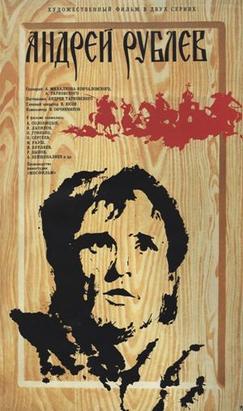
File:Andrei_Rublev_Russian_poster.jpg · Wikimedia Commons · See Wikimedia Commons
Andrei Rublev
Sign in to saveAlso known as The Passion According to Andrei
1966 film by Andrei Tarkovsky
Film · TMDB
8.0An expansive Russian drama, this film focuses on the life of revered religious icon painter Andrei Rublev. Drifting from place to place in a tumultuous era, the peace-seeking monk eventually gains a reputation for his art. But after Rublev witnesses a brutal battle and unintentionally becomes involved, he takes a vow of silence and spends time away from his work. As he begins to ease his troubled soul, he takes steps towards becoming a painter once again.
Cast
- Anatoliy Solonitsyn as Andrei Rublev
- Ivan Lapikov as Kirill
- Mykola Hrynko as Daniil Chornyy
- Nikolai Sergeyev as Theophanus the Greek
- Irma Raush as God's Fool
- Nikolay Burlyaev as Boriska
Themes
- rape
- christianity
- monk
- artist
- cathedral
- crucifixion
- famine
- painter
- icon
- biography
This product uses the TMDB API but is not endorsed or certified by TMDB.
Ratings
IMDb
8/10
60,197 votes
Rotten Tomatoes
96%
- Year
- 1966
- Runtime
- 205 min
- Genres
- Biography, Drama, History
- Rated
- R
- Awards
- 4 wins & 1 nomination total
via OMDb · IMDb
Key facts
- Directed by
- Andrei Tarkovsky
- Written by
- Andrei Konchalovsky Andrei Tarkovsky
- Produced by
- Tamara Ogorodnikova
- Starring
- Anatoly Solonitsyn Ivan Lapikov Nikolai Grinko Nikolai Sergeyev Irma Raush Nikolai Burlyayev Rolan Bykov Bolot Beyshenaliyev
- Cinematography
- Vadim Yusov
- Edited by
- Lyudmila Feiginova Tatyana Egorycheva Olga Shevkunenko
- Music by
- Vyacheslav Ovchinnikov
- Production company
- Mosfilm
- Release dates
- 16 December 1966 ( 1966-12-16 ) (Moscow) 24 December 1971 ( 1971-12-24 ) (Soviet Union)
- Running time
- 205 minutes (first cut) 183 minutes (final cut)
- Country
- Soviet Union
- Languages
- Russian Tatar Italian
- Budget
- 1.3 million Rbls
via Wikipedia infobox
Wikidata facts
- Instance of
- film
- Part of
- Vatican's list of films
- Named after
- Andrei Rublev
- Genre
- biographical film
- Country of origin
- Soviet Union
- Original language
- Italian
- Director
- Andrei Tarkovsky
- Screenwriter
- Andrei Tarkovsky
- Composer
- Vyacheslav Ovchinnikov
- Production company
- Mosfilm
- Cinematographer
- Vadim Yusov
- Narrative location
- Moscow
- Filming location
- Russia
- Duration
- 185
- FilmAffinity ID
- 763373
- Distribution format
- video on demand
Show 9 more facts
- publication date
- 1971-12-24
- title
- Андрей Рублёв
- color
- black-and-white
- distributed by
- Netflix
- capital cost
- 900000
- different from
- Andrei Rublev
- assessment
- Bechdel test
- review score
- 95%
- characters
- Edigu
Sources (15)
via Wikidata · CC0
~37 min read
Encyclopedic overview
Andrei Rublev (Russian: Андрей Рублёв, romanized: Andrey Rublyov) is a 1966 Soviet epic biographical historical drama film directed by Andrei Tarkovsky who co-wrote it with Andrei Konchalovsky. The film was re-edited from the 1966 film titled The Passion According to Andrei by Tarkovsky which was censored during the first decade of the Brezhnev era in the Soviet Union. The film is loosely based on the life of Andrei Rublev, a 15th-century Russian icon painter. The film features Anatoly Solonitsyn, Nikolai Grinko, Ivan Lapikov, Nikolai Sergeyev [ru], Nikolai Burlyayev and Tarkovsky's wife Irma Raush. Savva Yamshchikov, a famous Russian restorer and art historian, was a scientific consultant for the film.
Andrei Rublev is set against the background of Russia in the early 15th century. Although the film is only loosely based on Rublev's life, it seeks to depict a realistic portrait of medieval Russia. Tarkovsky sought to create a film that shows the artist as "a world-historic figure" and "Christianity as an axiom of Russia's historical identity" during a turbulent period of Russian history. In addition to treating the artist as "a world-historic figure," Tarkovsky also sought to detail and investigate the intersection between faith and artistry. In his book Sculpting in Time, Tarkovsky writes: "It is a mistake to talk about the artist 'looking for' his subject. In fact the subject grows within him like a fruit, and begins to demand expression. It is like childbirth... The poet has nothing to be proud of: he is not master of the situation, but a servant. Creative work is his only possible form of existence, and his every work is like a deed he has no power to annul. For him to be aware that a sequence of such deeds is due and right, that it lies in the very nature of things, he has to have faith in the idea, for only faith interlocks the system of images." In Andrei Rublev, Tarkovsky depicts the philosophy that faith is necessary for art, thereby commenting on the deserved role of faith in the secular, atheist society he was in at the time of the film's creation.
Excerpted from Wikipedia’s “Andrei Rublev” article, available under the CC BY-SA 4.0 licence.