
File:RIAN_archive_25981_Academician_Sakharov.jpg · Wikimedia Commons · See Wikimedia Commons
Andrei Sakharov
Sign in to saveAlso known as AndAndrei D. Sakharovrei Dmitrievich Sakharov
Soviet nuclear physicist and human rights activist (1921–1989)
Andrei Sakharov was a Soviet nuclear physicist who played a key role in developing his country's hydrogen bomb but later became one of the Soviet Union's most prominent critics, fighting for human rights and nuclear disarmament until his death in 1989. His life matters because it illustrates both the scientific achievements and moral conflicts of the Cold War era, and because his courageous activism helped establish the modern human rights movement in the Soviet bloc.
AI-generated from the Wikipedia summary — may contain errors.
Nobel Prize
- The Nobel Peace Prize1975
“for his struggle for human rights in the Soviet Union, for disarmament and cooperation between all nations”
Official website
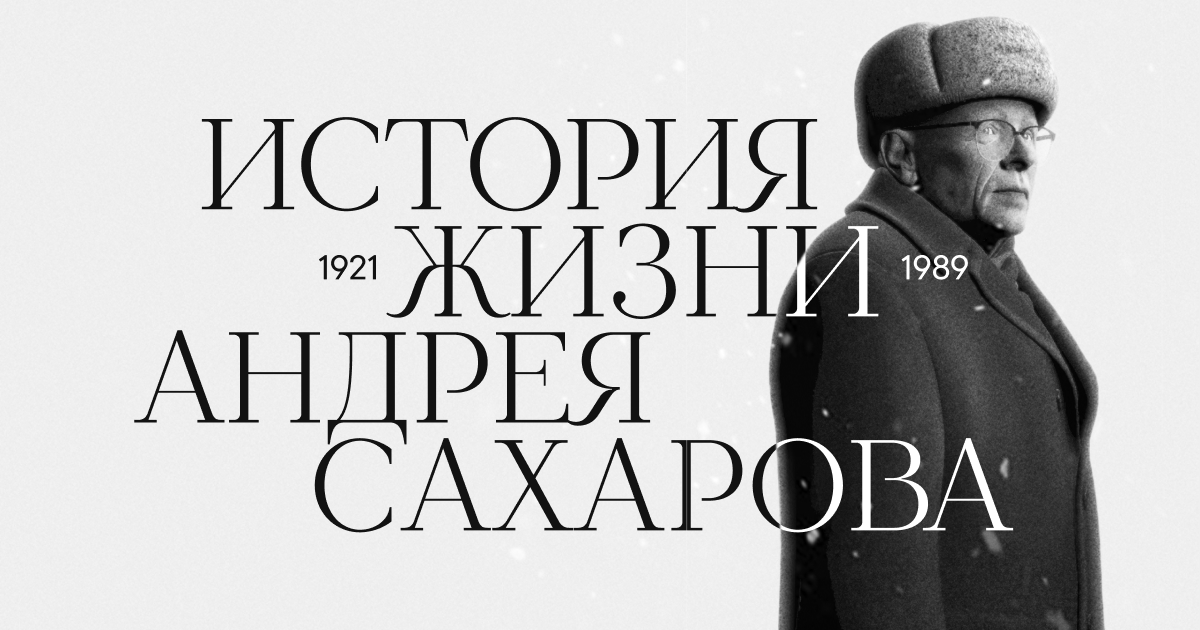
Глава 1 – Семья. Детство. Юность
Юный Андрей Сахаров занимается в школе на дому и впервые влюбляется в физику, а в СССР укрепляется тоталитарный режим.
sakharov.space →Link to the official site · 9,892 chars · not written by Vinony
Wikidata facts
- Instance of
- human
- Given name
- Andrey
- Gender
- male
- Citizenship
- Russian Socialist Federative Soviet Republic
- Place of birth
- Moscow
- Place of death
- Moscow
- Spouse
- Yelena Bonner
- Occupation
- politician
- Educated at
- MSU Faculty of Physics
- Employer
- Lebedev Physical Institute
- Languages spoken
- Russian
- Religion
- atheism
- Doctoral advisor
- Igor Tamm
- Field of work
- physics
- Official website
- www.sakharov.space
- Image
- RIAN archive 25981 Academician Sakharov.jpg
Show 16 more facts
- cause of death
- myocardial infarction
- Commons category
- Andrei Sakharov
- date of birth
- 1921-05-21
- place of burial
- Vostryakovo Cemetery
- date of death
- 1989-12-14
- manner of death
- natural causes
- member of
- American Philosophical Society
- topic's main category
- Category:Andrei Sakharov
- name in native language
- Андрей Дмитриевич Сахаров
- Commons gallery
- Андрей Дмитриевич Сахаров
- on focus list of Wikimedia project
- Wikipedia:Vital articles/Level/4
- ethnic group
- Russians
- subject has role
- prisoner of conscience
- maintained by WikiProject
- WikiProject Mathematics
- interested in
- nuclear physics
Sources (7)
via Wikidata · CC0
~40 min read
Encyclopedic overview
Andrei Dmitrievich Sakharov (Russian: Андрей Дмитриевич Сахаров; 21 May 1921 – 14 December 1989) was a Soviet physicist and a Nobel Peace Prize laureate, which he was awarded in 1975 for emphasizing human rights around the world.
Although he spent his career in physics in the Soviet program of nuclear weapons, overseeing the development of thermonuclear weapons, Sakharov also did fundamental work in understanding particle physics, magnetism, and physical cosmology. Sakharov is mostly known for his political activism for individual freedom, human rights, civil liberties and reforms in the Soviet Union, for which he was deemed a dissident and faced persecution from the Soviet establishment.
Excerpted from Wikipedia’s “Andrei Sakharov” article, available under the CC BY-SA 4.0 licence.
Gallery (10)
Available in 96 languages
- Español
- Français
- Deutsch
- 中文
- 日本語
- Русский
- Português
- Italiano
- العربية
- हिन्दी
- Abkhazian
- Afrikaans
- Aragonese
- Armenian
- Asturian
- azb
- Azerbaijani
- Bahasa Indonesia
Show 77 more
- Bangla
- Bashkir
- Basque
- be_x_old
- Belarusian
- Bosnian
- Breton
- Bulgarian
- Catalan
- Crimean Tatar
- Croatian
- Czech
- Danish
- Egyptian Arabic
- Esperanto
- Estonian
- Finnish
- Galician
- Georgian
- Greek
- Haitian Creole
- Hebrew
- Hungarian
- Icelandic
- Ido
- Irish
- Javanese
- Kazakh
- Kotava
- Kurdish
- Kyrgyz
- Latin
- Latvian
- Lithuanian
- Luxembourgish
- Macedonian
- Malagasy
- Malay
- Malayalam
- Marathi
- Mazanderani
- Mingrelian
- Mongolian
- Nederlands
- Norwegian
- Norwegian Nynorsk
- Occitan
- Pashto
- Polski
- Punjabi
- Quechua
- Romanian
- Serbian
- Serbian (Latin)
- simple
- Slovak
- Slovenian
- Svenska
- Tajik
- Tamil
- Tatar
- Tiếng Việt
- Türkçe
- Ukrainian
- Urdu
- Uzbek
- Waray
- Western Frisian
- Western Panjabi
- Wu Chinese
- Yiddish
- Yoruba
- zh_min_nan
- zh_yue
- فارسی
- ไทย
- 한국어
via Wikidata sitelinks · CC0