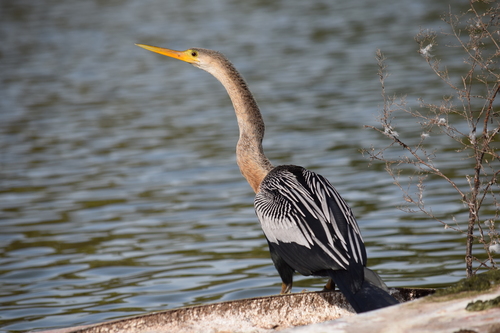
(c) Justina Martelli, some rights reserved (CC BY-NC), uploaded by Justina Martelli · cc-by-nc
Anhinga
Sign in to saveThe darters, anhingas, or snakebirds are mainly tropical waterbirds in the family Anhingidae, which contains a single genus, Anhinga. There are four living species, three of which are very common and widespread while the fourth is rarer and classified as near-threatened by the IUCN. The term snakebird is usually used without any additions to signify whichever of the completely allopatric species occurs in any one region. It refers to their long thin neck, which has a snake-like appearance when they swim with their bodies submerged, or when mated pairs twist it during their bonding displays. "D
Species
Anhinga
GENUS
- KingdomAnimalia
- PhylumChordata
- ClassAves
- OrderSuliformes
- FamilyAnhingidae
Змеешейки или змеиные птицы (лат. Anhinga) — единственный род птиц в семействе змеешейковых (Anhingidae). На сегодняшний день в нём известно четыре вида, один из которых находится под угрозой исчезновения. Своё название получили благодаря своей длинной тонкой шее, которая при плавании выглядит подобно змее, когда остальная часть туловища скрыта под водой. Змеешейки — крупные птицы с различным диморфным (то есть различным у самцов и самок) оперением. У самцов чёрное и тёмно-коричневое оперение, прямой гребешок на затылке, и больший, чем у самок, клюв. У самок оперение гораздо менее яркое, особенно на шее и подгрудке. Как у самцов, так и самок имеются серые прерывистые линии на оперении верхней части крыльев. Клюв длинный, прямой, на конце заострённый, имеет слегка зубчатые края. Лапы у змеешеек полностью перепончатые, короткие и расположены далеко в задней части туловища. Оперение намокает, как у бакланов, и поэтому после погружения змеешейки широко расправляют крылья, чтобы дать им просохнуть. При полёте либо посадке издают щёлкающие или стрекочущие звуки. При выведении потомства взрослые птицы иногда издают каркающие либо шипящие звуки. Змеешейки морфологически и экологически близ
via GBIF
Museum specimens
- Specimen records
- 57
- Family
- Anhingidae
- Collections
- ROM, MVZ, UCMP, UF, NCSM, UMZC
- Recorded in
- United States, Malawi, Australia, Mauritius; [Indian Ocean], Mexico
Wikidata facts
- Instance of
- taxon
- Parent taxon
- Anhingidae
- Image
- ET Bahir Dar asv2018-02 img08 Blue Nile at the bridge.jpg
Show 5 more facts
- taxon rank
- genus
- taxon name
- Anhinga
- Commons category
- Anhinga
- topic's main category
- Category:Anhinga
- Commons gallery
- Anhinga
Sources (2)
via Wikidata · CC0
~18 min read
Encyclopedic overview
11 sectionsContents
- Description
- Distribution and ecology
- Diet
- Predation
- Breeding
- Systematics and evolution
- Living species
- Fossil record
- Citations
- General and cited sources
- External links
The darters, anhingas, or snakebirds are mainly tropical waterbirds in the family Anhingidae, which contains a single genus, Anhinga. There are four living species, three of which are very common and widespread while the fourth is rarer and classified as near-threatened by the IUCN. The term snakebird is usually used without any additions to signify whichever of the completely allopatric species occurs in any one region. It refers to their long thin neck, which has a snake-like appearance when they swim with their bodies submerged, or when mated pairs twist it during their bonding displays. "Darter" is used with a geographical term when referring to particular species. It alludes to their manner of procuring food, as they impale fishes with their thin, pointed beak. The American darter (A. anhinga) is more commonly known as the anhinga. It is sometimes called "water turkey" in the southern United States; though the anhinga is quite unrelated to the wild turkey, they are both large, blackish birds with long tails that are sometimes hunted for food.
== Description == thumb|left|Female anhinga (A. anhinga) taking off thumb|left|Australasian darter drying its wings Anhingidae are large birds with sexually dimorphic plumage. They measure about in length, with a wingspan around , and weigh some . The males have black and dark-brown plumage, a short erectile crest on the nape and a larger bill than the female. The females have much paler plumage, especially on the neck and underparts, and are a bit larger overall. Both have grey stippling on long scapulars and upper wing coverts. The sharply pointed bill has serrated edges, a desmognathous palate and no external nostrils. The darters have completely webbed feet, and their legs are short and set far back on the body.
Excerpted from Wikipedia’s “Anhinga” article, available under the CC BY-SA 4.0 licence.