Russell A. Mittermeier;Don E. Wilson
Antechinomys laniger
Sign in to saveAlso known as Kultarr
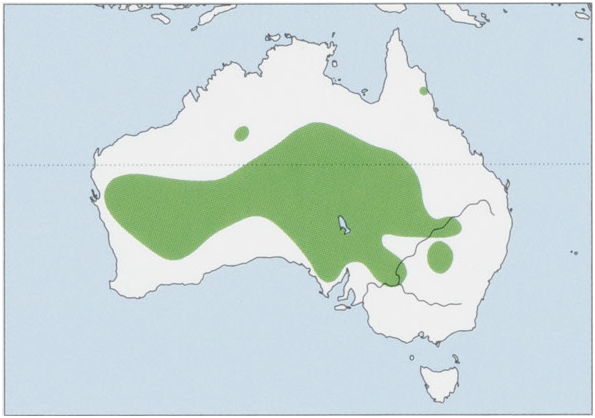
The kultarr (Antechinomys laniger) (also called the "jerboa-marsupial" or marsupial jerboa) is a small insectivorous nocturnal marsupial inhabiting the arid interior of Australia. Preferred habitat includes stony deserts, shrubland, woodland, grassland and open plains. The kultarr has a range of adaptations to help cope with Australia's harsh arid environment including torpor similar to hibernation that helps conserve energy. The species has declined across its former range since European settlement due to changes in land management practices and introduced predators.
Species
Least ConcernSPECIES
- KingdomAnimalia
- PhylumChordata
- ClassMammalia
- OrderDasyuromorphia
- FamilyDasyuridae
Maximum longevity: 3.5 years (captivity)
via GBIF · IUCN
Museum specimens
- Specimen records
- 595
- With media
- 1
- Family
- Dasyuridae
- Collections
- MVZ, ANWC, NMV, QM
- Recorded in
- Australia
Wikidata facts
- Instance of
- taxon
- Parent taxon
- Antechinomys
- Image
- Antechinomys laniger 2.jpg
Show 9 more facts
- taxon rank
- species
- IUCN conservation status
- Least Concern
- Commons category
- Antechinomys laniger
- taxon name
- Antechinomys laniger
- Commons gallery
- Antechinomys laniger
- taxon common name
- Jerboa-Springbeutelmaus
- longest observed lifespan
- 3.5
- taxon author citation
- (Gould, 1856)
- short name
- A. laniger
Sources (2)
via Wikidata · CC0
~12 min read
Encyclopedic overview
20 sectionsContents
- Description
- Taxonomy
- Distribution
- Ecology and behaviour
- Life cycle and reproduction
- Home range and movement
- Diet
- Habitat
- Torpor as an adaptation
- Threats to survival
- Habitat degradation
- Predation by cats and foxes
- Flooding
- Fire
- Insecticides used to control locusts
- Conservation and management
- Current status
- Targeted conservation programs
- See also
- References
The kultarr (Antechinomys laniger) (also called the "jerboa-marsupial" or marsupial jerboa) is a small insectivorous nocturnal marsupial inhabiting the arid interior of Australia. Preferred habitat includes stony deserts, shrubland, woodland, grassland and open plains. The kultarr has a range of adaptations to help cope with Australia's harsh arid environment including torpor similar to hibernation that helps conserve energy. The species has declined across its former range since European settlement due to changes in land management practices and introduced predators.
==Description== The kultarr is a small carnivorous marsupial of the family Dasyuridae with unique morphological features. It is nocturnal, hunting a variety of invertebrates including spiders, crickets and cockroaches. During the day it shelters in a burrows in hollow logs, beneath grass tussocks, at the base of shrubs and trees or cracks in the soil. Males weigh between 17 and 30 grams and 80–100 mm in length. Females are slightly smaller between 14 and 29 grams and 70–95 mm in length. They have a brown or fawn-sandy color, with a white underside. The kultarr has a long tail with a distinctive dark brush-like tip. The muzzle is sharply pointed and the eyes and ears are particularly large; the eyes have dark rings around them. It has distinguishing elongated hind legs having four toes similar to macropodids. The hind legs are designed for a bipedal or hopping style movement, used to evade predators and catch prey such as insects. Kultarrs have been recorded moving at speeds of 13.8 km/h in open country.
Excerpted from Wikipedia’s “Antechinomys laniger” article, available under the CC BY-SA 4.0 licence.