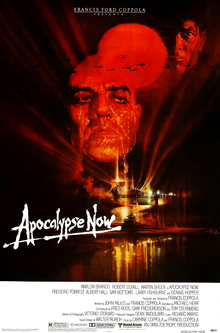
File:Apocalypse_Now_poster.jpg · Wikimedia Commons · See Wikimedia Commons
Apocalypse Now
Sign in to saveAlso known as Apocalypse Now Final Cut
1979 film directed by Francis Ford Coppola
OverviewAI-generated
*Apocalypse Now* is a 1979 American war, action, drama, and thriller film directed by Francis Ford Coppola. The screenplay was written by Coppola, Michael Herr, and John Milius, with Vittorio Storaro serving as director of photography. The cast includes Marlon Brando, Robert Duvall, Frederic Forrest, and Albert Hall. Produced by American Zoetrope, the film was shot in the Philippines and is associated with the New Hollywood movement. Its main subject is the Vietnam War.
The film has a runtime of 147 minutes and was released on various dates, including May 10, 1979, and October 4, 1979. It received the Palme d'Or, the Academy Award for Best Cinematography, the Academy Award for Best Sound, and the National Board of Review: Top Ten Films. Additionally, it received nominations for the Academy Award for Best Director, Best Supporting Actor, Best Cinematography, and Best Film Editing. The film's budget was 31,500,000, and it generated 150,000,000 in revenue.
Synthesized by Vinony from 41 facts across 5 sources: Wikidata, TMDb, IMDb, Vinony collections, Vinony graph. Generated from structured data (not the Wikipedia text) and checked against those facts — may still contain errors.
Film · TMDB
8.3At the height of the Vietnam war, Captain Benjamin Willard is sent on a dangerous mission that, officially, "does not exist, nor will it ever exist." His goal is to locate - and eliminate - a mysterious Green Beret Colonel named Walter Kurtz, who has been leading his personal army on illegal guerrilla missions into enemy territory.
Cast
- Martin Sheen as Captain Benjamin Willard
- Marlon Brando as Colonel Walter Kurtz
- Frederic Forrest as Jay 'Chef' Hicks
- Albert Hall as Chief Phillips
- Laurence Fishburne as Tyrone 'Clean' Miller
- Sam Bottoms as Lance B. Johnson
Themes
- guerrilla warfare
- vietnam war
- journalist
- mission
- vietnam
- vietcong
- central intelligence agency (cia)
- cambodia
- army
- drug abuse
This product uses the TMDB API but is not endorsed or certified by TMDB.
Wikidata facts
- Instance of
- film
- Part of
- National Film Registry
- Country of origin
- United States
- Original language
- English language
- Based on
- Heart of Darkness
- Main subject
- Vietnam War
- Movement
- New Hollywood
- Collection
- Museum of Modern Art
- Director
- Francis Ford Coppola
- Screenwriter
- John Milius
- Cast member
- Kerry Rossall
- Composer
- Francis Ford Coppola
- Producer
- Francis Ford Coppola
- Production company
- American Zoetrope
- Cinematographer
- Vittorio Storaro
- Narrative location
- Vietnam
- Filming location
- Philippines
- Duration
- 147
- FilmAffinity ID
- 701892
- Distribution format
- video on demand
- Official website
- www.lionsgate.com/movies/apocalypse-now
- Image
- Flickr - law keven - Apocalypse Now^.......minus the Helicopters...jpg
Show 14 more facts
- Commons category
- Apocalypse Now
- topic's main category
- Category:Apocalypse Now
- publication date
- 1979-00-00
- film editor
- Walter Murch
- title
- Apocalypse Now
- nominated for
- Academy Award for Best Sound
- production designer
- Dean Tavoularis
- distributed by
- Netflix
- after a work by
- Joseph Conrad
- capital cost
- 31500000
- box office
- 92158064
- film format
- 35 mm film
- set in environment
- jungle
- review score
- 4.4/5
Sources (15)
via Wikidata · CC0
~40 min read
Encyclopedic overview
Apocalypse Now is a 1979 American psychological epic war film produced and directed by Francis Ford Coppola (credited as Francis Coppola). The screenplay, written by Coppola and John Milius, with narration by Michael Herr, is loosely inspired by the 1899 novella Heart of Darkness by Joseph Conrad, with the setting changed from late 19th-century Congo to the Vietnam War. The film follows a river journey from South Vietnam into Cambodia undertaken by Captain Willard (Martin Sheen), who is on a secret mission to assassinate Colonel Kurtz (Marlon Brando), a renegade Special Forces officer who is accused of murder and presumed insane. The ensemble cast also features Robert Duvall, Frederic Forrest, Albert Hall, Sam Bottoms, Laurence Fishburne, Dennis Hopper, G. D. Spradlin and Harrison Ford.
Milius became interested in adapting Heart of Darkness for a Vietnam War setting in the late 1960s, and initially began developing the film with Coppola as producer and George Lucas as director. After Lucas became unavailable, Coppola took over directorial control, and was influenced by Werner Herzog's Aguirre, the Wrath of God (1972) in his approach to the material. Initially set to be a five-month shoot in the Philippines starting in March 1976, a series of problems lengthened it to over a year. These problems included expensive sets being destroyed by severe weather, Brando arriving on set overweight and completely unprepared, and Sheen having a breakdown and suffering a near-fatal heart attack on location. After photography was finally finished in May 1977, the release was postponed several times while Coppola edited over a million feet of film. Many of these difficulties are chronicled in the documentary Hearts of Darkness: A Filmmaker's Apocalypse (1991).
Excerpted from Wikipedia’s “Apocalypse Now” article, available under the CC BY-SA 4.0 licence.
Gallery (10)
Available in 67 languages
- Español
- Français
- Deutsch
- 中文
- 日本語
- Русский
- Português
- Italiano
- العربية
- Afrikaans
- Aragonese
- Armenian
- Asturian
- azb
- Azerbaijani
- Bahasa Indonesia
- Bangla
- Basque
Show 48 more
- Belarusian
- Bosnian
- Breton
- Bulgarian
- Catalan
- Croatian
- Czech
- Danish
- Egyptian Arabic
- eml
- Esperanto
- Finnish
- Galician
- Georgian
- Greek
- Hebrew
- Hungarian
- Icelandic
- Ido
- Javanese
- Latin
- Latvian
- Macedonian
- Malay
- Malayalam
- Marathi
- Moroccan Arabic
- Nederlands
- Norwegian
- Polski
- Romanian
- Romansh
- Serbian
- Serbian (Latin)
- simple
- Slovak
- Slovenian
- Svenska
- Tiếng Việt
- Türkçe
- Ukrainian
- Urdu
- Welsh
- Wu Chinese
- zh_yue
- فارسی
- ไทย
- 한국어
via Wikidata sitelinks · CC0