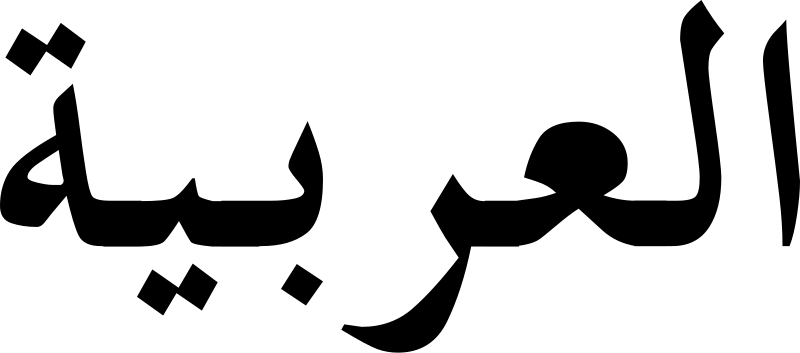
File:Arabic_albayancalligraphy.svg · Wikimedia Commons · See Wikimedia Commons
Arabic
Sign in to saveAlso known as Arabic language, Arabian, Arabian language
Arabic is a Central Semitic language of the Afroasiatic language family spoken primarily in the Arab world. The International Organization for Standardization (ISO) assigns language codes to 32 varieties of Arabic, including its standard form of Literary Arabic, known as Modern Standard Arabic, which is derived from Classical Arabic. This distinction exists primarily among Western linguists; Arabic speakers themselves generally do not distinguish between Modern Standard Arabic and Classical Arabic, but rather refer to both as ( "the eloquent Arabic") or simply '''' ().
Arabic is a Central Semitic language spoken primarily across the Arab world, with the ISO recognizing 32 distinct varieties including Modern Standard Arabic, which is based on Classical Arabic. While Western linguists distinguish between Modern Standard Arabic and Classical Arabic, Arabic speakers themselves typically refer to both simply as "the eloquent Arabic," viewing them as a unified tradition rather than separate forms.
AI-generated from the Wikipedia summary — may contain errors.
Key facts
- Language.ld17
- Najdi Arabic
- Language.dia4
- Levantine
- Language.dia5
- Maghrebi
- Language.lc18
- acx
- Language.lc30
- auz
- Language.lc10
- afb
- Language.ld18
- Omani Arabic
- Language.lc19
- ayp
- Language.lingua
- 12-AAC
- Language.name
- Arabic
- Language.nativename
- ()
- Language.states
- Arab world and surrounding regions
- Language.ethnicity
- Arabs, and other ethnic groups of the Arab world
- Language.speakers
- million native speakers of all varieties
- Language.date
- 2020–2024
- Language.speakers2
- million L2 users of all varieties (2020–2024)
- Language.speakers_label
- Speakers
- Language.familycolor
- Afro-Asiatic
via Wikipedia infobox
Wikidata facts
- Image
- Learning Arabic calligraphy.jpg
Show 14 more facts
- short name
- арабски
- Wikimedia language code
- ar
- Commons category
- Arabic language
- native label
- اللُّغَة العَرَبِيّة
- Wikimedia Incubator URL
- incubator.wikimedia.org/wiki/Wy/ar
- P10369
- Bulgaria
- number of speakers, writers, or signers
- 422000000
- P8168
- Nick Punto
- P11012
- CH3
- entry in abbreviations table
- 阿
- Stack Exchange tag
- linguistics.stackexchange.com/tags/arabic
- P13311
- April
- NCI Thesaurus ID
- C153339
Sources (8)
via Wikidata · CC0
~34 min read
Article
46 sectionsContents
- Classification
- History
- Old Arabic
- Classical Arabic
- Standardization
- Spread
- Development
- Neo-Arabic
- Nahda
- Classical, Modern Standard and spoken Arabic
- Status and usage
- Diglossia
- Status in the Arab world in relation to other languages
- As a foreign language
- Vocabulary
- Lexicography
- Pre-modern Arabic lexicography
- Western lexicography of Arabic
- Modern Arabic lexicography
- Loanwords
- Influence on other languages
- Spoken varieties
- Koiné
- Dialect groups
- Phonology
- Grammar
- Literary Arabic
- Nouns and adjectives
- Verbs
- Derivation
- Colloquial varieties
- Writing system
- Calligraphy
- Romanization
- Numerals
- Arabic alphabet and nationalism
- Lebanon
- Egypt
- Sample text
- See also
- Notes
- References
- Citations
- Sources
- Further reading
- External links
Arabic is a Central Semitic language of the Afroasiatic language family spoken primarily in the Arab world. The International Organization for Standardization (ISO) assigns language codes to 32 varieties of Arabic, including its standard form of Literary Arabic, known as Modern Standard Arabic, which is derived from Classical Arabic. This distinction exists primarily among Western linguists; Arabic speakers themselves generally do not distinguish between Modern Standard Arabic and Classical Arabic, but rather refer to both as ( "the eloquent Arabic") or simply '' ().
Arabic is the third–most widespread official language after English and French, one of six official languages of the United Nations, and the liturgical language of Islam. Arabic is widely taught in schools and universities around the world and is used to varying degrees in workplaces, governments and the media. Arabic is spoken by as many as 380 million speakers, both native and non-native, in the Arab world, making it the fifth–most spoken language in the world and the fourth–most used language on the Internet in terms of users. It also serves as the liturgical language of more than two billion Muslims. In 2011, Bloomberg Businessweek ranked Arabic the fourth–most useful language for business, after English, Mandarin Chinese, and French. Arabic is written with the Arabic alphabet, an abjad script that is written from right to left.
Gallery (384)
Available in 256 languages
- Español
- Français
- Deutsch
- 中文
- 日本語
- Русский
- Português
- Italiano
- العربية
- हिन्दी
- Abkhazian
- abstract
- Acehnese
- Adyghe
- Afrikaans
- Albanian
- Albanian
- Amharic
Show 237 more
- Angika
- Aragonese
- Aramaic
- Armenian
- Arpitan
- Assamese
- Asturian
- Avaric
- Awadhi
- azb
- Azerbaijani
- Bahasa Indonesia
- Balinese
- Bangla
- Banjar
- Bashkir
- Basque
- bat_smg
- Bavarian
- be_x_old
- Belarusian
- Betawi
- Bhojpuri
- Bikol
- Bosnian
- Breton
- btm
- Bulgarian
- Buriat
- Burmese
- Catalan
- cdo
- Cebuano
- Central Kurdish
- Chechen
- Cherokee
- Cheyenne
- Church Slavic
- Chuvash
- Colognian
- Cornish
- Corsican
- Crimean Tatar
- Croatian
- Czech
- Danish
- Divehi
- Egyptian Arabic
- eml
- Erzya
- Esperanto
- Estonian
- Extremaduran
- Faroese
- Fiji Hindi
- Filipino
- Finnish
- fiu_vro
- Gagauz
- Galician
- Gan Chinese
- gcr
- Georgian
- Gorontalo
- Gothic
- Greek
- Guarani
- Gujarati
- Haitian Creole
- Hakka Chinese
- Hausa
- Hawaiian
- Hebrew
- Hungarian
- hyw
- Iban
- Icelandic
- Ido
- Igbo
- Iloko
- Inari Sami
- Ingush
- Interlingua
- Interlingue
- Inuktitut
- Inupiaq
- Irish
- Jamaican Creole English
- Javanese
- Kabardian
- Kabyle
- Kannada
- Kanuri
- Kara-Kalpak
- Karachay-Balkar
- Kashmiri
- Kazakh
- kbp
- kge
- Khmer
- Kinyarwanda
- Komi
- Komi-Permyak
- Kongo
- Kurdish
- Kyrgyz
- Ladino
- Lao
- Latin
- Latvian
- lbe
- Lezghian
- Ligurian
- Limburgish
- Lingala
- Lingua Franca Nova
- Lithuanian
- lld
- Lojban
- Lombard
- Low German
- Lower Sorbian
- Luxembourgish
- Macedonian
- Madurese
- Maithili
- Malagasy
- Malay
- Malayalam
- Maltese
- Manipuri
- Manx
- Māori
- map_bms
- Marathi
- Mazanderani
- Minangkabau
- Mingrelian
- Moksha
- Mongolian
- Moroccan Arabic
- Navajo
- nds_nl
- Nederlands
- Nepali
- Newari
- Northern Frisian
- Northern Sami
- Northern Sotho
- Norwegian
- Norwegian Nynorsk
- Novial
- nrm
- Nyanja
- Occitan
- Old English
- olo
- Oromo
- Ossetic
- Papiamento
- Pashto
- Picard
- Piedmontese
- Polski
- Punjabi
- Quechua
- Romanian
- Rusyn
- Sanskrit
- Santali
- Sardinian
- Scots
- Scottish Gaelic
- Serbian
- Serbian (Latin)
- Shan
- Shona
- Sicilian
- Silesian
- simple
- Sindhi
- Sinhala
- skr
- Slovak
- Slovenian
- Somali
- Southern Sotho
- Standard Moroccan Tamazight
- Sundanese
- Svenska
- Swahili
- syl
- szy
- Tachelhit
- Tajik
- Talysh
- Tamil
- Tatar
- Telugu
- Tibetan
- Tiếng Việt
- Toki Pona
- Tulu
- Türkçe
- Turkmen
- Tuvinian
- Tyap
- Udmurt
- Ukrainian
- Upper Sorbian
- Urdu
- Uyghur
- Uzbek
- Venetian
- Veps
- Volapük
- Walloon
- Waray
- Wayuu
- Welsh
- West Flemish
- Western Frisian
- Western Panjabi
- wikifunctions
- Wu Chinese
- Yakut
- Yiddish
- Yoruba
- Zaza
- Zeelandic
- zh_classical
- zh_min_nan
- zh_yue
- Zhuang
- فارسی
- ไทย
- 한국어
via Wikidata sitelinks · CC0