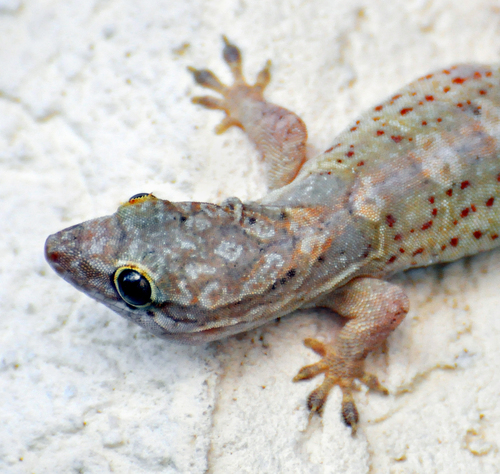
(c) Don Taylor, some rights reserved (CC BY-NC-ND) · cc-by-nc-nd
Aristelliger
Sign in to saveAristelliger is a genus of Caribbean geckos in the family Sphaerodactylidae, commonly known as croaking geckos or Caribbean geckos. The nine named species in the genus are native to various islands in the West Indies, though the species A. georgeensis is also found on mainland Belize. Aristelliger species are nocturnal and mostly arboreal, occupying palm tree trunks and other vertical surfaces. They are among the largest neotropical geckos, with A. lar reaching up to 135 mm (5.3 inches) in snout-vent-length (not including the tail). They are primarily insectivorous, feeding on a variety of art
Species
Croaking Lizard
GENUS
- KingdomAnimalia
- PhylumChordata
- ClassSquamata
- FamilySphaerodactylidae
via GBIF
Museum specimens
- Specimen records
- 82
- With media
- 21
- Family
- Sphaerodactylidae
- Collections
- USNM, MCZ
- Recorded in
- Bahamas, Jamaica, Cayman Islands
Wikidata facts
- Instance of
- taxon
- Parent taxon
- Sphaerodactylidae
- Image
- Aristelliger georgeensis 35218379.jpg
Show 4 more facts
- taxon rank
- genus
- taxon name
- Aristelliger
- topic's main category
- Category:Aristelliger
- Commons category
- Aristelliger
Sources (1)
via Wikidata · CC0
~3 min read
Encyclopedic overview
3 sectionsContents
- Species
- References
- Further reading
Aristelliger is a genus of Caribbean geckos in the family Sphaerodactylidae, commonly known as croaking geckos or Caribbean geckos. The nine named species in the genus are native to various islands in the West Indies, though the species A. georgeensis is also found on mainland Belize. Aristelliger species are nocturnal and mostly arboreal, occupying palm tree trunks and other vertical surfaces. They are among the largest neotropical geckos, with A. lar reaching up to 135 mm (5.3 inches) in snout-vent-length (not including the tail). They are primarily insectivorous, feeding on a variety of arthropods. Cannibalism of eggs and hatchlings has been reported in A. cochranae. A. lar is omnivorous, and may be an important seed disperser for fruits of the plant Marcgravia. Many species of Aristelliger are accustomed to living among human structures, though several are threatened by urban and agricultural development or invasive species.
==Species== {| class="wikitable mw-collapsible"|border="1" cellpadding="2" cellspacing="0" style="border-collapse: collapse;" |colspan=6, style="text-align: center"|List of species |- ! bgcolor="#f0f0f0" |Image ! bgcolor="#f0f0f0" |Species ! bgcolor="#f0f0f0" |Taxon author ! bgcolor="#f0f0f0" |Common name(s) ! bgcolor="#f0f0f0" |Distribution ! bgcolor="#f0f0f0" |IUCN status |- | |A. barbouri |(Noble & Klingel, 1932) |Inagua croaking gecko, striped Caribbean gecko | style="width:35%" |Inagua (Bahamas) |Data Deficient |- | |A. cochranae |Grant, 1931 |Cochran's Caribbean gecko, Navassa croaking gecko | style="width:35%" |Navassa Island |Least Concern |- | |A. expectatus |Cochran, 1933 |Hispaniolan desert croaking gecko | style="width:35%" |Southwest Hispaniola and surrounding islands |Least Concern |- |190px |A. georgeensis |(Bocourt, 1873) |Saint George Island gecko | style="width:35%" |Coastal Belize and surrounding islands, southernmost Quintana Roo (Mexico), Swan Islands (Honduras), Providencia and San Andrés (Colombia) |Least Concern |- | |A. hechti |Schwartz & Crombie, 1975 |Caicos croaking gecko | style="width:35%" |North Caicos, East Caicos, various nearby cays (Turks and Caicos Islands) |Vulnerable |- |190px |A. lar |Cope, 1862 |Hispaniolan giant croaking gecko, spotted Caribbean gecko | style="width:35%" |Hispaniola and surrounding islands |Near Threatened |- | |A. nelsoni |(Barbour, 1914) |Swan Islands croaking gecko | style="width:35%" |Swan Islands (Honduras) |Endangered |- |190px |A. praesignis |(Hallowell, 1856) |Croaking lizard, woodslave, Jamaican croaking gecko | style="width:35%" |Jamaica and the Cayman Islands |Least Concern |- | |A. reyesi |Díaz & Hedges, 2009 |Reyes' Caribbean gecko, Cuban croaking gecko | style="width:35%" |Península de Hicacos (Cuba) |Critically Endangered |}
Excerpted from Wikipedia’s “Aristelliger” article, available under the CC BY-SA 4.0 licence.