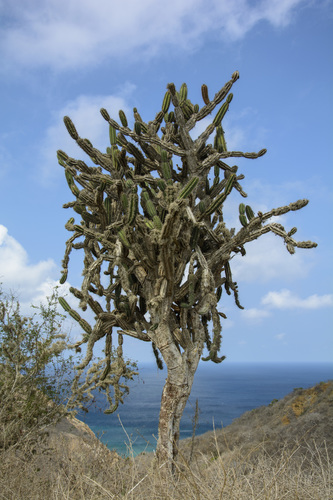
(c) Frank Dietze, all rights reserved, uploaded by Frank Dietze
Armatocereus
Sign in to saveArmatocereus (from Latin armatus, "armed" and cereus, "pliant/soft") is a genus of mostly tree-like cacti from South America (Ecuador and Peru). These species have a conspicuous constriction at the end of the annual growth. The flowers are mostly white, with a more or less spiny ovary. The fruits are mostly spiny.
Species
GENUS
- KingdomPlantae
- PhylumTracheophyta
- ClassMagnoliopsida
- OrderCaryophyllales
- FamilyCactaceae
Armatocereus is een geslacht van cactussen. De soorten komen voor in het Andesgebergte in de landen Colombia, Ecuador en Peru.
via GBIF · Kew POWO
Museum specimens
- Specimen records
- 9
- With media
- 7
- Family
- Cactaceae
- Collections
- MICH, NY, F, TEX, MO, K
- Recorded in
- Peru, Perú, Ecuador
Wikidata facts
- Instance of
- taxon
- Image
- Armatocereus laetus 11.jpg
Show 6 more facts
- taxon rank
- genus
- taxon name
- Armatocereus
- Commons category
- Armatocereus
- topic's main category
- Category:Armatocereus
- taxon common name
- 花铠柱属
Sources (1)
via Wikidata · CC0
~3 min read
Encyclopedic overview
6 sectionsContents
- Description
- Taxonomy
- Phylogeny and classification
- Species
- Distribution and habitat
- References
Armatocereus (from Latin armatus, "armed" and cereus, "pliant/soft") is a genus of mostly tree-like cacti from South America (Ecuador and Peru). These species have a conspicuous constriction at the end of the annual growth. The flowers are mostly white, with a more or less spiny ovary. The fruits are mostly spiny.
==Description== Armatocereus species are columnar cacti, bushlike or treelike, with cylindrical upright branched stems. The stems have 5–12 distinct ribs, and are made up of sections with a narrower "neck" between them, corresponding to annual growth. The large areoles bear strong spines, rarely few or none. The narrow tubular flowers appear at night, and have a spiny ovary and floral tube and white petals (red in A. rauhii). The red or green fruit is large, globular or ovoid, with strong spines that are lost on maturity. It contains large black seeds, ovoid or kidney-shaped.
Excerpted from Wikipedia’s “Armatocereus” article, available under the CC BY-SA 4.0 licence.