
Artemis II
Sign in to saveArtemis II was a crewed flyby of the Moon. It was the first crewed flight of the NASA-led Artemis program and the first crewed flight beyond low Earth orbit since Apollo 17 in 1972. Artemis II was the second flight of the Space Launch System (SLS) and the first crewed flight of the Orion spacecraft, named Integrity by the four-person crew.
Artemis II was a crewed mission that flew astronauts around the Moon for the first time since 1972, marking NASA's return to human exploration beyond Earth's orbit. The mission tested the Space Launch System rocket and Orion spacecraft—key vehicles designed to eventually land humans on the Moon again as part of the broader Artemis program.
AI-generated from the Wikipedia summary — may contain errors.
In the Vinony graph
Vinony's link graph records 1,100 inbound references to Artemis II, and connects out to atmospheric entry, X (social network) and UTC.
The entry is geolocated on the map.
It sits within the topics 2026 in Florida, 2026 on the Moon and April 2026 in the United States.
Vinony links it to 71 Wikipedia language editions.
Wikipedia views (30d)
351,467 totalvia Wikimedia Pageviews API
Described at
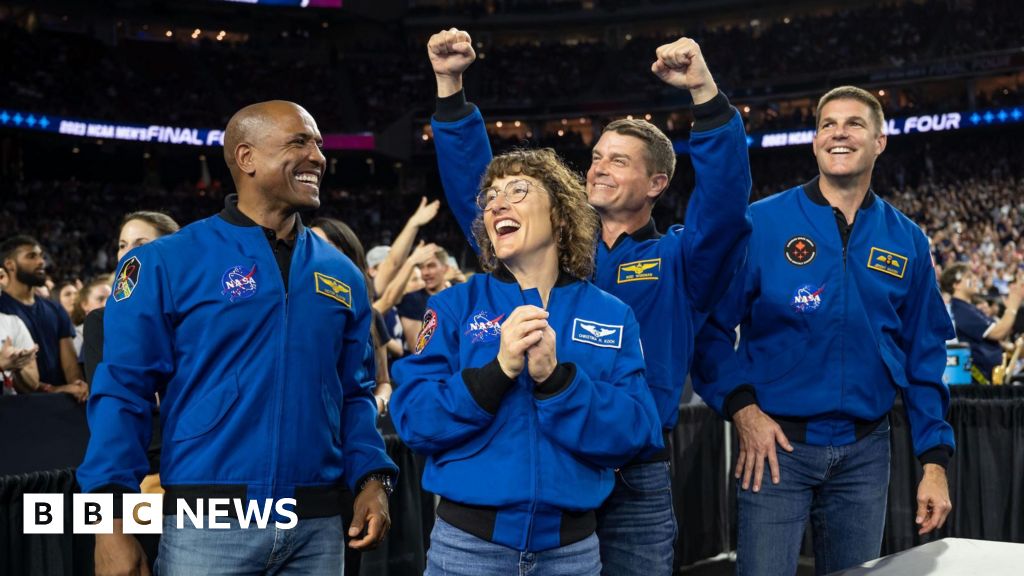
Who are the Artemis II astronauts heading to the Moon?
The crew, who are accomplished pilots, engineers and scientists, reveal their hopes, fears and family sacrifices.
bbc.co.uk →Four astronauts are about to become the most closely watched crew since Apollo. They will be the first in more than 50 years to orbit the moon, testing the path back for the next generation. The crew includes three Nasa astronauts - Commander Reid Wiseman, Victor Glover and Christina Koch - along with Jeremy Hansen of the Canadian Space Agency. Not only are they accomplished pilots, engineers and scientists, they are also spouses and parents balancing a heroic adventure against the risks they and their loved ones will face. Born in Baltimore, Maryland, Wiseman lost his wife to cancer in 2020 and has raised their two teenage daughters alone. He describes being a single parent as his "greatest challenge and the most rewarding phase" of his life. He has not shielded his children from the realities of risk, however. While out on a walk with them, he said: "Here's where the will is, here's where the trust documents are, and if anything happens to me, here's what's going to happen to you… That's part of this life." He says he wishes more families had that conversation – because "you never know what the next day is going to bring". For the personal item Nasa allows astronauts to take up with them, Wiseman plans to take a small notepad so that he can jot down his thoughts during the mission. Christina Koch is an engineer and physicist who became an astronaut in 2013 and went on to set the record for the longest single spaceflight by a woman, spending 328 days aboard the International Space Station in 2019. During that mission she also took part in the first all-female spacewalk. Born in Grand Rapids, Michigan, and raised in North Carolina, she will become the first woman to travel to the Moon. Her journey to Artemis II began with a photograph. As a child she kept a poster of the Earth rising above the lunar surface – Bill Anders' famous Earthrise picture from Apollo 8 – on her bedroom wall, and decided she wanted to become an astronaut when she learnt that a human, not an automatic camera, had squeezed the shutter. "The fact that it was a human behind that lens made that picture so much more profound and changed the way we thought of our own home," she says. "The Moon was not just a symbol for thinking about our place in the Universe, it is a beacon for science and understanding where we came from." Koch has spent more than 25 years around Apollo veterans through a scholarship foundation and Nasa remembrance events, and says that what the former astronauts have really taught her is camaraderie. Koch is taking handwritten notes from people close to her for her personal item, which she has described as a "tactile connection" to loved ones back on Earth. Jeremy Hansen is a former Royal Canadian Air Force fighter pilot and physicist who joined the Canadian Space Agency in 2009. Although he has never flown in space before, he has played a key role in training new astronauts at Nasa's Johnson Space Centre, becoming the first Canadian to lead that work. He is married with three children and enjoys sailing, rock climbing and mountain biking. Like Koch, Hansen traces his fascination with space back to Apollo 8. Growing up in rural Canada, he turned his treehouse into an imaginary spaceship after seeing a photograph of Buzz Aldrin standing on the lunar surface. The risks the Apollo astronauts took has shaped how he talks to his own family about Artemis II. Over the Christmas holidays they watched footage of the uncrewed Artemis I launch together so he could warn them that, when the main engines light, it can briefly look and sound like the rocket is exploding – and reassure them that this is normal. He has told them, too, that when they hear engineers on the loop discussing "worst case scenarios" or unusual sensor readings, it will often sound scarier than it is; it is simply how teams probe the edges of safety on a first crewed flight. If all goes to plan, Hansen will become the first non-American to travel to the Moon – a m
Excerpt from a page describing this subject · 14,158 chars · not written by Vinony
Wikidata facts
- Instance of
- human spaceflight
- Part of
- Artemis program
- Country
- United States
- Operator
- NASA
- Followed by
- Artemis III
- Follows
- Artemis I
- Duration
- 783135
- Official website
- www.nasa.gov/mission/artemis-ii
- Image
- Artemis II Launch (NHQ202604010307).jpg
- Significant event
- splashdown
Show 6 more facts
- start point
- Kennedy Space Center Launch Complex 39B
- Commons category
- Artemis 2
- UTC date of spacecraft launch
- 2026-04-01
- crew members
- Jeremy Hansen
- described at URL
- www.bbc.co.uk/news/articles/cdj7e11pw10o
- UTC date of spacecraft landing
- 2026-04-11
Sources (9)
via Wikidata · CC0
~40 min read
Encyclopedic overview
Artemis II (April 1–11, 2026) was a crewed flyby of the Moon. It was the first crewed flight beyond low Earth orbit since Apollo 17 in 1972, the first crewed flight of the NASA-led Artemis program, the first crewed flight of the Space Launch System (SLS), and the first crewed flight of the Orion spacecraft, named Integrity by the four-person crew.
The mission was a test flight supporting the Artemis IV mission to return humans to the lunar surface. Originally designated Exploration Mission-2 (EM-2) and intended to support the canceled Asteroid Redirect Mission, its objectives were revised after the establishment of the Artemis program in 2017. The mission's primary goal was to validate the Orion spacecraft's systems, crew operations, and mission procedures ahead of sustained lunar exploration in future Artemis missions. Artemis II's mission objectives were similar to those of Apollo 8 in 1968, the first crewed lunar flight of the Apollo program, while its free-return trajectory resembled that flown by Apollo 13 in 1970.
Excerpted from Wikipedia’s “Artemis II” article, available under the CC BY-SA 4.0 licence.
Gallery (14)
On the map
Available in 71 languages
- Español
- Français
- Deutsch
- 中文
- 日本語
- Русский
- Português
- Italiano
- العربية
- Afrikaans
- Aragonese
- Armenian
- Asturian
- Azerbaijani
- Bahasa Indonesia
- Bangla
- Basque
- Belarusian
Show 52 more
- Bhojpuri
- Bosnian
- Bulgarian
- Burmese
- Catalan
- Central Kurdish
- Chuvash
- Croatian
- Czech
- Danish
- Egyptian Arabic
- Estonian
- Finnish
- Georgian
- Greek
- Hebrew
- Hungarian
- Icelandic
- Inari Sami
- Irish
- Kashmiri
- Kazakh
- Lao
- Latvian
- Lithuanian
- Luxembourgish
- Macedonian
- Malay
- Nederlands
- Norwegian
- Papiamento
- Polski
- Romanian
- Serbian
- simple
- Slovak
- Slovenian
- Svenska
- Tamil
- Telugu
- Tiếng Việt
- Toki Pona
- Türkçe
- Ukrainian
- Urdu
- Welsh
- Wu Chinese
- zh_yue
- Zulu
- فارسی
- ไทย
- 한국어
via Wikidata sitelinks · CC0