Image from GBIF · CC BY-NC-ND
Species
SPECIES
- KingdomPlantae
- PhylumTracheophyta
- ClassMagnoliopsida
- OrderAsterales
- FamilyAsteraceae
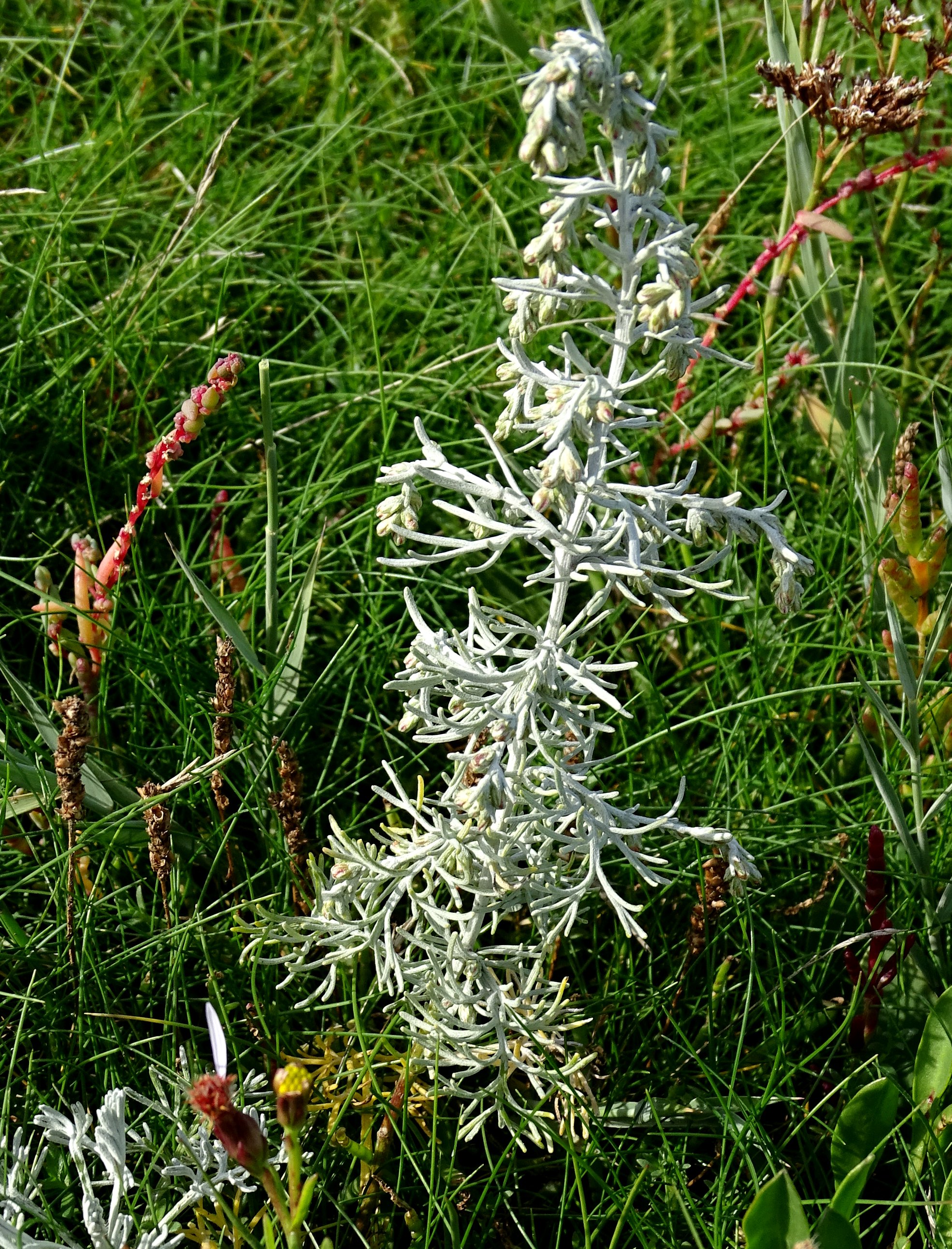
You won't mistake this plant as you walk on a salt marsh through a group of sea wormwood plants. They emit a strong lavender-like odor, even the dead dried up plants that still stand in the winter. From a distance, the plant is easy to identify by its silver-gray color. You see silver fields of sea wormwood growing between the purple sea lavender. Sea wormwood grows almost exclusively on slightly elevated, sandy borders of flowing gullies in salt marshes. It is the last plant to flower on the salt marsh but its flowers are very small.
via GBIF · Kew POWO
Museum specimens
- Specimen records
- 1,853
- With media
- 1,476
- Family
- Asteraceae
- Collections
- UPS, MICH, DEK, OSW, NHMUK
- Recorded in
- Sweden, India, Denmark, Pakistan, United Kingdom
Wikidata facts
Show 7 more facts
- taxon rank
- species
- taxon name
- Artemisia maritima
- taxon common name
- strandmalört
- Commons gallery
- Artemisia maritima
- Commons category
- Artemisia maritima
- short name
- A. maritima
Sources (2)
via Wikidata · CC0
~3 min read
Encyclopedic overview
Artemisia maritima is a European species of wormwood known as sea wormwood, and also formerly often by its synonym Seriphidium maritimum. It is native to the Atlantic coasts of northern Europe, from western and northern France, Ireland, the United Kingdom, Belgium, the Netherlands, Germany, Denmark, Sweden, Norway, the Baltic States, and northwestern Russia. In Great Britain, it is found as far north as Wigton on the west coast and Cruden Bay on the east coast, and in Ireland, on the east and west coasts between Dublin and Killough, and Tralee Bay to Galway; it also occurs on the Isle of Man.
There are two subspecies:
Excerpted from Wikipedia’s “Artemisia maritima” article, available under the CC BY-SA 4.0 licence.