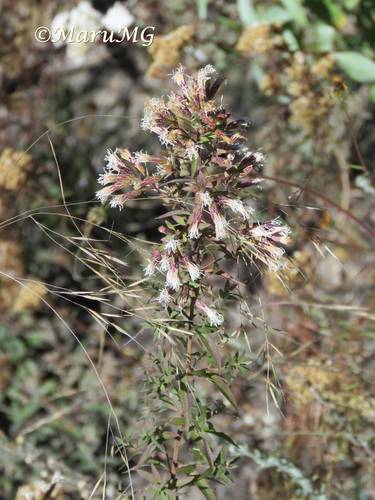
(c) María Eugenia Mendiola González, some rights reserved (CC BY-NC-SA), uploaded by María Eugenia Mendiola González · cc-by-nc-sa
Asanthus
Sign in to saveAsanthus is a small genus of flowering plants in the family Asteraceae, found only in northern Mexico and the southwestern United States.
Species
GENUS
- KingdomPlantae
- PhylumTracheophyta
- ClassMagnoliopsida
- OrderAsterales
- FamilyAsteraceae
Asanthus es un género de plantas perteneciente a la familia Asteraceae. Comprende 3 especies descritas y aceptadas.[1][2][3] Taxonomía El género fue descrito por R.M.King & H.Rob. y publicado en Phytologia 24(2): 66. 1972.[4] Especies aceptadas A continuación se brinda un listado de las especies del género Asanthus aceptadas hasta junio de 2012, ordenadas alfabéticamente. Para cada una se indica el nombre binomial seguido del autor, abreviado según las convenciones y usos. Asanthus solidaginifolius (A.Gray) R.M.King & H.Rob. Asanthus squamulosus (A.Gray) R.M.King & H.Rob. Asanthus thyrsiflorus (A.Gray) R.M.King & H.Rob. Referencias ↑ Asanthus en PlantList ↑ Asanthus en Global Compositae ↑ D.J.N.Hind & H.E.Robinson. 2007. Tribe Eupatorieae In: The Families and Genera of Vascular Plants vol.VIII. (Joachim W.Kadereit & Charles Jeffrey, volume editors. Klaus Kubitzky, general editor). Springer-Verlag. Berlin, Heidelberg. ↑ «Asanthus». Tropicos.org. Missouri Botanical Garden. Consultado el 28 de junio de 2012. Datos: Q4803563 Especies: Asanthus
via GBIF · Kew POWO
Museum specimens
- Specimen records
- 3
- With media
- 2
- Family
- Asteraceae
- Collections
- CAS, USFS
- Recorded in
- United States
Wikidata facts
- Instance of
- taxon
- Parent taxon
- Eupatorieae
Show 5 more facts
- taxon name
- Asanthus
- taxon rank
- genus
- topic's main category
- Category:Asanthus
- taxon common name
- brickellbush
Sources (1)
via Wikidata · CC0
~1 min read
Encyclopedic overview
1 sectionsContents
- References
Asanthus is a small genus of flowering plants in the family Asteraceae, found only in northern Mexico and the southwestern United States.
Each of the species was originally named as a member of Brickellia, and later transferred when King and Robinson named the genus. Asanthus and Brickellia both have cypsela (achenes) with 10 ribs, but in Asanthus the style is glabrous and narrow at the base whereas in Brickellia the style has a pubescent, enlarged base. Molecular phylogenetic analysis has provided support that the two genera represent phylogenetically distinct lineages and thus should be recognized as distinct.
Excerpted from Wikipedia’s “Asanthus” article, available under the CC BY-SA 4.0 licence.