Russell A. Mittermeier;Anthony B. Rylands;Don E. Wilson
Ateles belzebuth
Sign in to saveAlso known as White-bellied spider monkey, White-fronted spider monkey, Marimonda
species of mammal
Species
EndangeredSPECIES
- KingdomAnimalia
- PhylumChordata
- ClassMammalia
- OrderPrimates
- FamilyAtelidae
Maximum longevity: 37 years (captivity) Observations: One wild born specimen of the *hybridus* subspecies was about 37 years old when it died in captivity (Richard Weigl 2005).
via GBIF · IUCN
Museum specimens
- Specimen records
- 157
- With media
- 18
- Family
- Atelidae
- Collections
- RBINS-SCIENTIFIC HERITAGE, AMNH, YPM
- Recorded in
- Brazil, Colombia, Peru
Wikidata facts
Show 8 more facts
- taxon rank
- species
- IUCN conservation status
- Endangered status
- taxon name
- Ateles belzebuth
- Commons category
- Ateles belzebuth
- taxon common name
- Weißstirn-Klammeraffe
- longest observed lifespan
- 37
- short name
- A. belzebuth
- taxon range
- Caracaraí
Sources (2)
via Wikidata · CC0
~6 min read
Encyclopedic overview
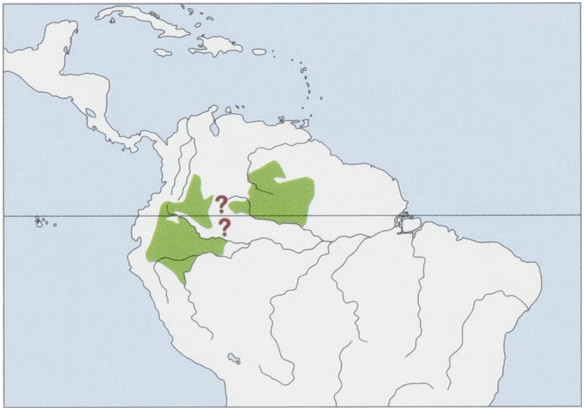
The white-bellied spider monkey (Ateles belzebuth), also known as the white-fronted or long-haired spider monkey, is an endangered species of spider monkey, a type of New World monkey. It is found in the north-western Amazon in Colombia, Ecuador, Venezuela, Peru and Brazil, ranging as far south as the lower Ucayali River and as far east as the Branco River. In the past, the Peruvian, brown and white-cheeked spider monkeys have been treated as subspecies of A. belzebuth. As presently defined, the white-bellied spider monkey is monotypic. It has a whitish belly and a pale patch on the forehead, which, despite its common name, often is orange-buff, though this might be due to dirt and other stainers. They live in groups of 20 to 40 individuals, splitting into small parties of 1 to 9 when in activity.
Vernacular names include mono prieto, mico prieto and marimonda (Colombia).
Excerpted from Wikipedia’s “Ateles belzebuth” article, available under the CC BY-SA 4.0 licence.