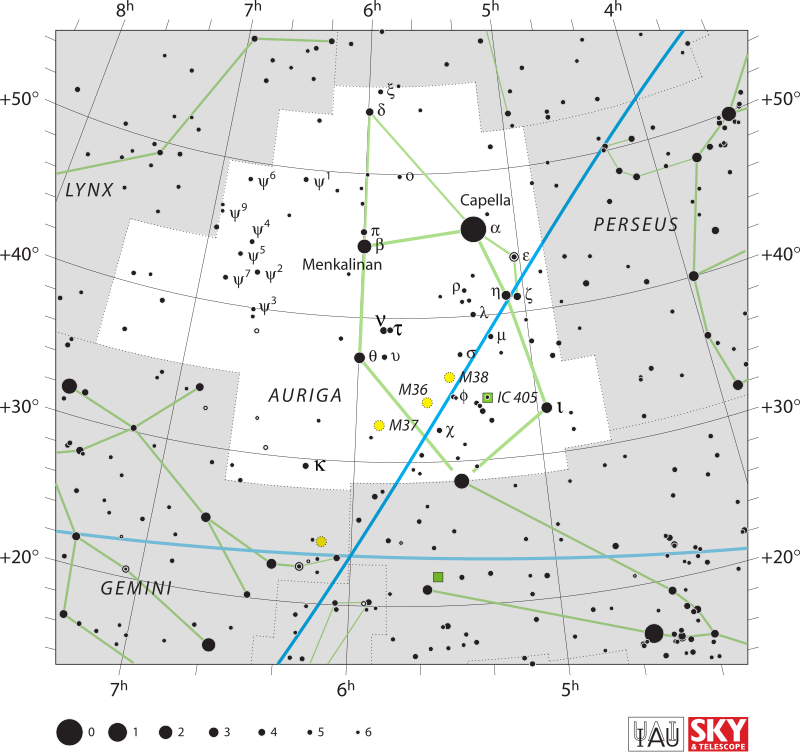
File:Auriga_IAU.svg · Wikimedia Commons · See Wikimedia Commons
Auriga is a constellation in the northern sky that has been recognized since ancient times, with its name meaning "the charioteer" in Latin. It is most easily seen during winter evenings in the northern hemisphere and is notable for containing some of the bright stars that form the Winter Hexagon pattern.
AI-generated from the Wikipedia summary — may contain errors.
Key facts
- Constellation.name
- Auriga
- Constellation.abbreviation
- Aur
- Constellation.genitive
- Aurigae
- Constellation.symbolism
- the Charioteer
- Constellation.RA
- –
- Constellation.dec
- –
- Constellation.family
- Perseus
- Constellation.areatotal
- 657
- Constellation.arearank
- 21st
- Constellation.numbermainstars
- 5, 8
- Constellation.numberbfstars
- 65
- Constellation.numberbrightstars
- 4
- Constellation.numbernearbystars
- 2
- Constellation.brighteststarname
- Capella (α Aur)
- Constellation.starmagnitude
- 0.08
- Constellation.neareststarname
- QY Aur
- Constellation.stardistancely
- 19.74
- Constellation.stardistancepc
- 6.05
via Wikipedia infobox
Wikidata facts
- Instance of
- constellation
- Named after
- auriga
- Official name
- Auriga
- Area
- 657
- Shares border with
- Lynx
- Child body
- Delta Aurigids
- Image
- AurigaCC.jpg
Show 8 more facts
- topic has template
- Template:Auriga (constellation)
- Commons category
- Auriga (constellation)
- topic's main category
- Category:Auriga
- Commons gallery
- Auriga
- described by source
- New International Encyclopedia
- short name
- Aur
- on focus list of Wikimedia project
- Wikipedia:Vital articles/Level/4
- maintained by WikiProject
- WikiProject Astronomy
via Wikidata · CC0
Article · Italiano
L'Auriga è una costellazione settentrionale. È una delle 48 costellazioni elencate da Tolomeo, ed è anche una delle 88 costellazioni moderne. La sua stella più brillante è Capella (α Aurigae), associata alla mitologica Amaltea; le tre stelle adiacenti (ε, ζ e η Aurigae) sono invece chiamate «i capretti». Luminosa e appariscente, l'Auriga è un punto di riferimento imprescindibile per l'identificazione di un buon numero di stelle e costellazioni nei cieli autunnali e invernali.
Abstract from DBpedia / Wikipedia · CC BY-SA
Gallery (32)
Available in 92 languages
- Español
- Français
- Deutsch
- 中文
- 日本語
- Русский
- Português
- Italiano
- العربية
- हिन्दी
- Afrikaans
- Armenian
- Asturian
- Azerbaijani
- Bahasa Indonesia
- Bangla
- Bashkir
- Basque
Show 73 more
- be_x_old
- Belarusian
- Bosnian
- Breton
- Bulgarian
- Burmese
- Catalan
- cdo
- Chuvash
- Cornish
- Corsican
- Croatian
- Czech
- Danish
- Egyptian Arabic
- Esperanto
- Estonian
- Finnish
- Galician
- Georgian
- Greek
- Hakka Chinese
- Hebrew
- Hungarian
- hyw
- Icelandic
- Irish
- Javanese
- Kannada
- Latin
- Latvian
- Lithuanian
- Low German
- Luxembourgish
- Macedonian
- Malay
- Malayalam
- Manx
- Marathi
- Moksha
- Mongolian
- Nederlands
- Northern Frisian
- Norwegian
- Norwegian Nynorsk
- Ossetic
- Polski
- Romanian
- Serbian
- Serbian (Latin)
- simple
- Slovak
- Slovenian
- Svenska
- Swahili
- Tajik
- Tamil
- Tibetan
- Tiếng Việt
- Türkçe
- Ukrainian
- Urdu
- Waray
- Welsh
- Western Panjabi
- Wu Chinese
- Yakut
- Zaza
- zh_min_nan
- zh_yue
- فارسی
- ไทย
- 한국어
via Wikidata sitelinks · CC0