Encyclopedia of Life · EOL (see source)
Australian Raven
Sign in to saveAlso known as Corvus coronoides
species of passerine bird in the crow family
Species
Least ConcernMaximum longevity: 21.8 years (captivity)
via IUCN
Wikidata facts
Show 11 more facts
- endemic to
- Australian continent
- taxon rank
- species
- IUCN conservation status
- Least Concern
- Commons category
- Corvus coronoides
- taxon name
- Corvus coronoides
- Commons gallery
- Corvus coronoides
- litter size
- 3.9
- egg incubation period
- 20
- taxon common name
- Cuervo Australiano
- diel cycle
- diurnality
- short name
- C. coronoides
via Wikidata · CC0
~30 min read
Encyclopedic overview
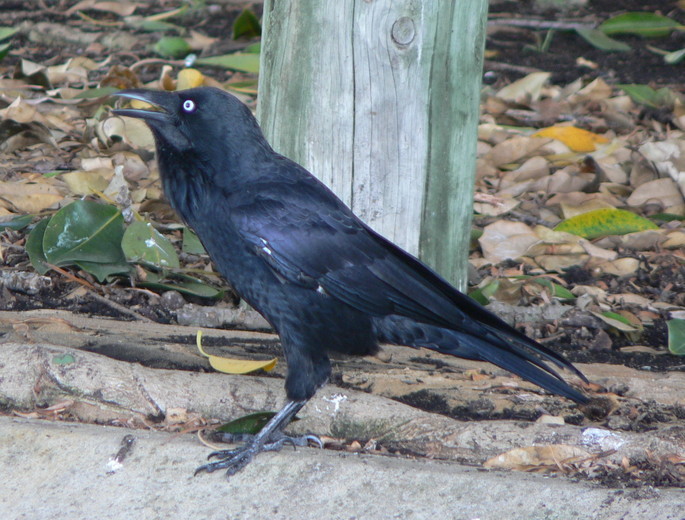
The Australian raven (Corvus coronoides) is a passerine corvid bird native to Australia. Measuring 46–53 centimetres (18–21 in) in length, it has an all-black plumage, beak and mouth, as well as strong, greyish-black legs and feet. The upperparts of its body are glossy, with a purple-blue, greenish sheen; its black feathers have grey bases. The Australian raven is distinguished from the Australian crow, and other related corvids, by its long chest feathers, or throat hackles, which are prominent in mature birds. Older individuals and subadults have white irises, while the younger birds' eyes display blue inner rims; hatchlings and young birds have brown, dark irises until about fifteen months of age, at which point their irises become hazel-coloured, with an inner blue rim around each pupil, this lasting until they are roughly 2.5 to 3 years of age. Nicholas Aylward Vigors and Thomas Horsfield described the Australian raven in 1827, its species name coronoides highlighting its similarity with the carrion crow (C. corone). Two subspecies are recognised, which differ slightly in their vocalisations, and are quite divergent, genetically.
The preferred habitat of the Australian raven includes open woodlands and transitional zones, in addition to cities and towns; it has adapted well to human settlements and other urban environments, and is a commonly sighted bird in several major cities, including Sydney, Canberra, Perth, Adelaide and Brisbane. The Australian raven is territorial, with pairs generally bonding for life. Breeding takes place between July and September, with almost no variation across its range. The nest is a bowl-shaped structure of sticks sited high in a tree, or occasionally in a man-made structure such as a windmill or other building.
Excerpted from Wikipedia’s “Australian Raven” article, available under the CC BY-SA 4.0 licence.