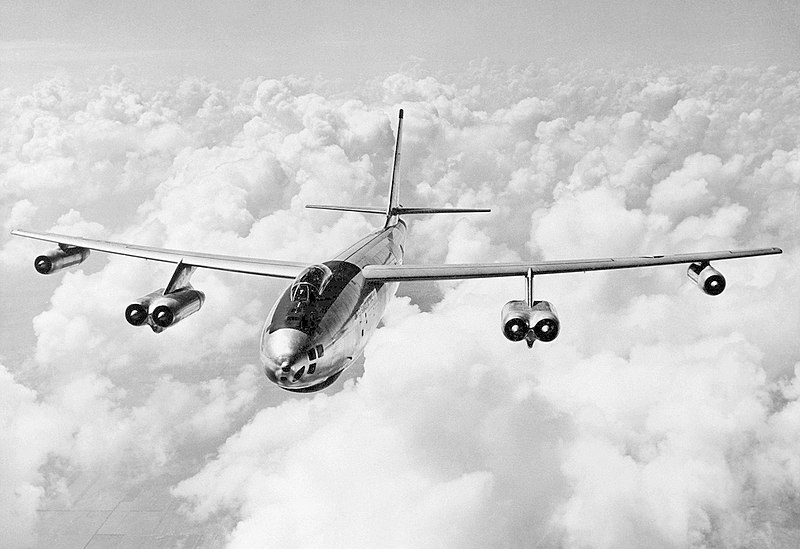
File:NNSA-NSO-990.jpg · Wikimedia Commons · See Wikimedia Commons
B-47 Stratojet
Sign in to saveAlso known as Boeing B-47 Stratojet
strategic bomber aircraft family by Boeing
Key facts
- Type
- Strategic bomber / reconnaissance
- National origin
- United States
- Manufacturer
- Boeing
- Status
- Retired
- Primary user
- United States Air Force
- Number built
- 2,042
- Introduction date
- June 1951
- First flight
- 17 December 1947
- Retired
- 1969 (B-47E), 1977 (EB-47E)
- Developed into
- Boeing XB-56
via Wikipedia infobox
Wikidata facts
- Operator
- United States Air Force
- Country of origin
- United States
- Developer
- Boeing
- Manufacturer
- Boeing
- Image
- Boeing XB-47D Stratojet testbed for Wright YT49 turboprop engine.jpg
- Height
- 8.54
- Length
- 32.65
Show 10 more facts
- Commons category
- Boeing B-47 Stratojet
- Commons gallery
- B-47 Stratojet
- total produced
- 2032
- first flight
- 1947-12-17
- service entry
- 1951-06-00
- service retirement
- 1969-00-00
- wingspan
- 35.37
- native label
- B-47 Stratojet
- cruise speed
- 896
- vehicle range
- 7478
Sources (7)
via Wikidata · CC0
~40 min read
Encyclopedic overview
The Boeing B-47 Stratojet (Boeing company designation Model 450) is a retired American long-range, six-engined, turbojet-powered strategic bomber that was designed to fly at high subsonic speed and at high altitude to avoid enemy interceptor aircraft. The primary mission of the B-47 was as a nuclear bomber capable of striking targets within the Soviet Union.
Development of the B-47 can be traced back to a requirement expressed by the United States Army Air Forces (USAAF) in 1943 for a reconnaissance bomber that harnessed newly-developed jet propulsion. Another key innovation adopted during the development process was the swept wing, drawing upon captured German research. With its engines carried in nacelles underneath the wing, the B-47 represented a major innovation in post–World War II combat jet design, and contributed to the development of modern jet airliners.
Excerpted from Wikipedia’s “B-47 Stratojet” article, available under the CC BY-SA 4.0 licence.