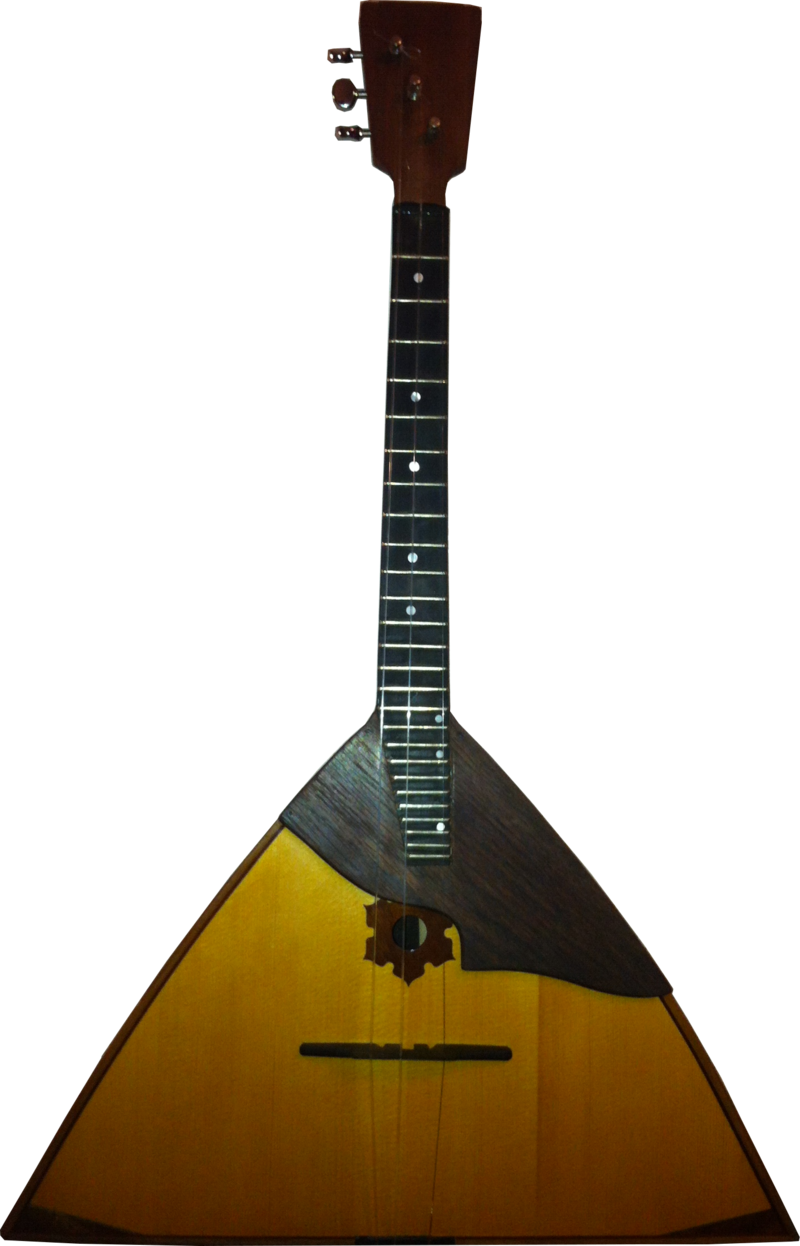
File:3_string_prim_balalaika.png · Wikimedia Commons · See Wikimedia Commons
balalaika
Sign in to saveAlso known as balabayka, balalayka
The balalaika (, ) is a Russian stringed musical instrument with a characteristic triangular wooden, hollow body, fretted neck, and three strings. Two strings are usually tuned to the same note and the third string is a perfect fourth higher. The higher-pitched balalaikas are used to play melodies and chords. The instrument generally has a short sustain, necessitating rapid strumming or plucking when it is used to play melodies. Balalaikas are often used for Russian folk music and dancing.
The balalaika is a Russian stringed instrument with a distinctive triangular body, a fretted neck, and three strings—two tuned to the same note and one a perfect fourth higher—that produces a relatively short-sustaining sound requiring rapid playing techniques. It is traditionally used in Russian folk music and dance, with higher-pitched versions typically playing melodies and chords.
AI-generated from the Wikipedia summary — may contain errors.
Key facts
- Instrument.name
- Balalaika
- Instrument.image
- 3 string prim balalaika.png
- Instrument.image_size
- 200 px
- Instrument.caption
- 3 string prima balalaika
- Instrument.background
- string
- Instrument.classification
- Plucked string instrument
- Instrument.hornbostel_sachs
- 321.321
- Instrument.hornbostel_sachs_desc
- Composite chordophone
- Instrument.developed
- Late 18th to early 19th centuries late 20th century
- Instrument.range
- center
- Instrument.related
- Bağlama Dombra Domra Panduri Tovshuur
via Wikipedia infobox
Wikidata facts
- Country of origin
- Russia
- Image
- Balalajka, druga polovina 20. veka.jpg
Show 3 more facts
- described by source
- Explanatory Dictionary of the Living Great Russian Language
- Commons category
- Balalaika
- Hornbostel-Sachs classification
- 321.321
Sources (3)
via Wikidata · CC0
~14 min read
Encyclopedic overview
13 sectionsContents
- Etymology
- Types
- Technique
- History
- The pre-Andreyev period
- The Andreyev period
- Balalaika orchestra
- Solo instrument
- Notable players
- In popular culture
- See also
- References
- External links
The balalaika (, ) is a Russian stringed musical instrument with a characteristic triangular wooden, hollow body, fretted neck, and three strings. Two strings are usually tuned to the same note and the third string is a perfect fourth higher. The higher-pitched balalaikas are used to play melodies and chords. The instrument generally has a short sustain, necessitating rapid strumming or plucking when it is used to play melodies. Balalaikas are often used for Russian folk music and dancing.
The balalaika family of instruments includes instruments of various sizes, from the highest-pitched to the lowest: the piccolo balalaika, prima balalaika, secunda balalaika, alto balalaika, bass balalaika, and contrabass balalaika. There are balalaika orchestras which consist solely of different balalaikas; these ensembles typically play classical music that has been arranged for balalaikas. The prima balalaika is the most common; the piccolo is rare. There have also been descant and tenor balalaikas, but these are considered obsolete. All have three-sided bodies; spruce, evergreen, or fir tops; and backs made of three to nine wooden sections (usually maple).
Excerpted from Wikipedia’s “balalaika” article, available under the CC BY-SA 4.0 licence.