Described at
What is Balboa? - Brisbane Balboa Swing
Balboa is a swing dance that originated in Southern California.
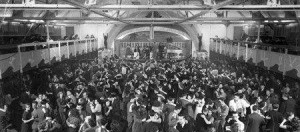
brisbanebalboaswing.dance →Balboa (original Balboa or Pure-Bal) is a dance that originated in Southern California during the 1920s and 1930s. Balboa also now refers to a fusion of dances that originated from that era. The original Balboa dance is a form of swing dance "Swing (dance)") that started as early as 1915 and gained in popularity in the 1930s and 1940s. It is danced primarily in close embrace , and is led "Lead and follow (dance)") with a full body connection "Connection (dance)") . The art of Balboa is in the subtle communication between the lead and follow , including weight shifts, which most viewers cannot see. As a result, Balboa is considered more of a “dancer’s dance” than a “spectator’s dance”. Its exact origins are obscure, especially as most of the original Balboa dancers have since died. Balboa is danced to a wide variety of tempos. Because the basic step takes up such a small space, Balboa can be danced to fast music (over 300 beats per minute). Balboa is also danced to slow music (under 100 beats per minute), which allows more time for intricate footwork and variations. Designed to take up only a small space, Balboa involves chaining two-step movements together into groups of eight count patterns with two sets of four steps each while shuffling the feet on the floor. The dance was originally a response to overcrowded ballrooms where the swing-out or breakaway "Breakaway (dance)") (a move popular in Lindy Hop at the time) was often difficult, if not actually banned by the venue. Balboa is often perceived as a restrained or introverted dance, with most movement occurring below the knees; however, part of its appeal is its variations on turns and twirls that allow the lead to show off his partner’s legs—an effect that is heightened when the follow is wearing an effective skirt and high heels. Modern Balboa dancers sometimes distinguish between two types of Balboa, “Pure Balboa” and “Bal-Swing.” In Pure Balboa, dancers stay in close embrace for almost the entire time, their torsos touching, doing variations based on footwork, turning as a couple and moving as a couple. Bal-Swing, in contrast, incorporates movements in which there is more space between the partners and thus more latitude for dynamic movements, including turns for one or both partners, and so forth. Bal-Swing was originally known as just “Swing”, or sometimes “Randy Swing” in newspaper articles of the time. The Bal-Swing dance style came from Charleston, and its earliest known use was a contest in Venice Beach in 1932. Balboa came from Southern California during the 1920s and increased in popularity until World War II . Balboa is named after the Balboa Peninsula in Newport Beach, California , where the dance was invented.[[2]]( Alma Heaton included two pages on Balboa in his 1954 book “Ballroom Dance Rhythms”,[[3]]( and a page of instruction in “Techniques of Teaching Ballroom Dance”.[[4]]( A small, active Balboa community has always existed in the Los Angeles area. Today, Balboa is resurging worldwide due in part to the efforts of Jonathan Bixby "Jonathan Bixby (dancer)") and Sylvia Sykes . “We can’t tell you how to dance Balboa, but we can tell you when you are not dancing Balboa.” Both dances evolved at the same time with the same swing music. Both are considered evolutionary descendants of Charleston "Charleston (dance)") . Though some consider Balboa to be an adaptation of various Latin dances such as the Rumba "Rumba (dance)") done to American big band music, the latter were not yet popular with American swing dancers when Balboa was developed, so a connection to Latin dance is doubtful. Balboa had also typically been recognized as a regional dance done in Southern California whereas Lindy Hop was more widespread nationally, but that is no longer the case among modern swing dancers: today, most consider Balboa and Bal-Swing legitimate forms of swing dance. Both Bal-swing and Lindy Hop would have been considered dances done by jitterbugs during the 1930s
Excerpt from a page describing this subject · 18,966 chars · not written by Vinony
Wikidata facts
- Subclass of
- swing
- Image
- CalBal 2025 open classic finals all-skate (still).jpg
Show 3 more facts
- Commons category
- Balboa (dance)
- described at URL
- www.dancetime.com/dance-styles/balboa-dance
- inception
- 1915-00-00
via Wikidata · CC0