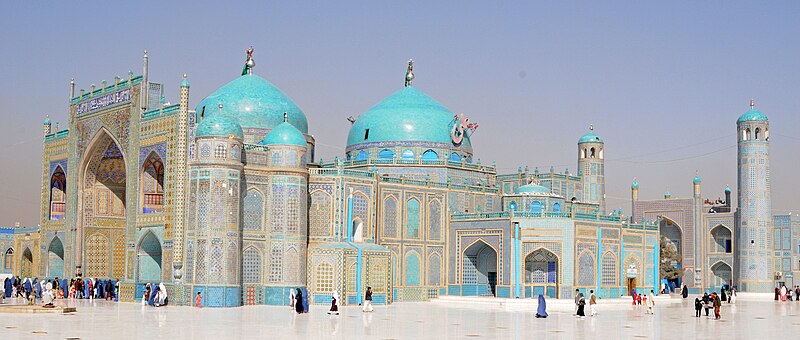
File:Blue_Mosque_in_the_northern_Afghan_city_in_2012.jpg · Wikimedia Commons · See Wikimedia Commons
Balkh Province is a region in northern Afghanistan that has historically been an important center of trade, culture, and learning along the Silk Road. Today it remains one of Afghanistan's significant provinces, known for its agricultural production and its strategic location in the country's north.
AI-generated from the Wikipedia summary — may contain errors.
Wikidata facts
- Instance of
- province of Afghanistan
- Country
- Afghanistan
- Located in
- Afghanistan
- Contains
- Zari
- Capital
- Mazar-i-Sharif
- Official language
- Pashto
- Population
- 1509183
- Area
- 16186.3
- Elevation
- 340
- Time zone
- UTC+04:30
- Shares border with
- Khatlon Province
- Image
- Outskirts of Mazar-e Sharif in northern Afghanistan.jpg
- Significant event
- Battle of Balkh
Show 8 more facts
- Commons category
- Balkh Province
- topic's main category
- Category:Balkh Province
- office held by head of government
- governor
- category for people born here
- Category:Births in Balkh Province
- category of associated people
- Category:People from Balkh Province
- language used
- Turkmen
- male population
- 766853
- female population
- 742330
Sources (3)
via Wikidata · CC0
~32 min read
Encyclopedic overview
Balkh (Persian: ولایت بلخ) is one of the northern provinces of Afghanistan and is widely regarded as one of the country's most historically significant and culturally rich regions. It borders Jowzjan and Sar-e-Pol to the west, Samangan to the south, Kunduz to the east, and the Surxondaryo Region of Uzbekistan to the north. The provincial capital is Mazar-i-Sharif, which functions as the main administrative, economic, and cultural center of the province.
Covering an area of approximately 16,000 square kilometers and having an estimated population of about 1.6 million people (as of 2023), Balkh is defined by its fertile plains in the Kunduz River basin and its proximity to the northern Afghan steppe, which contrasts with the mountainous regions further south. The province contains numerous archaeological sites and ancient cities, including the historic city of Balkh, which was a major center of trade, religion, and learning in antiquity, often referred to as the "mother of cities".
Excerpted from Wikipedia’s “Balkh Province” article, available under the CC BY-SA 4.0 licence.
Gallery (12)
On the map
Available in 77 languages
- Español
- Français
- Deutsch
- 中文
- 日本語
- Русский
- Português
- Italiano
- العربية
- हिन्दी
- Asturian
- azb
- Azerbaijani
- Bahasa Indonesia
- Bangla
- Basque
- be_x_old
- Belarusian
Show 58 more
- Bulgarian
- Catalan
- Cebuano
- Central Kurdish
- Crimean Tatar
- Czech
- Danish
- Esperanto
- Estonian
- Filipino
- Finnish
- Georgian
- Greek
- Hebrew
- Hungarian
- Kashmiri
- Latvian
- Lithuanian
- Malay
- Marathi
- Mazanderani
- Minangkabau
- Mongolian
- Nederlands
- Newari
- Northern Frisian
- Norwegian
- Norwegian Nynorsk
- Ossetic
- Pashto
- Polski
- Punjabi
- Romanian
- Scots
- Serbian
- simple
- Sindhi
- Slovak
- Sundanese
- Svenska
- Tajik
- Tamil
- Tiếng Việt
- Türkçe
- Ukrainian
- Urdu
- Uyghur
- Uzbek
- Waray
- Welsh
- Western Panjabi
- Wu Chinese
- Zaza
- zh_min_nan
- zh_yue
- فارسی
- ไทย
- 한국어
via Wikidata sitelinks · CC0