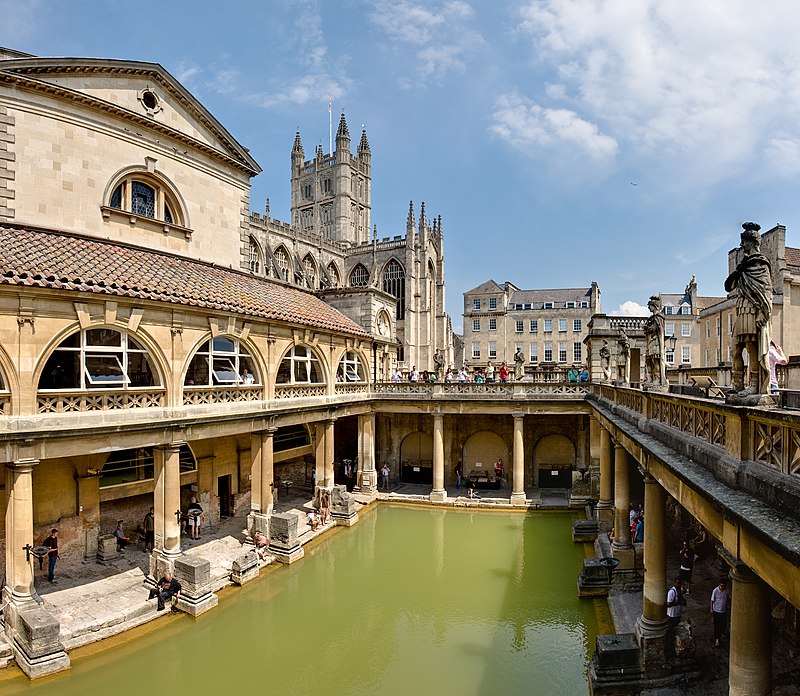
File:Roman_Baths_in_Bath_Spa,_England_-_July_2006.jpg · Wikimedia Commons · See Wikimedia Commons
Bath
Sign in to saveAlso known as Bath, Somerset, City of Bath
ciudad en el condado ceremonial de Somerset, en el sudoeste de Inglaterra
Bath is a historic city located in Somerset in the southwest of England. It matters as a significant cultural and architectural center, though the specific reasons for its historical importance would require additional context to detail accurately.
AI-generated from the Wikipedia summary — may contain errors.
Weather now
7-day forecast
via Open-Meteo
Place details
- Locality
- Bath
- Region
- England
- Country
- United Kingdom
- Population
- 101,557
- Timezone
- Europe/London
via OpenStreetMap · GeoNames
Wikidata facts
- Official name
- Bath
- Country
- Kingdom of England
- Located in
- Bath and North East Somerset
- Population
- 83286
- Area
- 29
- Elevation
- 132
- Time zone
- UTC+01:00
- Body of water
- River Avon
- Capital of
- Bath and North East Somerset
- Follows
- Aquae Sulis
- Official website
- www.mayorofbath.co.uk
- Image
- Bath Somerset 2023 -City- by-RaBoe 055.jpg
- Dialing code
- 01225
Show 16 more facts
- twinned administrative body
- Manly
- Commons category
- Bath, Somerset
- topic's main category
- Category:Bath, Somerset
- Commons gallery
- Bath
- category for people born here
- Q8045303
- category for people who died here
- Category:Deaths in Bath, Somerset
- category of associated people
- Category:People from Bath, Somerset
- OS grid reference
- ST745645
- native label
- Bath
- postal code
- BA2
- inception
- 0043-00-00
- P8168
- Leslie Nielsen
- different from
- Bath
- P12749
- Tallinn
- associated electoral district
- Bath
Sources (15)
via Wikidata · CC0
Travel guide
Get around
Most locations in Bath are easily walkable from the city centre and stations. Avoid using a car in town center.
Do
What's on? Read Bath Chronicle (published Thursday), or Venue Magazine (Wednesday).
Buy
The 2010 Southgate Shopping Centre is constructed in a mock Georgian style and features a selection of mid-to-upper range clothing chains plus some pretty good places to eat. It is opposite the railway and bus station but offers little of interest for the tourist as it provides predominantly mainstream retailers available in many high streets in Britain. This was a historic area up until the 1960s when it was demolished due to persistent flooding problems.
Boutique shopping can be found in the North part of the centre, notable for its art and antique showrooms. Head up Milsom Street to George Street and beyond. Bath claims to have one of the highest percentages of independent shops in any British high-street.
Walcot Street to the north-east of the centre has been designated the "artisan quarter" by the Council and has a number of independent stores.
Eat
For its size, Bath has an excellent choice of eateries for any budget and taste. Mainstream restaurant chains are present as well as many independents. Within the city centre there are Italian, French, Thai, Nepali, Indian, Spanish, Turkish, Japanese and fusion restaurants. There are also specialist fish, steak, and gourmet restaurants. Most pubs sell food at lunchtime and in the evening.
Drink
Bath, has a huge array of pubs and bars to choose from, ranging from the very traditional pubs serving real ale to the typical trendy bars: thumb|200px|The Salamander, exterior view
The most notable pubs:
Other notable pubs are:
Notable bars are:
Sleep
thumb|Typical Georgian architecture of Bath, as viewed looking north-west from Bathwick Hill Accommodation in and around Bath ranges from budget hostels and smart, comfortable self-catering homes, through elegant bed and breakfast and guest houses, hospitable farms and inns, to top-of-the-range hotels.
Stay safe
Overall Bath is a very safe city to visit; the large number of tourists and university students generates a friendly and vigorous feel to the city. Bath city centre is lively and bustling until late on Friday and Saturday evenings, although things get rougher around kicking out time late at night. Women would be well advised to avoid wandering around alone at night. The common problem for tourists is the occasional groups of homeless beggars around the parks and abbey - you may see them drinking lager and shouting abuse, which can surprise many first-time visitors. However, they're not pushy when asking for money, and argue amongst themselves rather than getting passers-by involved. Accept it as a byproduct of a city that attracts tourism (and therefore money), and it's no problem.
The river between Pultney Bridge and the weir looks good for a spot of swimming when you're young and fit. It is actually very dangerous, and every year people die doing it. Warleigh weir is good if you're looking for a swim - about 3 miles along the canal.
If you're a keen cyclist, there's a wonderful Bath-to-Bristol cycle path at your disposal. However, please be aware that there have been robberies and attacks on this stretch of cycle path in 2008. Police have made arrests, but it's something you should consider if planning to make the journey.
Connect
As of April 2022, Bath has 5G from EE and Three, and 4G from O2 and Vodafone. Wifi is widely available in public places.
Bath Library (in the Podium Shopping Centre) offers Internet access at £3.60 an hour for non members.
Go next
Bradford on Avon — a beautiful, picture-postcard small town near Bath; it's accessible by rail and there's a lovely 30-minute walk along the canal to Avoncliff where the Cross Guns pub provides good food in an excellent riverside setting - and you can catch the train back to Bath from there. Trains between Bath Spa and Bradford on Avon take 15-20 minutes and run 2-3 times an hour. Bristol — with its many attractions situated around the floating harbour and Avon Gorge, is 12 miles drive or 15 minutes train journey away, and makes an excellent day trip from Bath. Cheltenham— another historic spa town, which started its journey in the early 1700s with the discovery of healing waters. Swindon — known for its history as the heart of the Great Western Railway, 20 minutes on the train, or an hour by car on A46 and M4 motorway.
Travel guide from Wikivoyage (CC BY-SA 4.0)
Article · Español
Bath (/ˈbɑːθ/) es una ciudad en el condado ceremonial de Somerset, en el sudoeste de Inglaterra. Está situada a 156 km al oeste de Londres y a veintiún kilómetros al sureste de Bristol. Le fue concedido el estatus de ciudad en el año 1590 a través de un decreto real de la reina Isabel I, y posteriormente el de ("municipio condal”) en 1889, lo cual le garantizó independencia del resto de Somerset. Más tarde, Bath se convirtió en parte de Avon, cuando dicho condado fue creado en 1974. Desde 1996, con la abolición del condado de Avon, la ciudad ha sido el principal centro urbano de la autoridad unitaria de Bath and North East Somerset (“Bath y Noreste de Somerset”, B&NES). Bath fue fundada como un complejo termal por los romanos bajo el nombre latino de (“las aguas de Sulis”), en 43 d. C., aunque la tradición oral sin ningún sustento sugiere que ya existía desde antes. Los romanos construyeron el complejo y un templo en las colinas adyacentes en el valle del río Avon, alrededor de la fuente de las aguas termales. Edgar el Pacífico fue coronado como rey de Inglaterra en la Abadía de Bath en el 973. Tiempo después, se popularizó por sus aguas termales durante la Época georgiana, lo cual propició una gran expansión y dejó un reconocido legado arquitectónico georgiano para cuya construcción se utilizó piedra de Bath. Bath fue reconocida como Patrimonio de la Humanidad de la Unesco en 1987. La ciudad posee una gran variedad de teatros, museos y demás edificios de importancia cultural, lo cual ha contribuido a su desarrollo como destino turístico, recibiendo cada año más de 3,8 millones[cita requerida] de visitantes de un día y un millón de turistas que pasan más tiempo en el lugar. Existen dos universidades (la Universidad de Bath y la Universidad de Bath Spa) y numerosos centros de enseñanza secundaria y superior.
Abstract from DBpedia / Wikipedia · CC BY-SA
Gallery (12)
On the map
Available in 97 languages
- Español
- Français
- Deutsch
- 中文
- 日本語
- Русский
- Português
- Italiano
- العربية
- Afrikaans
- Aramaic
- Armenian
- azb
- Azerbaijani
- Bahasa Indonesia
- Balinese
- Bangla
- Basque
Show 78 more
- be_x_old
- Belarusian
- Breton
- Bulgarian
- Catalan
- Cebuano
- Central Kurdish
- Croatian
- Czech
- Danish
- Egyptian Arabic
- Esperanto
- Estonian
- Filipino
- Finnish
- Galician
- Georgian
- Greek
- Hebrew
- Hungarian
- Icelandic
- Ido
- Interlingue
- Irish
- Javanese
- Kazakh
- Kurdish
- Latin
- Latvian
- Lithuanian
- lld
- Lombard
- Luxembourgish
- Macedonian
- Maltese
- Manipuri
- Mazanderani
- Mingrelian
- Moksha
- Mongolian
- Nederlands
- Northern Frisian
- Norwegian
- Norwegian Nynorsk
- nrm
- Old English
- Ossetic
- Piedmontese
- Polski
- Quechua
- Romanian
- Sardinian
- Serbian
- Serbian (Latin)
- Silesian
- simple
- Sindhi
- Slovak
- Slovenian
- Somali
- Svenska
- Tatar
- Tiếng Việt
- Türkçe
- Ukrainian
- Urdu
- Volapük
- Waray
- Welsh
- Western Frisian
- Western Panjabi
- Wu Chinese
- Zaza
- Zeelandic
- zh_yue
- فارسی
- ไทย
- 한국어
via Wikidata sitelinks · CC0