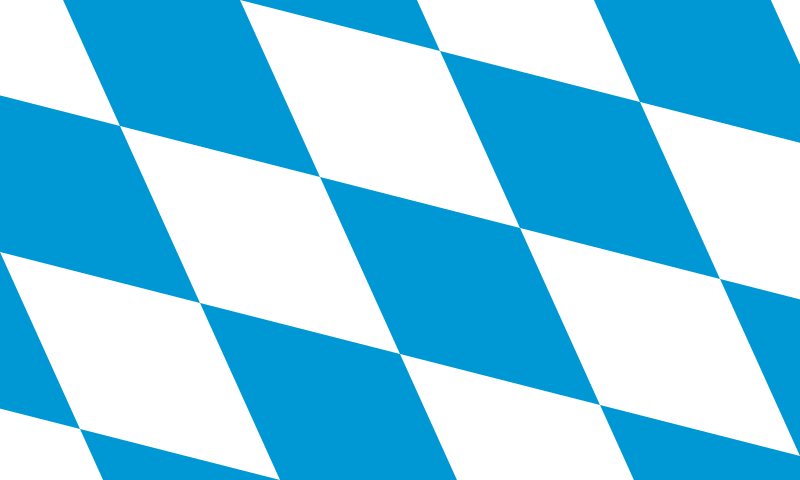
File:Flag_of_Bavaria_(lozengy).svg · Wikimedia Commons · See Wikimedia Commons
Bayern
Sign in to saveAlso known as Free State of Bavaria, Freistaat Bayern, Freistoot Bayern, State of Bavaria
Land der Bundesrepublik Deutschland
Bavaria is the largest state in Germany by area and the second most populous, located in the southeastern part of the country with its capital in Munich. It borders several German states as well as Austria and the Czech Republic, making it an important region in central Europe.
AI-generated from the Wikipedia summary — may contain errors.
Key facts
- Settlement.official_name
- Free State of Bavaria
- Settlement.settlement_type
- State
- Settlement.imagesize
- 270px
- Settlement.image_map
- File:Locator map Bavaria in Germany.svg
- Settlement.map_caption
- Location of Bavaria in Germany
- Settlement.image_flag
- 120px|border|Flag of Free State of Bavaria120px|border|Flag of Free State of Bavaria
- Settlement.flag_size
- 120px
- Settlement.image_shield
- Coat of arms of Bavaria.svg
- Settlement.shield_size
- 110
- Settlement.anthem
- File:Für Bayern (Bayernhymne).ogg
- Settlement.mapframe
- yes
- Settlement.mapframe zoom
- 5
- Settlement.mapframe point
- none
- Settlement.mapsize
- 155px
- Settlement.subdivision_type
- Country
- Settlement.subdivision_name
- Germany
- Settlement.seat_type
- Capital(and largest city)
- Settlement.seat
- Munich
via Wikipedia infobox
Wikidata facts
- Instance of
- ward
- Part of
- Southern Germany
- Named after
- Bajuwari
- Official name
- Freistoot Boarn
- Demonym
- بَوَارِيَّةٌ
- Country
- Weimar Republic
- Located in
- Bizone
- Contains
- Swabia
- Continent
- Europe
- Capital
- Munich
- Official language
- Standard High German
- Population
- 13038724
- Area
- 70551
- Elevation
- 503
- Time zone
- Central European Time
- Head of government
- Markus Söder
- Form of government
- parliamentary republic
- Legislature
- Bavarian Senate
- Anthem
- Bayernhymne
- Shares border with
- South Bohemian Region
- Highest point
- Zugspitze
- Follows
- Kingdom of Bavaria
- Official website
- bayernportal.de
- Unemployment rate
- 3.0
Show 41 more facts
- Flag
- flag of Bavaria
- Coat of arms
- coat of arms of Bavaria
- Patron saint
- Benno
- topic's main Wikimedia portal
- Portal:Bavaria
- Commons category
- Bavaria
- topic's main category
- Category:Bavaria
- inception
- 1919-01-12
- category for people born here
- Category:Births in Bavaria
- category for people who died here
- Category:Deaths in Bavaria
- category for films shot at this location
- Category:Films shot in Bavaria
- category of associated people
- Category:People from Bavaria
- category for people buried here
- Category:Burials in Bavaria
- top-level Internet domain
- .bayern
- history of topic
- history of Bavaria
- IPA transcription
- ˈbaɪ̯ɐn
- Commons gallery
- Bayern
- described by source
- Granat Encyclopedic Dictionary
- language used
- Main-Franconian
- twinned administrative body
- São Paulo
- lowest point
- Kahl am Main
- archives at
- Bavarian Hauptstaatsarchiv
- water as percent of area
- 2.0
- public holiday
- Second Day of Christmas
- main regulatory text
- Constitution of the Free State of Bavaria
- native label
- Freistaat Bayern
- short name
- Beieren
- compulsory education (minimum age)
- 6
- compulsory education (maximum age)
- 18
- P6482
- Bavaria
- P8168
- Zaharija of Serbia
- P11012
- Primorsky Krai
- social media followers
- 26300
- privacy policy URL
- www.bayern.de/datenschutz
- impressum URL
- www.bayern.de/impressum
- contact page URL
- www.bayern.de/buergerservice/kontakt
- email address
- mailto:[email protected]
- phone number
- +49-89-21650
- terms of service URL
- www.bayern.de/impressum
- web feed URL
- www.bayern.de/rss/pm_alle.php
- budget
- 71424666800
- official jobs URL
- sei-dabay.de
Sources (12)
via Wikidata · CC0
Article · Deutsch
Der Freistaat Bayern ([ˈbaɪ̯ɐn] ; Ländercode BY), kurz Bayern, ist das flächengrößte der 16 Länder der Bundesrepublik Deutschland und liegt in deren Südosten. Mit rund 13,2 Millionen Einwohnern ist er das zweitbevölkerungsreichste Bundesland. Die Landeshauptstadt und bevölkerungsreichste Stadt ist München mit rund 1,5 Millionen Einwohnern. Der Freistaat hat im Süden Anteil am Hochgebirge der Ostalpen und an dem bis zur Donau reichenden flachen Alpenvorland. Nördlich der Donau bestimmen Mittelgebirge wie der Bayerische Wald oder das Fichtelgebirge das Landschaftsbild. Seine staatsrechtliche Ordnung beruht auf der Verfassung des Freistaates Bayern. Die Bezeichnung Freistaat trägt Bayern seit 1918 mit der Ausrufung als Republik und dem damit verbundenen Ende des Königreichs Bayern. Bereits im Jahre 555 n. Chr. und damit rund 500 Jahre vor der Verwendung des Begriffs deutsch im heutigen Sinn ist das ältere bayerische Stammesherzogtum nachgewiesen, das Teil des fränkischen Herrschaftsbereichs wurde. Unter den Karolingern entstand erstmals ein baierisches Königtum. Nach dem Ende der Herrschaft der Karolinger erstarkte die baierische Eigenständigkeit im jüngeren bayerischen Stammesherzogtum. Mit Beginn der Herrschaft der Wittelsbacher 1180 folgte der Übergang zum Territorialstaat. Sie regierten Bayern über 700 Jahre bis 1918. Baiern war Kurfürstentum des Heiligen Römischen Reiches und ab 1806 Königreich. Durch die Verfassungen von 1808 und 1818 wurde Bayern konstitutionelle Monarchie. Bayern konnte auf dem Wiener Kongress 1814 als eine der Siegermächte einen großen Teil der Gebietsgewinne behalten; unter anderem kamen Teile Frankens, Schwabens und die neugeschaffene linksrheinische Pfalz zu Bayern. 1918 brach die Wittelsbachermonarchie in der Novemberrevolution zusammen. In der Weimarer Republik verlor Bayern seine Reservatrechte weitgehend zugunsten des Reichs. Nach der NS-Machtergreifung erfolgte schrittweise die Aushebelung sämtlicher politischen Möglichkeiten Bayerns, so des Bayerischen Landtags, aber auch der bayerischen Staatsbürgerschaft. Die Amerikanische Besatzungsmacht stellte Bayern 1945 offiziell wieder als unabhängigen Staat her. Die Pfalz wurde 1946 von Bayern abgetrennt und ist heute Teil von Rheinland-Pfalz. 1949 gründete der Freistaat unter Vorbehalten die Bundesrepublik mit. Traditionell gliedert es sich in die drei Landesteile und „Stämme“ Altbayern (Bezirk und Regierungsbezirk Oberpfalz, Ober- und Niederbayern), Franken (Ober-, Mittel- und Unterfranken) und Schwaben. Die Heimatvertriebenen aus den ehemaligen deutschen Ostgebieten werden als vierter Stamm bezeichnet.
Abstract from DBpedia / Wikipedia · CC BY-SA
Gallery (632)
On the map
31 mapped locations
Available in 175 languages
- Español
- Français
- Deutsch
- 中文
- 日本語
- Русский
- Português
- Italiano
- العربية
- हिन्दी
- Afrikaans
- Albanian
- Albanian
- Amharic
- Aragonese
- Armenian
- Arpitan
- Asturian
Show 156 more
- Aymara
- azb
- Azerbaijani
- Bahasa Indonesia
- Balinese
- Bangla
- Bashkir
- Basque
- bat_smg
- Bavarian
- be_x_old
- Belarusian
- Bosnian
- Breton
- Bulgarian
- Buriat
- Burmese
- Catalan
- cbk_zam
- cdo
- Cebuano
- Central Kurdish
- Chechen
- Chuvash
- Colognian
- Cornish
- Crimean Tatar
- Croatian
- Czech
- dag
- Danish
- Egyptian Arabic
- eml
- Esperanto
- Estonian
- Extremaduran
- Filipino
- Finnish
- Friulian
- Galician
- Georgian
- Greek
- Guarani
- Hakka Chinese
- Hebrew
- Hungarian
- Icelandic
- Ido
- Iloko
- Ingush
- Interlingua
- Interlingue
- Irish
- Javanese
- Kara-Kalpak
- Kashubian
- Kazakh
- kge
- Kongo
- Kurdish
- Kyrgyz
- Latgalian
- Latin
- Latvian
- Ligurian
- Limburgish
- Lingua Franca Nova
- Lithuanian
- lld
- Lombard
- Low German
- Lower Sorbian
- Luxembourgish
- Macedonian
- Malagasy
- Malay
- Malayalam
- Maltese
- Manx
- Marathi
- Mazanderani
- Mingrelian
- Mongolian
- Moroccan Arabic
- nds_nl
- Nederlands
- Nepali
- Newari
- Northern Frisian
- Northern Sami
- Norwegian
- Norwegian Nynorsk
- Novial
- Occitan
- Old English
- Ossetic
- Palatine German
- Pampanga
- Papiamento
- Pashto
- Pennsylvania German
- Picard
- Piedmontese
- Polski
- Punjabi
- Quechua
- Romanian
- Romansh
- Rusyn
- Sardinian
- Saterland Frisian
- Scots
- Scottish Gaelic
- Serbian
- Serbian (Latin)
- Sicilian
- Silesian
- simple
- Sindhi
- Slovak
- Slovenian
- Sundanese
- Svenska
- Swahili
- Tajik
- Talysh
- Tamil
- Tatar
- Tetum
- Tiếng Việt
- Toki Pona
- Türkçe
- Turkmen
- Ukrainian
- Upper Sorbian
- Urdu
- Uzbek
- Venetian
- Volapük
- Waray
- Welsh
- West Flemish
- Western Frisian
- Western Panjabi
- Wu Chinese
- Yakut
- Yiddish
- Yoruba
- Zaza
- Zeelandic
- zh_classical
- zh_min_nan
- zh_yue
- فارسی
- ไทย
- 한국어
via Wikidata sitelinks · CC0