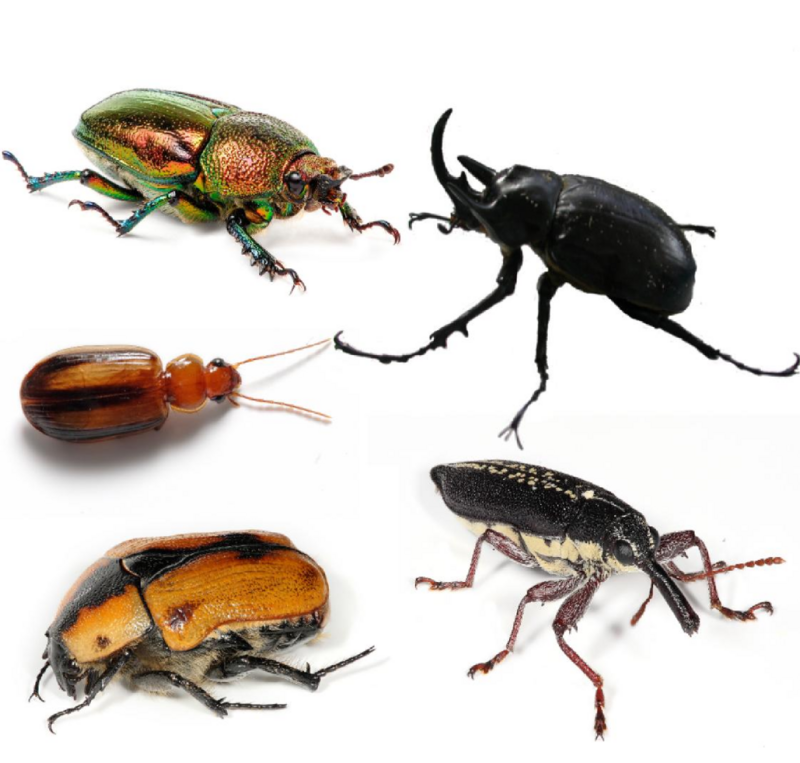
File:Coleoptera_collage.png · Wikimedia Commons · See Wikimedia Commons
beetles
Sign in to saveAlso known as coleopteran, coleopterans
Beetles are insects that form the order Coleoptera (), in the superorder Holometabola. Their front pair of wings are hardened into wing-cases, elytra, distinguishing them from most other insects. The Coleoptera, with about 400,000 described species, is the largest of all orders, constituting almost 40% of described arthropods and 25% of all known animal species; new species are discovered frequently, with estimates suggesting that there are between 0.9 and 2.1 million total species.
OverviewAI-generated
Beetles, scientifically known as Coleoptera, constitute an order within the class Insecta and phylum Arthropoda. This taxon is a subclass of insects and belongs to the parent taxa Endopterygota, Holometabola, and Coleopterida. The group has been studied through the field of coleopterology. Its temporal range began during the Lopingian period, approximately 318 million years ago.
The habitat for beetles includes marine, brackish, and freshwater environments. The taxon holds an accepted status in the World Register of Marine Species. It is referenced by 67,885 other encyclopedia articles and appears on the Wikipedia:Vital articles/Level/4 focus list. PubMed records 37,017 items related to beetles. The name is described in sources such as the Brockhaus and Efron Encyclopedic Dictionary and the Encyclopædia Britannica 11th edition.
Synthesized by Vinony from 26 facts across 4 sources: Wikidata, PubMed, WoRMS, Vinony graph. Generated from structured data (not the Wikipedia text) and checked against those facts — may still contain errors.
Species
beetles
Order
- PhylumArthropoda
- ClassInsecta
- OrderColeoptera
鞘翅目(Coleoptera)是昆蟲綱中最大的目,包括各種甲蟲。目前全世界的甲蟲,約182科,約有35萬種,超過全動物界其他所有目的總和。除了在海洋和極地之外,任何環境都可以發現甲蟲。 甲蟲一般都有外骨骼,前翅為硬殼,通常可以覆蓋身體的一部分以及保護後翅;前翅不能拿來飛行。一些種類已經有部分的種類喪失飛行能力,如步行蟲和象鼻蟲。 甲蟲為完全變態的生物(卵、幼蟲、蛹、成蟲)
via
Research
37,017 papers- How Dung Beetles Steer Straight.ReviewAnnual review of entomology · 2021Dacke M, Baird E, El Jundi B et al.DOI: 10.1146/annurev-ento-042020-102149
- Microbial bases of herbivory in beetles.ReviewTrends in microbiology · 2025García-Lozano M, Salem HDOI: 10.1016/j.tim.2024.08.004
- Bombardier beetles repel invasive bullfrogs.PeerJ · 2022Sugiura S, Date TDOI: 10.7717/peerj.13805
- Dung beetles and fecal helminth transmission: patterns, mechanisms and questions.Parasitology · 2014Nichols E, Gómez ADOI: 10.1017/S0031182013002011
- Charles Darwin, beetles and phylogenetics.ReviewDie Naturwissenschaften · 2009Beutel RG, Friedrich F, Leschen RADOI: 10.1007/s00114-009-0601-2
- The Evolution of Flower Beetles as Visitors and Pollinators.ReviewAnnual review of entomology · 2026de Medeiros BAS, Peris DDOI: 10.1146/annurev-ento-121423-013404
- Conifer-killing bark beetles locate fungal symbionts by detecting volatile fungal metabolites of host tree resin monoterpenes.PLoS biology · 2023Kandasamy D, Zaman R, Nakamura Y et al.DOI: 10.1371/journal.pbio.3001887
- Identification of Forensically Important Carrion Beetles (Coleoptera: Staphilinidae) in China Based on COI and COII.Journal of medical entomology · 2023Luo Y, Meng FDOI: 10.1093/jme/tjac141
via PubMed
Wikidata facts
Show 13 more facts
- taxon rank
- order
- taxon name
- Coleoptera
- Commons category
- Coleoptera
- topic's main category
- Category:Coleoptera
- taxon common name
- biller
- studied by
- coleopterology
- start time
- 318000000-
- described by source
- Encyclopædia Britannica 11th edition
- on focus list of Wikimedia project
- Wikipedia:Vital articles/Level/4
- IPA transcription
- ˌkoʊliˈɑptəɹə
- topic has template
- Template:Coleoptera
- Serbo-Croatian preferred project code
- sr
- temporal range start
- Lopingian
Sources (8)
via Wikidata · CC0
~69 min read
Encyclopedic overview
59 sectionsContents
- Etymology
- Distribution and diversity
- Evolution
- Late Paleozoic and Triassic
- Jurassic
- Cretaceous
- Cenozoic
- Phylogeny
- External morphology
- Head
- Thorax
- Legs
- Wings
- Abdomen
- Digestive system
- Nervous system
- Respiratory system
- Circulatory system
- Specialized organs
- Reproduction and development
- Mating
- Life cycle
- Egg
- Larva
- Pupa and adult
- Behaviour
- Locomotion
- Communication
- Parental care
- Eusociality
- Feeding
- Ecology
- Anti-predator adaptations
- Camouflage
- Mimicry and aposematism
- Other defences
- Parasitism
- Pollination
- Mutualism
- Tolerance of extreme environments
- Migration
- Relationship to humans
- In ancient cultures
- As pests
- As beneficial resources
- As food and medicine
- As biodiversity indicators
- In art and adornment
- In entertainment
- As pets
- As things to collect
- As inspiration for technologies
- In conservation
- Notes
- See also
- References
- Bibliography
- Further reading
- External links
Beetles are insects that form the order Coleoptera (), in the superorder Holometabola. Their front pair of wings are hardened into wing-cases, elytra, distinguishing them from most other insects. The Coleoptera, with about 400,000 described species, is the largest of all orders, constituting almost 40% of described arthropods and 25% of all known animal species; new species are discovered frequently, with estimates suggesting that there are between 0.9 and 2.1 million total species.
Found in almost every habitat except the sea and the polar regions, they interact with their ecosystems in several ways: beetles often feed on plants and fungi, break down animal and plant debris, and eat other invertebrates. Some species are serious agricultural pests, such as the Colorado potato beetle, while others such as Coccinellidae (ladybirds or ladybugs) eat aphids, scale insects, thrips, and other plant-sucking insects that damage crops. Some others also have unusual characteristics, such as fireflies, which use a light-emitting organ for mating and communication purposes.
Excerpted from Wikipedia’s “beetles” article, available under the CC BY-SA 4.0 licence.
Gallery (53)
Available in 123 languages
- Español
- Français
- Deutsch
- 中文
- 日本語
- Русский
- Português
- Italiano
- العربية
- हिन्दी
- Afrikaans
- Albanian
- Amharic
- Aragonese
- Armenian
- Asturian
- Atikamekw
- Azerbaijani
Show 104 more
- Bahasa Indonesia
- Balinese
- Bangla
- Bashkir
- Basque
- bat_smg
- be_x_old
- Belarusian
- Bikol
- Bosnian
- Breton
- Bulgarian
- Burmese
- Catalan
- Cebuano
- Central Kurdish
- Chuvash
- Cornish
- Croatian
- Czech
- Danish
- Egyptian Arabic
- Esperanto
- Estonian
- Filipino
- Finnish
- Galician
- Georgian
- Greek
- Guarani
- Hakka Chinese
- Hausa
- Hebrew
- Hungarian
- Icelandic
- Ido
- Ingush
- Interlingua
- Irish
- Javanese
- Kabyle
- Kannada
- Kazakh
- Kurdish
- Kyrgyz
- Latin
- Latvian
- Lingua Franca Nova
- Lithuanian
- lld
- Low German
- Luxembourgish
- Macedonian
- Malagasy
- Malay
- Malayalam
- Navajo
- Nederlands
- Northern Frisian
- Norwegian
- Norwegian Nynorsk
- Occitan
- Old English
- Ossetic
- Palatine German
- Pampanga
- Papiamento
- Pashto
- Polski
- Punjabi
- Quechua
- Romanian
- Saterland Frisian
- Serbian
- Serbian (Latin)
- simple
- Sinhala
- Slovak
- Slovenian
- Sundanese
- Svenska
- Swahili
- Tajik
- Tamil
- Tatar
- Tiếng Việt
- Toki Pona
- Türkçe
- Tyap
- Ukrainian
- Upper Sorbian
- Urdu
- Uzbek
- Waray
- Welsh
- West Flemish
- Wu Chinese
- Yiddish
- Yoruba
- zh_min_nan
- zh_yue
- فارسی
- ไทย
- 한국어
via Wikidata sitelinks · CC0