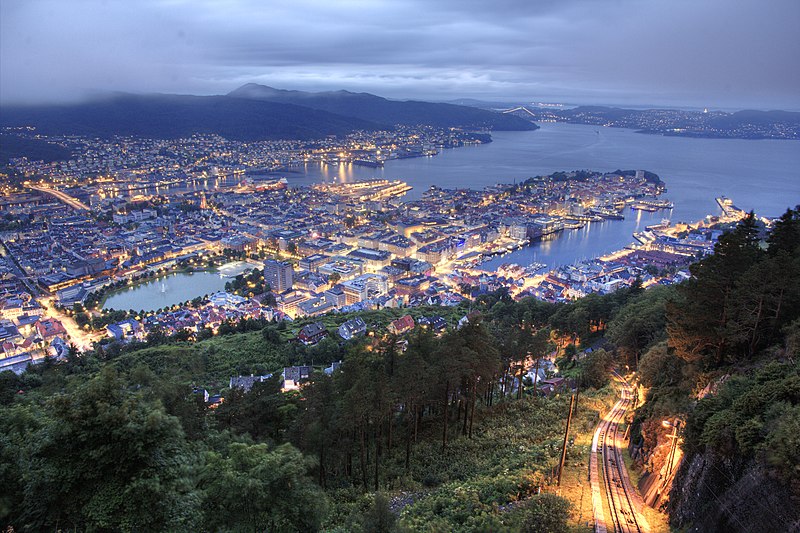
File:Bergen_panorama_at_night_-_panoramio_(1).jpg · Wikimedia Commons · See Wikimedia Commons
Bergen
Sign in to saveAlso known as Bjørgvin
Bergen (, ) is a city and municipality in the Vestland county on the west coast of Norway. Bergen is the second-largest city in Norway after the capital, Oslo.
Bergen is the second-largest city in Norway, located on the west coast in Vestland county. As a major urban center in the country, it serves as an important cultural and economic hub for Norway's western region.
AI-generated from the Wikipedia summary — may contain errors.
Weather now
7-day forecast
via Open-Meteo
Place details
- Locality
- Bergen
- Country
- Norge
- Population
- 294,029
- Timezone
- Europe/Oslo
via OpenStreetMap · GeoNames
Key facts
- Settlement.area_land_km2
- 444.99
- Settlement.area_water_km2
- 19.72
- Settlement.area_urban_km2
- 94.03
- Settlement.area_metro_km2
- 2755
- Settlement.population_density_km2
- auto
- Settlement.area_water_percent
- 4.2
- Settlement.population_as_of
- 1 January 2024
- Settlement.population_total
- 294,029
- Settlement.population_metro
- 469,238
- Settlement.population_density_metro_km2
- auto
- Settlement.name
- Bergen
- Settlement.settlement_type
- City and municipality
- Settlement.imagesize
- 260px
- Settlement.image_flag
- Flag of Bergen, Norway.svg
- Settlement.image_shield
- Bergen våpen.svg
- Settlement.map_caption
- Location of Bergen
- Settlement.pushpin_map
- Norway#Vestland#Europe
- Settlement.pushpin_relief
- 1
via Wikipedia infobox
Research organization · ROR
- Type
- Government
- Location
- Bergen, Norway
- Status
- Active
GRID grid.457997.1 · ISNI 0000 0004 0375 5599
Wikidata facts
- Instance of
- big city
- Official name
- Bergen
- Demonym
- bergensar
- Country
- Denmark–Norway
- Located in
- Bergen Municipality
- Continent
- Europe
- Official language
- Norwegian
- Population
- 95889
- Area
- 87.17
- Elevation
- 5
- Time zone
- UTC+01:00
- Capital of
- Vestland
- Image
- 00 4400 View over the store Lungegårdsvann - Bergen (Norway).jpg
Show 16 more facts
- twinned administrative body
- Callao
- Commons category
- Bergen, Norway
- category for people born here
- Category:Births in Bergen, Norway
- category for people who died here
- Category:Deaths in Bergen, Norway
- category of associated people
- Category:People from Bergen
- postal code
- 5003–5098
- inception
- 1070-00-00
- described by source
- Pax Leksikon
- different from
- Bergen Municipality
- topic's main category
- Category:Bergen
- IPA transcription
- [ˈbæ̀rɡ(ə)n]
- native label
- Bergen
- Commons gallery
- Bergen
- P12749
- Isabela
Sources (12)
via Wikidata · CC0
Travel guide
Understand
thumb|350px|View from Mount Fløyen The character of Bergen is defined by its location, surrounded by steep mountains and sea (straits and fjords). The city has many lakes. It is a typical Norwegian wooden town, even downtown there are notable neighbourhoods of small wooden houses in various styles. Few towns if any have so many wooden houses in the centre. In some areas wooden houses have been replaced by taller masonry structures, giving the city a fascinating mix of old and new.
Bergen is a sprawling city stretching some 40-50 km in either direction where the 286,000 inhabitants (2021) are separated by mountains, fjords and lakes. Only the central parts are visible from the panorama points at Mount Fløyen. The distant parts of the city are mostly of less interest to the visitor. The city centre is on the other hand compact and can be covered by walking for most visitors. Bergen is facing the ocean and coast, and the hinterland is relatively sparsely populated. Bergen is separated from eastern Norway by crooked fjords and wide, inhospitable mountain areas, and until the Bergen railway was built in 1909 the most practical transport east-west was several days sailing around the coast.
See
thumb|Panoramic view of Bergen thumb|Goats enjoying the view from Mt Fløyen. There's a number of attractions in Bergen and the surrounding areas. Surveys do, however, show that most tourists in Bergen find the atmosphere, cultural landscape and architecture more compelling than the typical sights, so pick a few things to see and spend the rest of your time in Bergen sitting down in a park or café, strolling around the city, enjoying a concert or hiking the mountains. On sunny summer days, stay downtown until late to enjoy the sunset in the north.
Buy
Bergen has a number of shopping centres, and international chains are well represented. As prices are rather high in Norway, regular shopping is probably not the most interesting thing to do in Bergen, even if you get a VAT refund (see the Tax Free shopping section below). But if you know where to go, you can find rare and unique items, both traditional crafts and stuff made by local designers - and some other fun stuff. Keep in mind that with a very few exceptions, Bergen shuts down completely on Sundays and holidays.
Eat
There is a great variety of restaurants and cafes in Bergen, but you should expect to spend some time looking for the best places. In the most central parts of the city, many of the restaurants are all the same. Move a block away from the most central parts of downtown to find lower prices and better food. Kitchens usually close at 23:00 at the latest.
Waiters and other restaurant staff have good wages. You are not required to leave any money to cover the service, but many people choose to tip the waiter if he or she has been helpful and nice, and if the food was good. If you choose to leave a tip, rounding up or adding about five to ten percent will be appreciated. A rule of thumb would be that the more expensive the food is, the more are you expected to leave a tip.
Keep in mind that tap water is safe to drink and (usually) free of charge. To save money, ask for tap water to drink.
Drink
There is a great variety of bars, night clubs, concert venues etc. in Bergen. Night clubs are usually open from 23:00, but life never starts before 01:00. Bars opens at different hours, some can be open all day. No places are allowed to serve alcohol after 03:00, and the consumption of alcoholic beverages must cease at 03:30 at the latest. Many places are required to close earlier. The establishments are only allowed to let people bring their drinks outside if they have been granted a special permit. A requirement to get this permit is that they have a confined space outdoors for their guests. All drinks must be indoors by 01:00. People go out all week, but Fridays and Saturdays are the best nights, Saturdays being the clear winner (most places will be a bit too crowded on Saturdays). Some clubs have a 2 for 1 policy on Wednesdays, and Sunday is usually the night for people in the industry.
Most places require that you are 20 years of age (look in the list for details) and that you can provide a valid ID, even if you are much older. Valid IDs are Norwegian bank cards, European standard driver's licenses and ID cards and passports. Drinking in public is illegal. Emptying a can in front of a police officer on a Saturday night will earn you a kr. 2500 fine. If you stroll through a park a bit outside the city centre on a sunny day you will still see a lot of people having a beer or a glass of wine with the picnic. The police usually won't mind as long as everything passes in an …
Sleep
Outside the summer season, getting a hotel room is usually not a problem, although it can be quite expensive unless you have a reservation. In the summer season (from May to Sept) a reservation well in advance is required. Breakfast is normally included in the price except at hostels and camping sites.
Stay safe
Bergen has, as the rest of Norway, a generally low crime rate. The most likely crimes for tourists to experience is car break-ins and bicycle theft. Pickpockets is also becoming an increasing problem in the summer season, but it's still nothing like in larger cities in Europe. It is always a good idea to look after your belongings, this includes never leaving valuable objects visible in your car and locking your bike safely.
There are no particularly unsafe areas in Bergen. The upper part of Nygårdsparken used to be the hang-out place for drug addicts. The lower part of Nygårdsparken is a beautiful place popular among the locals. To make the whole park family friendly the upper part was closed down and renovated for two years forcing the drug addicts to disperse. As a consequence they are now spread across the city. The drug addicts are usually completely harmless, but nevertheless not fun to be around.
Buying sex is illegal in Norway.
People party hard on Friday and Saturday night, and hoards of drunk people will appear in the central areas from around midnight, singing, carousing, and just hanging around. Some foreigners may perceive this as threatening, but they are mostly harmless, even all-male groups chanting football songs. If approached, just smile and stay friendly, but uneasy visitors should avoid groups of drunk young after midnight. Summer evenings has daylight until 23:00 or 24:00, adding to the safety for visitors.
There is an emergency and accident ward at …
Stay healthy
In acute illness or if accident occurs contact: There are many pharmacies (apotek) in Bergen, that are selling medications and can give you advice on the treatment of injury and disease.
Respect
As in the rest of Norway, it is customary to take your shoes off when entering a home. This in particular done as a practical matter, due to the wet weather (slush and salt in winter).
People from Bergen have a reputation for being more loud and direct than many other parts of Norway. Locals are perhaps the most patriotic in Norway.
Connect
Area codes are no longer in use in Norwegian phone numbers. Phone numbers are normally eight digits, some special numbers may be three, four or five digits. In any case you should always dial all of the digits to make a call. The country code of Norway is +47. If you are calling abroad from a land line, dial 00 before your country code and phone number.
Cellular phone coverage is very good throughout the city. Three different networks are available, Telenor, NetCom and Network Norway. Check with your local operator to find out which one is the cheaper for you. The difference is usually not big. Norway, like most of Europe, uses GSM 900 and 1800, which means that some cell phones from USA, Canada and countries in Asia will not work. For those in need of mobile data lines, both HSDPA/3G/UMTS, EDGE and GPRS coverage is good on all networks.
There are no telephone centres in the city, and only a very few phone booths. Most hotels have phones in every room, but international calls from these phones are usually very expensive. There are some calling cards available, this is probably the cheapest way to phone home.
Many cafes and restaurants have free Wi-Fi for their patrons. Free Wi-Fi is also available at Bergen Public Library, Strømgaten 6 (by the bus station). Most large hotels do also have wireless Internet access, however access at a hotel may be pricy.
If you are a registered user at an eduroam participating institution, you can connect to a high-speed secure Wi-Fi networ…
Travel guide from Wikivoyage (CC BY-SA 4.0)
~43 min read
Encyclopedic overview
37 sectionsContents
- History
- Modern history
- Fires
- Toponymy
- Geography
- Climate
- Cityscape
- Administration
- Boroughs
- Demographics
- Education
- Economy
- Transport
- Air
- Sea
- Road
- Rail
- Lightrail
- Culture and sports
- Music
- Street art
- Parks and bathing places
- Parks
- Bathing places
- Media
- Newspapers
- Other Publications
- TV Channels
- Neighbourhoods
- ''Grunnkretser''
- International relations
- Twin towns – sister cities
- Gallery
- Notable people from Bergen
- References
- Bibliography
- External links
Bergen (, ) is a city and municipality in the Vestland county on the west coast of Norway. Bergen is the second-largest city in Norway after the capital, Oslo.
At the beginning of 2026, the population was 294,860, according to Statistics Norway. The municipality covers and is on the peninsula of Bergenshalvøyen. The city centre and northern neighbourhoods are on Byfjorden, 'the city fjord'. The city is surrounded by mountains, causing Bergen to be called the "city of seven mountains". Many of the extra-municipal suburbs are on islands. Bergen is the administrative centre of Vestland county. The city consists of eight boroughs: Arna, Bergenhus, Fana, Fyllingsdalen, Laksevåg, Ytrebygda, Årstad, and Åsane.
Excerpted from Wikipedia’s “Bergen” article, available under the CC BY-SA 4.0 licence.
Gallery (52)
On the map
3 mapped locations
Available in 123 languages
- Español
- Français
- Deutsch
- 中文
- 日本語
- Русский
- Português
- Italiano
- العربية
- हिन्दी
- Afrikaans
- Albanian
- Albanian
- Amharic
- Aragonese
- Armenian
- Asturian
- azb
Show 104 more
- Azerbaijani
- Bahasa Indonesia
- Balinese
- Bangla
- Banjar
- Basque
- bat_smg
- be_x_old
- Belarusian
- Bishnupriya
- Bosnian
- Breton
- Bulgarian
- Catalan
- Cebuano
- Central Kurdish
- Chechen
- Church Slavic
- Croatian
- Czech
- Danish
- Egyptian Arabic
- Erzya
- Esperanto
- Estonian
- Faroese
- Finnish
- Galician
- Georgian
- Greek
- Gujarati
- Hausa
- Hebrew
- Hungarian
- hyw
- Icelandic
- Ido
- Interlingua
- Interlingue
- Irish
- Javanese
- Kara-Kalpak
- Latin
- Latvian
- Limburgish
- Lithuanian
- Lombard
- Low German
- Luxembourgish
- Macedonian
- Malagasy
- Malay
- Maltese
- Māori
- Marathi
- Moksha
- nds_nl
- Nederlands
- Northern Frisian
- Northern Sami
- Norwegian
- Norwegian Nynorsk
- Occitan
- Ossetic
- Pashto
- Piedmontese
- Polski
- Romanian
- Scots
- Serbian
- Serbian (Latin)
- Silesian
- simple
- Slovak
- Slovenian
- Svenska
- Swahili
- Tamil
- Tatar
- Telugu
- Tiếng Việt
- Toki Pona
- Tumbuka
- Türkçe
- Ukrainian
- Upper Sorbian
- Urdu
- Uzbek
- Venetian
- Veps
- Volapük
- Waray
- Welsh
- West Flemish
- Western Frisian
- Western Panjabi
- Wu Chinese
- Zaza
- Zeelandic
- zh_min_nan
- zh_yue
- فارسی
- ไทย
- 한국어
via Wikidata sitelinks · CC0