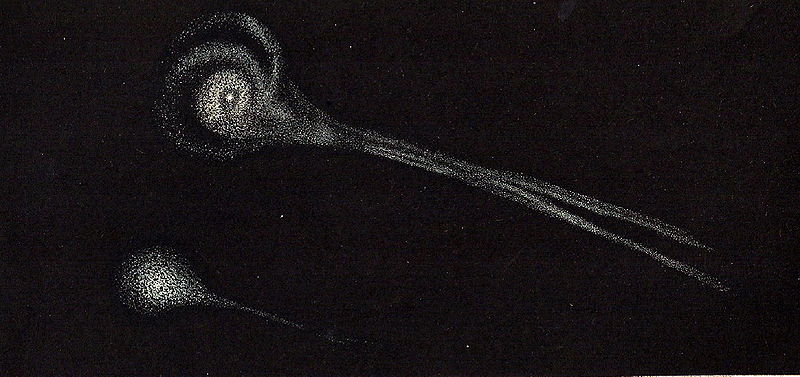
File:CometBiela.jpg · Wikimedia Commons · See Wikimedia Commons
Biela's Comet
Sign in to saveComet that dissolved and assumed as gone
Key facts
- Discovered by
- Wilhelm von Biela , (recognition of periodicity )
- Discovery date
- 27 February 1826
- Mpc designation
- D/1772 E1, D/1826 D1 D/1832 S1
- Alternative designations
- 1772, 1806 I, 1832 III 1846 II, 1852 III
- Epoch
- 29 September 1852 ( JD 2397760.5)
- Observation arc
- ~80 years
- Earliest precovery date
- 8 March 1772
- Aphelion
- 6.190 AU
- Perihelion
- 0.8606 AU
- Semi major axis
- 3.5253 AU
- Orbital period
- 6.619 years
- Inclination
- 12.550°
- Last perihelion
- 23 September 1852 (A), 24 September 1852 (B)
- Next perihelion
- Disintegrated
- Earth moid
- 0.0005 AU (75,000 km), (Epoch 1832)
- Mean diameter
- ≈0.5 km (0.31 mi) , (pre-breakup)
via Wikipedia infobox
Wikidata facts
- Instance of
- near-Earth object
- Named after
- Baron Wilhelm von Biela
- Parent body
- Sun
- Child body
- Andromedids
- Orbital period
- 2427.278122182916
- Image
- CometBiela.jpg
Show 15 more facts
- Commons category
- Comet Biela
- discoverer or inventor
- Baron Wilhelm von Biela
- described by source
- The Nuttall Encyclopædia
- time of discovery or invention
- 1826-02-27
- provisional designation
- 1772
- absolute magnitude
- 7.1
- orbital eccentricity
- 0.751299
- periapsis
- 0.879073
- apoapsis
- 6.190243166802708
- orbital inclination
- 13.2164
- longitude of ascending node
- 250.669
- argument of periapsis
- 221.6588
- time of periapsis
- 2390514.1152
- semi-major axis of an orbit
- 3.53465808340135
- mean anomaly
- 0.9469569963959761
Sources (3)
via Wikidata · CC0
~11 min read
Encyclopedic overview
Biela's Comet or Comet Biela (official designation: 3D/Biela) was a periodic Jupiter-family comet first recorded in 1772 by Montaigne and Messier and finally identified as periodic in 1826 by Wilhelm von Biela. It was subsequently observed to split in two and has not been seen since 1852. As a result, it is currently considered to have been destroyed. Remnants have survived as a meteor shower, the Andromedids.
The comet was first recorded on 8 March 1772 by Jacques Leibax Montaigne; During the same apparition, it was independently discovered by Charles Messier. The comet was also recorded in 1805 by Jean-Louis Pons, but was not recognized as the same object at the time.
Excerpted from Wikipedia’s “Biela's Comet” article, available under the CC BY-SA 4.0 licence.