
File:Bismillah_Khan.jpg · Wikimedia Commons · See Wikimedia Commons
OverviewAI-generated
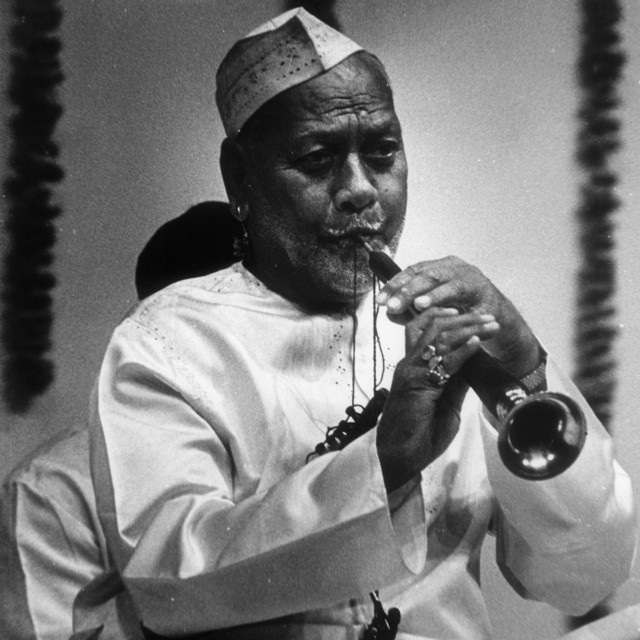
Bismillah Khan was a male musician who performed Hindustani classical music on the shehnai. He was a citizen of the British Raj, the Dominion of India, and India. His native name was بسم اللہ خان, and he spoke Hindi. He adhered to Islam and Shia Islam.
He was born in Dumraon in 1916 and died in Varanasi in 2006. His death resulted from a myocardial infarction due to natural causes. Throughout his career, he received the Sangeet Natak Akademi Award, Padma Bhushan, Bharat Ratna, and Padma Vibhushan.
Synthesized by Vinony from 24 facts across 4 sources: Wikidata, MusicBrainz, Last.fm, TMDb. Generated from structured data (not the Wikipedia text) and checked against those facts — may still contain errors.
Film & TV
Known for
- Meeting a Milestone — Himself1989
- The Music Room — Musician1958
- Hind Ka Lal — King Samarsingh1940
- Lal-e-Yaman — Demon Genie1933
via TMDB
Listeners · Last.fm
- Listeners
- 11,205
- Total plays
- 52,311
Tags
Ustad Bismillah Khan Sahib (Urdu: استاد بسم اللہ خان صاحب; Telugu:ఉస్తాద్ బిస్మిల్లా ఖాన్; March 21, 1916 – August 21, 2006) was an Indian shehnai maestro. He was the third classical musician to be awarded the Bharat Ratna (in 2001), the highest civilian honour in India and gained worldwide acclaim for playing the shehnai for more than eight decades Bismillah Khan was perhaps single handedly responsible for making the shehnai a famous classical instrument. <a href="https://www.last.fm/music/Bis
Key facts
- Born
- Qamaruddin Khan , ( 1916-03-21 ) 21 March 1916, Dumraon , Bihar , British India
- Died
- 21 August 2006 (2006-08-21) (aged 90), Varanasi , Uttar Pradesh , India
- Genres
- Indian classical music
- Occupation
- Musician
- Instrument
- Shehnai
- Members
- Afaq Haider, Savita Anand, Ajitesh Singh
- Past members
- Zamin Husain Khan
via Wikipedia infobox
Wikidata facts
- Instance of
- human
- Family name
- Khan
- Gender
- male
- Citizenship
- India
- Place of birth
- Dumraon
- Place of death
- Varanasi
- Occupation
- musician
- Languages spoken
- Hindi
- Religion
- Shia Islam
- Instrument
- shehnai
- Official website
- ustadbismillahkhan.com
- Image
- Bismillah at Concert1 (edited).jpg
Show 6 more facts
- date of birth
- 1916-03-21
- date of death
- 2006-08-21
- Commons category
- Bismillah Khan
- cause of death
- myocardial infarction
- manner of death
- natural causes
- name in native language
- بسم اللہ خان
via Wikidata · CC0
~9 min read
Encyclopedic overview
Ustad Bismillah Khan (born Qamaruddin Khan, 21 March 1916 – 21 August 2006), often referred to by the title Ustad, was an Indian musician credited with popularizing the shehnai, a reeded woodwind instrument. His virtuosity made him a leading Hindustani classical music artist, indelibly linking his name with the woodwind instrument. While the shehnai had importance as a folk instrument played primarily by musicians schooled in traditional ceremonies, Khan elevated its status and brought it to the concert stage.
Khan was a devout Muslim but performed at both Hindu and Muslim ceremonies, and was considered a symbol of religious harmony. Owing to his fame, he was selected to perform for the ceremony at Delhi's historic Red Fort as the Indian flag unfurled at the hour of India's independence on 15 August 1947. His music was played (in Raag Kafi) on television every Independence Day. Khan turned down invitations to perform in other countries before 1966, when the Indian government insisted that he play at the Edinburgh International Festival. This gained him a following in the West, and he continued to appear in Europe and North America thereafter.
Excerpted from Wikipedia’s “Bismillah Khan” article, available under the CC BY-SA 4.0 licence.