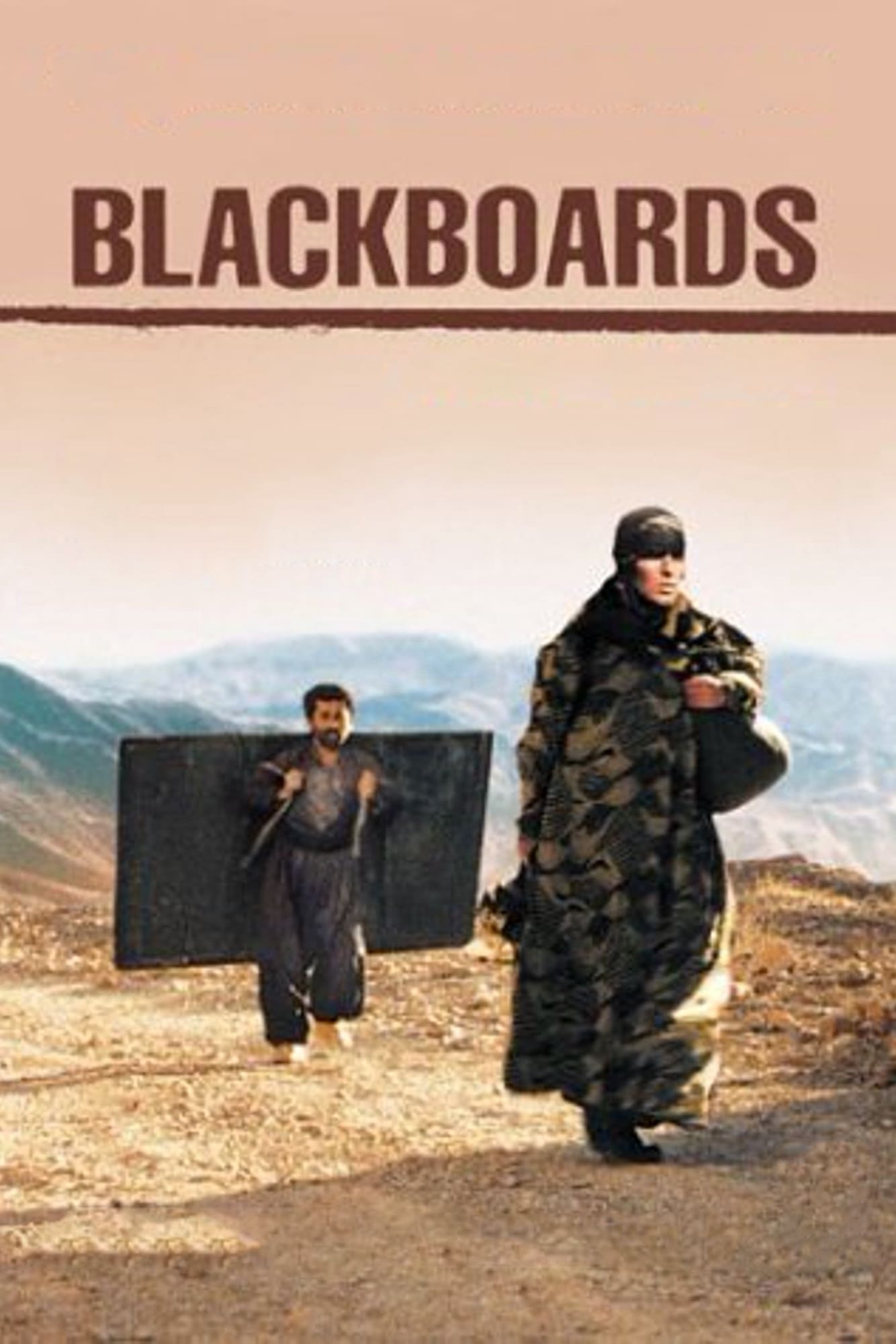
Poster from TMDB
Blackboards
Sign in to saveBlackboards (, Takhté siah; ) is a 2000 Iranian film directed by Samira Makhmalbaf. It focuses on a group of Kurdish refugees after the chemical bombing of Halabja by Saddam Hussein's Iraq during the Iran–Iraq War. The screenplay was co-written by Makhmalbaf with her father, Mohsen Makhmalbaf. The dialogue is entirely in Kurdish. Makhmalbaf describes it as "something between reality and fiction. Smuggling, being homeless, and people's efforts to survive are all part of reality... the film, as a whole, is a metaphor."
OverviewAI-generated
Blackboards is a 2000 war and drama film directed by Samira Makhmalbaf, who also co-wrote the screenplay with Mohsen Makhmalbaf. The film features cast members Bahman Ghobadi and Behnaz Jafari. It was produced in Iran, Italy, and Japan, with original languages of Kurdish and Persian. The narrative is set in Iran. Production companies include Fabrica, Makhmalbaf Film House Productions, RAI Cinema, and T-Mark.
Mohammad-Reza Darvishi composed the music, while Mohsen Makhmalbaf served as film editor. Jean-Pierre Kohut-Svelko was the production designer. The film has a runtime of 85 to 88 minutes. It was distributed by Netflix via video on demand and by Molotov TV. It participated in the 2000 Cannes Film Festival. The title is تخته سیاه.
Critical reception includes a Metascore of 64 and a Rotten Tomatoes rating of 74%. The film received 3 wins and 3 nominations. It is described by the source Women Make Film. Keywords associated with the work include society, teacher, poverty, blackboard, and woman director.
Synthesized by Vinony from 42 facts across 5 sources: Wikidata, TMDb, OMDb, Firecrawl, IMDb. Generated from structured data (not the Wikipedia text) and checked against those facts — may still contain errors.
Film · TMDB
6.7Itinerant Kurdish teachers, carrying blackboards on their backs, look for students in the hills and villages of Iran, near the Iraqi border during the Iran-Iraq war. Said falls in with a group of old men looking for their bombed-out village; he offers to guide them, and takes as his wife Halaleh, the clan's lone woman, a widow with a young son. Reeboir attaches himself to a dozen pre-teen boys weighed down by contraband they carry across the border; they're mules, always on the move. Said and Reeboir try to teach as their potential students keep walking. Danger is close; armed soldiers patrol the skies, the roads, and the border. Is there a role for a teacher? Is there hope?
Cast
- Said Mohamadi as Said
- Behnaz Jafari as Halaleh
- Bahman Ghobadi as Rebwar
- Mohamad Karim Rahmati as Father
- Rafat Moradi as Ribwar
- Mayas Rostami as Young boy storyteller
Themes
- society
- teacher
- poverty
- blackboard
- woman director
- kurd
- iran-iraq war
This product uses the TMDB API but is not endorsed or certified by TMDB.
Ratings
IMDb
6.8/10
2,997 votes
Rotten Tomatoes
74%
Metacritic
64/100
- Year
- 2000
- Runtime
- 88 min
- Genres
- Drama, War
- Awards
- 3 wins & 3 nominations total
via OMDb · IMDb
Key facts
- Film.name
- Blackboards
- Film.image
- Blackboards_poster.jpg
- Film.director
- Samira Makhmalbaf
- Film.writer
- Mohsen MakhmalbafSamira Makhmalbaf
- Film.starring
- Said Mohamadi
- Film.music
- Mohammad-Reza Darvishi
- Film.runtime
- 85 minutes
- Film.language
- Kurdish
via Wikipedia infobox
Wikidata facts
- Instance of
- film
- Participant in
- 2000 Cannes Film Festival
- Genre
- drama film
- Country of origin
- Italy
- Original language
- Persian
- Director
- Samira Makhmalbaf
- Screenwriter
- Mohsen Makhmalbaf
- Cast member
- Behnaz Jafari
- Composer
- Mohammad-Reza Darvishi
- Narrative location
- Iran
- Duration
- 88
- FilmAffinity ID
- 517877
- Distribution format
- video on demand
Show 8 more facts
- publication date
- 2002-01-17
- film editor
- Mohsen Makhmalbaf
- production designer
- Jean-Pierre Kohut-Svelko
- title
- تخته سیاه
- distributed by
- Netflix
- described by source
- Women Make Film
- review score
- 64/100
Sources (11)
via Wikidata · CC0
~2 min read
Encyclopedic overview
7 sectionsContents
- Plot
- Cast
- Reception
- Awards
- References
- Further reading
- External links
Blackboards (, Takhté siah; ) is a 2000 Iranian film directed by Samira Makhmalbaf. It focuses on a group of Kurdish refugees after the chemical bombing of Halabja by Saddam Hussein's Iraq during the Iran–Iraq War. The screenplay was co-written by Makhmalbaf with her father, Mohsen Makhmalbaf. The dialogue is entirely in Kurdish. Makhmalbaf describes it as "something between reality and fiction. Smuggling, being homeless, and people's efforts to survive are all part of reality... the film, as a whole, is a metaphor."
The film was an international co-production of the Makhmalbaf Productions of Iran, the Italian companies Fabrica and Rai Cinema, and the Japanese company T-Mark.
Excerpted from Wikipedia’s “Blackboards” article, available under the CC BY-SA 4.0 licence.