File:Lautrec_in_bed_1893.jpg · Wikimedia Commons · See Wikimedia Commons
blanket
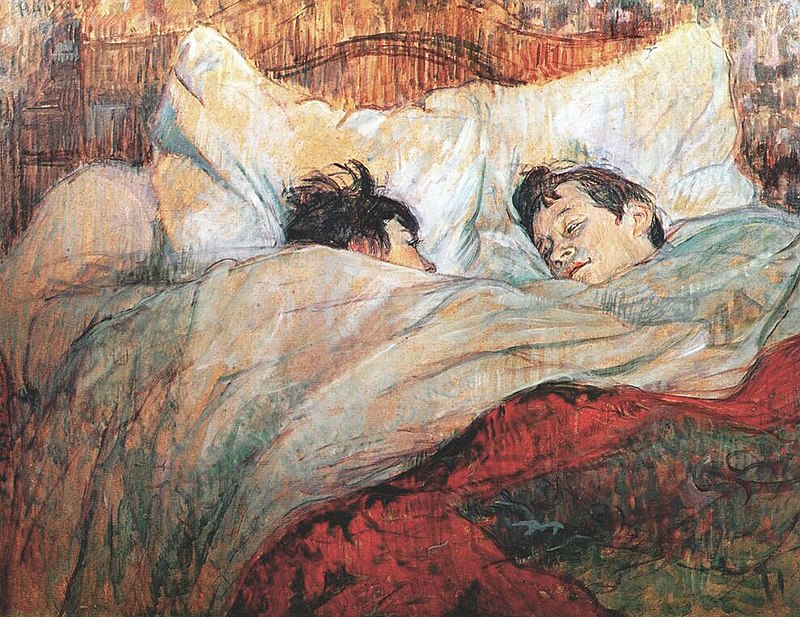
Sign in to savethumb|right|Le Lit (Toulouse-Lautrec)|The Bed, 1892 by [[Henri de Toulouse-Lautrec, depicts two people under a blanket]] A blanket is a swath of soft cloth large enough either to cover or to enfold most of the user's body and thick enough to keep the body warm by trapping radiant body heat that otherwise would be lost through convection and radiation.
A blanket is a large piece of soft cloth designed to cover your body and keep you warm by trapping the heat your body naturally radiates. Blankets matter because they provide an essential, affordable way to maintain body warmth and comfort, which is important for health and sleep.
AI-generated from the Wikipedia summary — may contain errors.
Wikidata facts
- Subclass of
- textile
- Material used
- fleece
- Image
- Filmmaking of "Black Thursday" on ulica Świętojańska in Gdynia - 24.jpg
- Has use
- sleep
Show 3 more facts
- Commons category
- Blankets
- topic's main category
- Category:Blankets
- model item
- comforter
via Wikidata · CC0
~4 min read
Encyclopedic overview
7 sectionsContents
- Etymology
- History
- Types
- Uses
- See also
- References
- External links
thumb|right|Le Lit (Toulouse-Lautrec)|The Bed, 1892 by [[Henri de Toulouse-Lautrec, depicts two people under a blanket]] A blanket is a swath of soft cloth large enough either to cover or to enfold most of the user's body and thick enough to keep the body warm by trapping radiant body heat that otherwise would be lost through convection and radiation.
== Etymology == The term arose from the generalization of a specific fabric called blanke, a heavily napped undyed woolen weave. A popular theory has that the name derives from an eponymous Thomas Blanket (Blanquette), a Flemish weaver who lived in Bristol, England, in the 14th century. However, earlier usage of the term is possible as a borrowing of the Old French word blanket for the type of fabric, attested as early as 1278 and deriving from the adjective blanc, meaning "white". William Shakespeare is recognised as the first person to use the verb blanket, meaning to 'cover with or as with a blanket'. In the play King Lear, published in 1608, the character Edgar says: "My face ile grime with filth, Blanket my loynes, else all my haire with knots."
Excerpted from Wikipedia’s “blanket” article, available under the CC BY-SA 4.0 licence.
Gallery (9)
Available in 83 languages
- Español
- Français
- Deutsch
- 中文
- 日本語
- Русский
- Português
- Italiano
- العربية
- हिन्दी
- Albanian
- Angika
- Armenian
- Atikamekw
- Aymara
- Azerbaijani
- Bahasa Indonesia
- Bangla
Show 64 more
- Banjar
- Basque
- Bikol
- Bosnian
- Breton
- Bulgarian
- Burmese
- Catalan
- Central Kurdish
- Cherokee
- Cheyenne
- Chuvash
- Croatian
- Czech
- Danish
- eml
- Esperanto
- Estonian
- Finnish
- Galician
- Gan Chinese
- Greek
- Guarani
- Hausa
- Hawaiian
- Hebrew
- Iban
- Ido
- Javanese
- Kannada
- Kashmiri
- Kurdish
- Latin
- Latvian
- Lingala
- Malay
- nds_nl
- Nederlands
- Nepali
- nup
- Quechua
- Romanian
- Serbian
- Shona
- Sicilian
- simple
- Sindhi
- Slovenian
- Sundanese
- Svenska
- Swahili
- Tajik
- Tiếng Việt
- Türkçe
- Ukrainian
- Urdu
- Uzbek
- Waray
- Wu Chinese
- zh_min_nan
- zh_yue
- فارسی
- ไทย
- 한국어
via Wikidata sitelinks · CC0