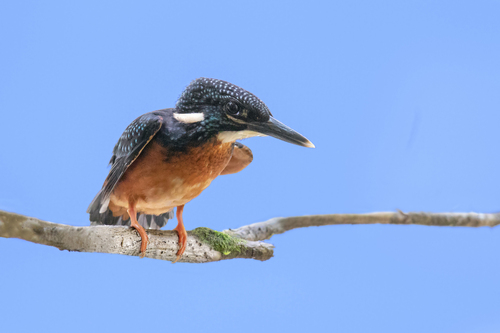
(c) Henry Koh, some rights reserved (CC BY) · cc-by
Species
Near ThreatenedBlyth's Kingfisher
species
via IUCN
Wikidata facts
Show 8 more facts
- taxon rank
- species
- IUCN conservation status
- Near Threatened
- taxon name
- Alcedo hercules
- Commons category
- Alcedo hercules
- taxon common name
- guarda-rios-grande
- litter size
- 4.9
- endemic to
- Eaglenest Wildlife Sanctuary
- taxon range
- Nanling Mountains
Sources (3)
via Wikidata · CC0
~8 min read
Encyclopedic overview
Blyth's kingfisher (Alcedo hercules) is the largest kingfisher in the genus Alcedo. Named for Edward Blyth, the species has also been known as Alcedo grandis and as the great blue kingfisher. Between 22 and 23 cm (8+5⁄8 and 9 in) long, the kingfisher has deep rufous underparts with a blackish blue breast patch, and brilliant cobalt blue or azure upperparts, tinged with purple. The wings are a dark blackish green, with blue speckles and tips to some of the feathers. The bill of the male is entirely black, while the female has a dark red lower mandible. The species is distinguished from the similar blue-eared kingfisher (Alcedo meninting) and common kingfisher (Alcedo atthis) by its greater size, heavy black bill, and dark lores.
The species breeds between the months of March and June. It builds nests at the end of tunnels dug in the banks of streams or ravines. Four to six eggs are laid, with both sexes incubating. A shy bird, it frequents small waterways, feeding on fish and insects caught by diving from a shrub close to the water. It is found along streams in evergreen forest and adjacent open country between 200 and 1,200 m (660 and 3,900 ft), mainly between 400 and 1,000 m (1,300 and 3,300 ft). The species ranges from Nepal through India, Bangladesh, Bhutan, China, Myanmar, Thailand, Laos, and Vietnam. Even within its preferred habitat the density of the species is low, and the population, though not thoroughly surveyed, is believed to be small, and declining further. The International Union for Conservation of Nature classifies it as "near threatened".
Excerpted from Wikipedia’s “Blyth's Kingfisher” article, available under the CC BY-SA 4.0 licence.