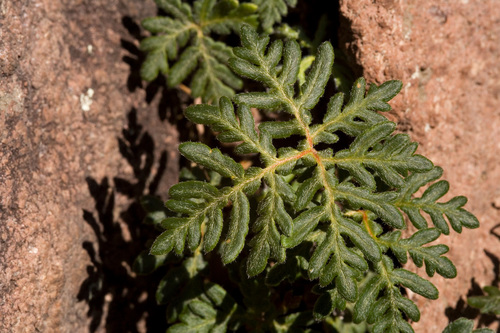
no rights reserved · cc0
Bommeria
Sign in to saveBommeria is a genus of small pteridaceous rock ferns, native to the New World. Genetic analysis has shown it to be a stem offshoot clade of all the cheilanthoid ferns (in family Pteridaceae), except for Doryopteris, which is an even more basal ("primitive") stem offshoot. for years, it was assumed that this genus was closely allied with Hemionitis, but genetic analysis has shown that genus to be a more advanced genus evolutionarily. The same set of analysis has shown many presumed genera within this family to be paraphyletic, but the small genus Bommeria appears to be monophyletic, or a natura
Species
copper fern
GENUS
- KingdomPlantae
- PhylumTracheophyta
- ClassPolypodiopsida
- OrderPolypodiales
- FamilyPteridaceae
via GBIF · Kew POWO
Museum specimens
- Specimen records
- 30
- With media
- 22
- Family
- Pteridaceae
- Collections
- IBUNAM, ANSP, MO, RSA, VT, NHMUK
- Recorded in
- Mexico, Bolivia, United States, Guatemala
Wikidata facts
- Instance of
- taxon
- Parent taxon
- Cheilanthoideae
- Image
- Garden and forest; a journal of horticulture, landscape art and forestry (1891) (14784131045).jpg
Show 6 more facts
- taxon rank
- genus
- taxon name
- Bommeria
- topic's main category
- Category:Bommeria
- Commons category
- Bommeria
- taxon common name
- bommeria fern
Sources (1)
via Wikidata · CC0
~3 min read
Encyclopedic overview
3 sectionsContents
- Phylogeny
- References
- Further reading
Bommeria is a genus of small pteridaceous rock ferns, native to the New World. Genetic analysis has shown it to be a stem offshoot clade of all the cheilanthoid ferns (in family Pteridaceae), except for Doryopteris, which is an even more basal ("primitive") stem offshoot. for years, it was assumed that this genus was closely allied with Hemionitis, but genetic analysis has shown that genus to be a more advanced genus evolutionarily. The same set of analysis has shown many presumed genera within this family to be paraphyletic, but the small genus Bommeria appears to be monophyletic, or a natural genus.
Bommeria is a "gymnogrammoid" fern, exhibiting unprotected sori aligned along veins on the undersides of the fronds. This is why it was assumed to be closely allied to Hemionitis. Such a feature is strongly at odds with most pteridoid ferns (Pteridaceae), which typically have linear marginal sori with an indusium, and sometimes protected with a reflexed leaf tissue margin. Apparently, this is a trait that can arise independently, and may be an atavistic trait.
Excerpted from Wikipedia’s “Bommeria” article, available under the CC BY-SA 4.0 licence.