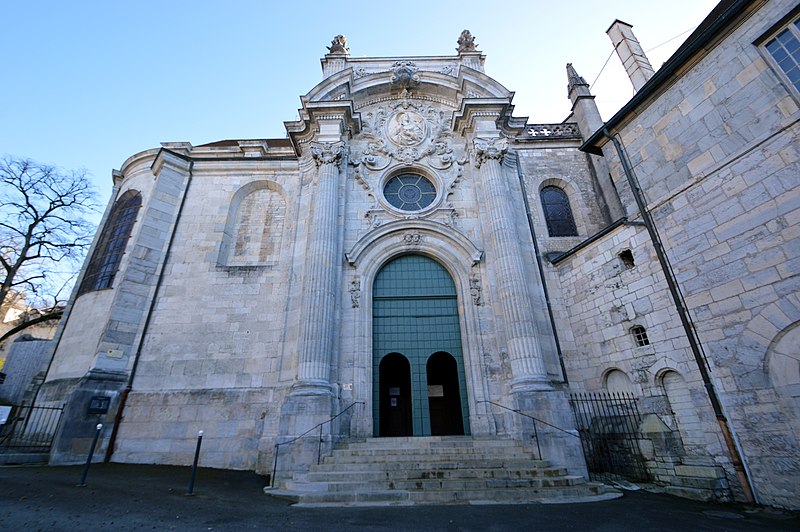
File:Besançon,_la_cathédrale_Saint-Jean_;_portail_nord.jpg · Wikimedia Commons · See Wikimedia Commons
Bourgogne-Franche-Comté
Sign in to saveAlso known as Burgundy-Free County, Burgundy-Franche-Comté, BFC
Bourgogne-Franche-Comté (; , sometimes abbreviated BFC; Arpitan: Borgogne-Franche-Comtât) is a region in northeastern France created by the 2014 territorial reform of French regions, from a merger of Burgundy and Franche-Comté. The new region came into existence on 1 January 2016, after the regional elections of December 2015, electing 100 members to the Regional Council of Bourgogne-Franche-Comté.
Bourgogne-Franche-Comté is a region in northeastern France that was created in 2016 by merging two former regions, Burgundy and Franche-Comté, as part of a nationwide restructuring of French administrative divisions. The merged region began operating on January 1, 2016, with a Regional Council of 100 elected members following elections held in December 2015.
AI-generated from the Wikipedia summary — may contain errors.
Key facts
- Settlement.official_name
- Bourgogne-Franche-Comté
- Settlement.native_name_lang
- fr
- Settlement.settlement_type
- Region
- Settlement.image_caption
- Clockwise from top: the Cathedral of Saint John in Besançon; the Théâtre de Lons-le-Saunier; the Loire Bridge and the Cathedral in Nevers; and view of Dijon
- Settlement.image_flag
- Flag_of_the_region_Bourgogne-Franche-Comté.svg
- Settlement.flag_size
- 120px
- Settlement.image_shield
- Blason région fr Bourgogne-Franche-Comté.svg
- Settlement.image_blank_emblem
- Bourgogne-Franche-Comté 2016.svg
- Settlement.blank_emblem_type
- Brandmark
- Settlement.image_map
- Bourgogne-Franche-Comté in France 2016.svg
- Settlement.subdivision_type
- Country
- Settlement.seat_type
- Regional council seat
- Settlement.seat
- Besançon
- Settlement.seat1_type
- Prefecture
- Settlement.seat1
- Dijon
- Settlement.parts_type
- Departments
- Settlement.parts_style
- list
- Settlement.parts
- 8
via Wikipedia infobox
Wikidata facts
- Instance of
- region of France
- Official name
- Bourgogne-Franche-Comté
- Country
- France
- Located in
- metropolitan France
- Contains
- Territoire de Belfort
- Capital
- Dijon
- Population
- 2802670
- Area
- 47784
- Shares border with
- Canton of Vaud
- Official website
- www.bourgognefranchecomte.fr
- Image
- Belvoir, le château.jpg
Show 13 more facts
- category for people who died here
- Category:Deaths in Bourgogne-Franche-Comté
- category of associated people
- Category:People from Bourgogne-Franche-Comté
- native label
- Bourgogne-Franche-Comté
- inception
- 2016-01-01
- category for people born here
- Category:People born in Bourgogne-Franche-Comté
- Commons category
- Bourgogne-Franche-Comté
- topic's main category
- Category:Bourgogne-Franche-Comté
- Commons gallery
- Bourgogne-Franche-Comté
- start time
- 2016-01-01
- annual number of weddings
- 9665
- social media followers
- 9744
- P11012
- Neugraben-Fischbek
- number of viewers/listeners
- 5473962
via Wikidata · CC0
~6 min read
Encyclopedic overview
14 sectionsContents
- Toponymy
- History
- Middle Ages
- Modern times
- Geography
- Departments
- Major communities
- Economy
- Transport
- Air
- Gallery
- See also
- References
- External links
Bourgogne-Franche-Comté (; , sometimes abbreviated BFC; Arpitan: Borgogne-Franche-Comtât) is a region in northeastern France created by the 2014 territorial reform of French regions, from a merger of Burgundy and Franche-Comté. The new region came into existence on 1 January 2016, after the regional elections of December 2015, electing 100 members to the Regional Council of Bourgogne-Franche-Comté.
The region covers an area of and eight departments; it had a population of 2,811,423 in 2017. Its prefecture and largest city is Dijon, although the regional council sits in Besançon, making Bourgogne-Franche-Comté one of two regions in France (along with Normandy) in which the prefect does not sit in the same city as the regional council.
Excerpted from Wikipedia’s “Bourgogne-Franche-Comté” article, available under the CC BY-SA 4.0 licence.
Gallery (13)
Available in 91 languages
- Español
- Français
- Deutsch
- 中文
- 日本語
- Русский
- Português
- Italiano
- العربية
- Afrikaans
- Albanian
- Albanian
- Aragonese
- Armenian
- Arpitan
- Asturian
- azb
- Azerbaijani
Show 72 more
- Bahasa Indonesia
- Balinese
- Basque
- be_x_old
- Belarusian
- Breton
- Bulgarian
- Burmese
- Catalan
- Cebuano
- Chechen
- Crimean Tatar
- Croatian
- Czech
- Danish
- Egyptian Arabic
- Esperanto
- Estonian
- Finnish
- Galician
- Greek
- Hausa
- Hebrew
- Hungarian
- Icelandic
- Ido
- Interlingue
- Kazakh
- Kurdish
- Latin
- Latvian
- Limburgish
- Lithuanian
- lld
- Luxembourgish
- Marathi
- Mongolian
- Nederlands
- Northern Frisian
- Norwegian
- Norwegian Nynorsk
- Occitan
- Ossetic
- Picard
- Piedmontese
- Polski
- Romanian
- Sardinian
- Scots
- Serbian
- Serbian (Latin)
- simple
- Slovak
- Slovenian
- Svenska
- Tatar
- Tiếng Việt
- Türkçe
- Ukrainian
- Urdu
- Venetian
- Waray
- Welsh
- West Flemish
- Western Frisian
- Wu Chinese
- Zaza
- Zeelandic
- zh_yue
- فارسی
- ไทย
- 한국어
via Wikidata sitelinks · CC0