Brabejum · Kew POWO · Kew Plants of the World Online
Brabejum
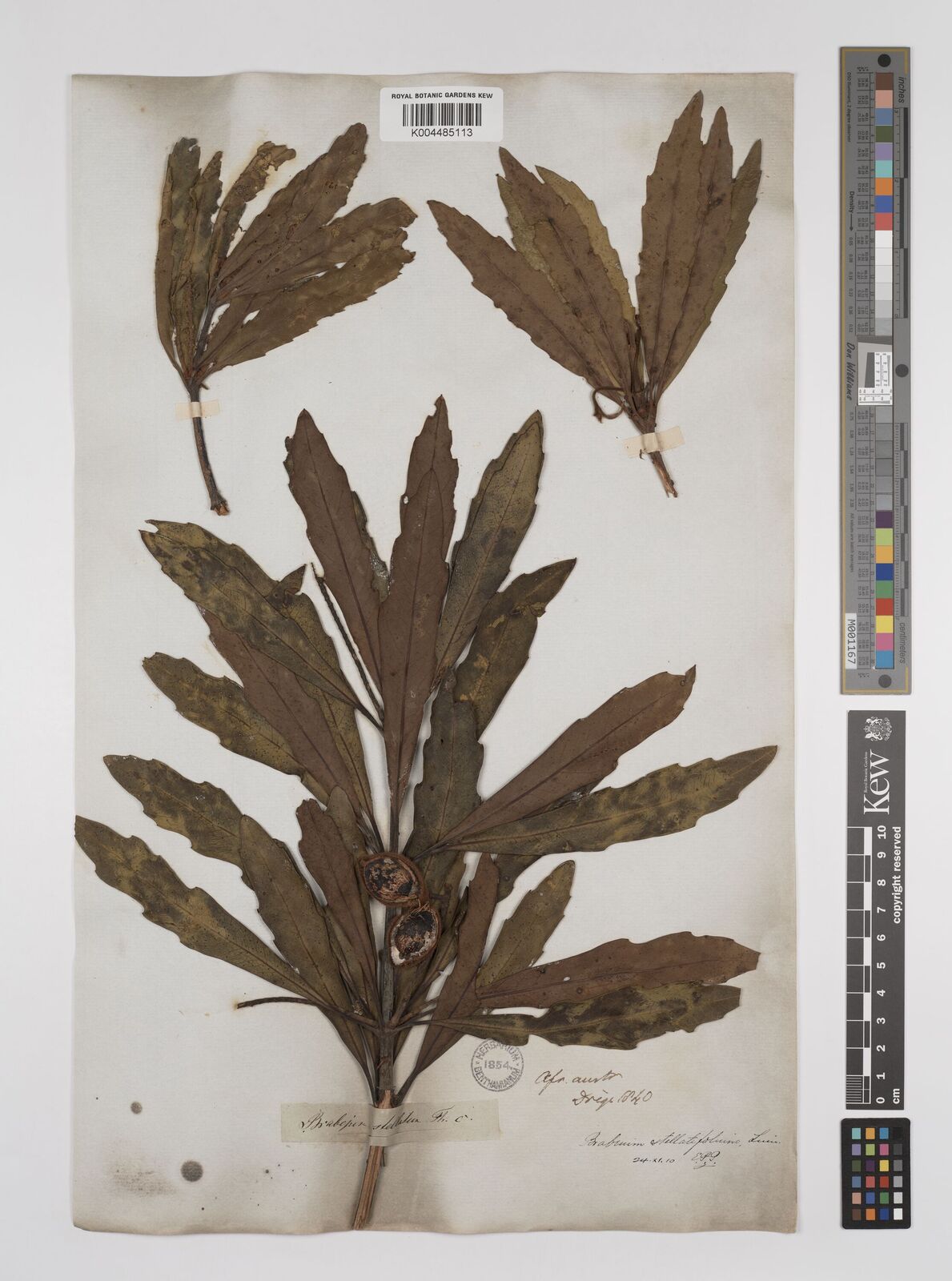
Sign in to saveBrabejum is a genus of a single species of large evergreen tree, Brabejum stellatifolium in the family Proteaceae, commonly called wild almond, bitter almond or ghoeboontjie. It is restricted in the wild to South Africa's Western Cape province, where it grows in thickets along the banks of streams. The plant is of botanical interest as being Africa's only member of the large grevilleoid subfamily. It is a bushy small tree with branches widely at ground level and numerous erect vigorous stems. Leaves grow up to 6 in (15 cm) long, narrow and bluntly toothed, appear at intervals along the br
Species
GENUS
- KingdomPlantae
- PhylumTracheophyta
- ClassMagnoliopsida
- OrderProteales
- FamilyProteaceae
via GBIF · Kew POWO
Museum specimens
- Specimen records
- 3
- With media
- 1
- Family
- Proteaceae
- Collections
- MO, VT, B
- Recorded in
- South Africa
Wikidata facts
- Instance of
- taxon
- Parent taxon
- Proteaceae
- Image
- Brabejum stellatifolium tree in flower - Cape Town 6.JPG
Show 6 more facts
- taxon name
- Brabejum
- taxon rank
- genus
- taxonomic type
- Brabejum stellatifolium
- topic's main category
- Category:Brabejum
- Commons category
- Brabejum
Sources (1)
via Wikidata · CC0
~7 min read
Encyclopedic overview
7 sectionsContents
- Name
- Appearance
- Distribution
- Growing ''Brabejum''
- Gallery
- References
- External links
Brabejum is a genus of a single species of large evergreen tree, Brabejum stellatifolium in the family Proteaceae, commonly called wild almond, bitter almond or ghoeboontjie. It is restricted in the wild to South Africa's Western Cape province, where it grows in thickets along the banks of streams. The plant is of botanical interest as being Africa's only member of the large grevilleoid subfamily. It is a bushy small tree with branches widely at ground level and numerous erect vigorous stems. Leaves grow up to 6 in (15 cm) long, narrow and bluntly toothed, appear at intervals along the branches, mostly in whorls of 6. In summer, the plant bears white flowers densely crowded on spikes arising from rusty buds at the leaf axils. The fruits to 2 in (5 cm) long, magenta to reddish brown, similar to an almond, appear in autumn. The nut is too bitter to eat; however, in earlier times it was boiled, roasted, and ground to make a "coffee" drink.
This tree has special significance in Cape Town's heritage, as it was used to make Van Riebeeck's Hedge—the Cape's first formal boundary. Parts of this original hedge can still be seen growing today at Kirstenbosch.
Excerpted from Wikipedia’s “Brabejum” article, available under the CC BY-SA 4.0 licence.