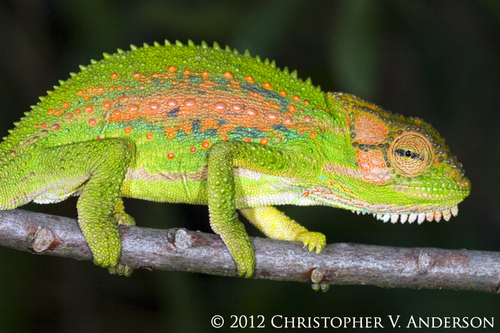
(c) Chris Anderson, all rights reserved, uploaded by Chris Anderson
Bradypodion
Sign in to saveBradypodion (meaning "slow-footed" in Greek) is a genus of chameleons in the family Chamaeleonidae, collectively called South African dwarf chameleons. All species are found in South Africa and most are endemic to this country, but a few can also be found in Eswatini, Lesotho, southernmost Namibia and possibly southernmost Mozambique. They are quite small chameleons where the different species often can be difficult to separate by appearance, although exact location (each species tends to have a rather small distribution) and the intense breeding colours of males are useful for their identific
Species
Cape Dwarf Chameleon
GENUS
- KingdomAnimalia
- PhylumChordata
- ClassSquamata
- FamilyChamaeleonidae
種 參內文 侏儒變色龍,又名侏儒避役,是侏儒蜥屬(Bradypodion)下的變色龍。牠們分佈在南部非洲,一些在東非及中非的細小變色龍有時也會被分類在此,但並沒有得到廣泛接受。 物種 B. atromontanum 川斯凱侏儒變色龍(B. caffrum) B. damaranum B. dracomontanum' 松果角變色龍 (B. fischeri ) 羅伯森侏儒變色龍(B. gutturale):可能是多個物種。 南非台地侏儒變色龍(B. karrooicum) B. kentanicum 黑頭侏儒變色龍(B. melanocephalum) 祖魯蘭侏儒變色龍(B. nemorale):可能是多個物種。 B. occidentale 西開普侏儒變色龍(B. pumilum) 剎泰路侏儒變色龍(B. setaroi) 史密夫侏儒變色龍(B. taeniabronchum) 夸祖魯侏儒變色龍(B. thamnobates) B. transvaalense 南方侏儒變色龍(B. ventrale) 分類 侏儒蜥屬的定界曾引發一些討論。大部份物種都似乎可以從形態特徵來分辨,此屬曾一度作為分佈在撒哈拉以南非洲及擁有半陽徑祖徵的細小變色龍的無效分類。[1][2]另外,很多現今的物種都被降級為亞種。[3]故此這個分類被受駁斥[2][4],不過一些物種仍能以形態[5]及粒線體DNA來分辨。[4] 侏儒變色龍的種系發生學及生物地理學較為一致。西開普侏儒變色龍及B. damaranum是分支的基底,但彼此關係不明。牠們之間似乎比其他物種更為接近,但整體上卻很疏遠。牠們散佈在西開普省海岸及東開普省西部,棲息在多種環境。牠們的祖徵包括體型很大,呈突出的綠色,及有長的尾巴。[4] 其餘的物種組成了一個分支,且可以分為小群。一群是源自德拉肯斯堡山脈,包括北部的B. dracomontanum、南部的B. transvaalense及在東南部未描述的物種。牠們的體型及習性都是祖徵。[4]另一群是在東開普省至誇祖魯-納塔爾省中部,介乎吉爾博森林(Gilboa Forest)及圖蓋拉河之間,包括夸祖魯侏儒變色龍、黑頭侏儒變色龍及在吉爾博森林內的新物種。這群可能是近期演化自單一祖先。[4] 在南非乾旱臺地棲息著一些稍大及神秘的物種。在B. kentanicum及南方侏儒變色龍之間似乎有一定的基因流由北開普省至東開普省的海岸。接近滅絕的史密夫侏儒變色龍較為接近此類,而羅伯森侏儒變色龍及在斯瓦特山脈未描述的群落則較為疏遠。[2][4]羅伯森侏儒變色龍本身可能是一個隱藏複合種群。B. occidentale是最後一種分佈在乾旱地區的物種,與其他的物種較為疏遠。 其他棲息在森林陡坡及灌木林的物種,都像黑頭侏儒變色龍及史密夫侏儒變色龍般細小。不過由於牠們之間的分野,其形態可以是趨同演化的適應
via GBIF
Museum specimens
- Specimen records
- 42
- With media
- 4
- Family
- Chamaeleonidae
- Collections
- TM, BYU, AMNH, NRM, NHMUK, ANSP
- Recorded in
- South Africa, Congo, The Democratic Republic Of The, Namibia
Wikidata facts
- Instance of
- taxon
- Parent taxon
- Chamaeleoninae
- Image
- Bradypodion gutturale.jpg
Show 4 more facts
- taxon rank
- genus
- Commons category
- Bradypodion
- taxon name
- Bradypodion
- topic's main category
- Category:Bradypodion
Sources (1)
via Wikidata · CC0
~9 min read
Encyclopedic overview
5 sectionsContents
- Species
- Undescribed species
- Systematics
- Footnotes
- References
Bradypodion (meaning "slow-footed" in Greek) is a genus of chameleons in the family Chamaeleonidae, collectively called South African dwarf chameleons. All species are found in South Africa and most are endemic to this country, but a few can also be found in Eswatini, Lesotho, southernmost Namibia and possibly southernmost Mozambique. They are quite small chameleons where the different species often can be difficult to separate by appearance, although exact location (each species tends to have a rather small distribution) and the intense breeding colours of males are useful for their identification. They are arboreal, but some species are mostly found low in the vegetation.
Bradypodion feed on small invertebrates, especially insects. They rapidly reach sexual maturity, typically at an age between half a year and one year, but sometimes up to two years. Adult males are territorial. It is the only genus of chameleon where females of all species give birth to live young rather than lay eggs (the only other chameleons that give birth to live young are certain Trioceros species). This is likely an adaption to the relatively cold climate of southern Africa in comparison to tropical Africa. Colder temperatures slow the development of eggs laid in the ground; when instead retained inside the body until birth, a female can actively sun bask to increase the temperature. A female can give birth to up to 20 young per time, twice or rarely even three times in a year.
Excerpted from Wikipedia’s “Bradypodion” article, available under the CC BY-SA 4.0 licence.