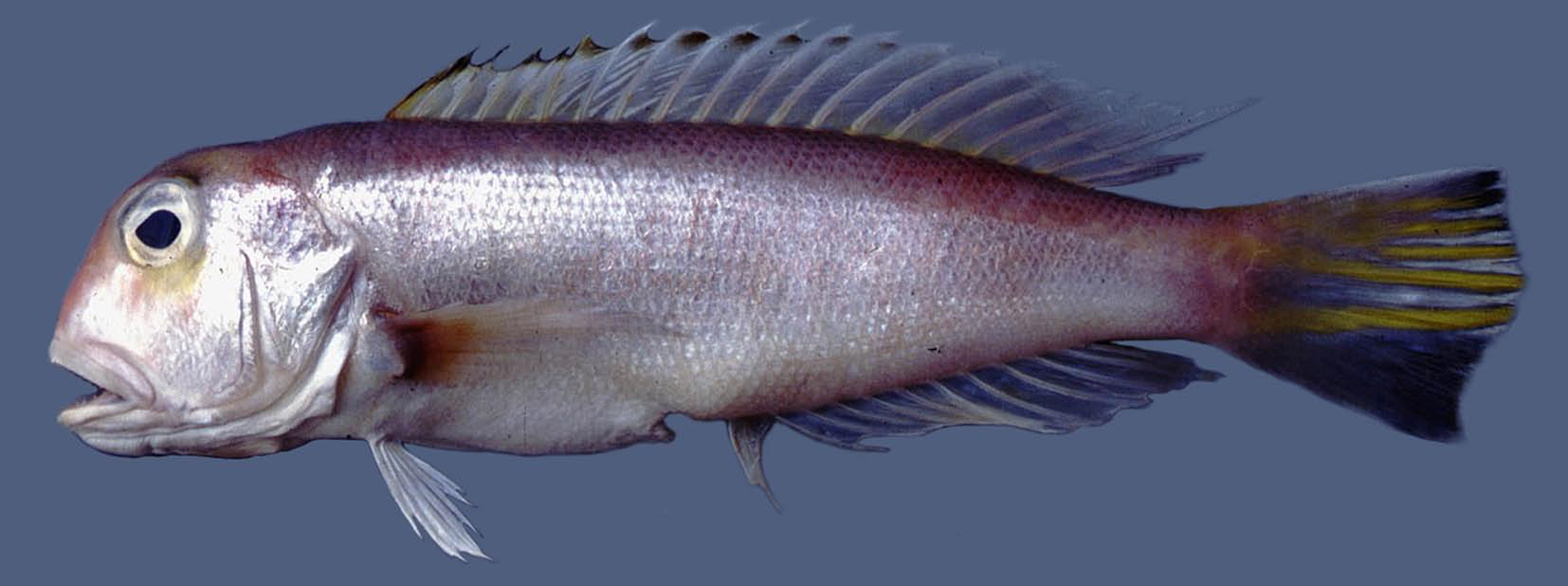
Hiramatsu, Wataru;Vinh, Chu Tien;Endo, Hiromitsu
Branchiostegus
Sign in to saveBranchiostegus is a genus of marine ray-finned fishes, tilefishes, belonging to the family Malacanthidae. They are found in the eastern Atlantic Ocean through the Indian Ocean to the western Pacific Ocean. Here they create burrows in soft substrates in the comparatively deep waters of the continental shelf and slope.
Species
アマダイ属
GENUS
- KingdomAnimalia
- PhylumChordata
- ClassTeleostei
- OrderPerciformes
- FamilyMalacanthidae
via GBIF
Museum specimens
- Specimen records
- 67
- With media
- 5
- Family
- Malacanthidae
- Collections
- USNM, AM, WAM, LACM, CAS
- Recorded in
- Philippines, Australia, Egypt, China, Indonesia, United States
Wikidata facts
- Instance of
- taxon
- Image
- Akaamadai0905.jpg
Show 5 more facts
- Commons category
- Branchiostegus
- taxon name
- Branchiostegus
- taxon rank
- genus
- topic's main category
- Category:Branchiostegus
- taxon common name
- Tilefish
Sources (1)
via Wikidata · CC0
~3 min read
Encyclopedic overview
4 sectionsContents
- Characteristics
- Species
- Systematics
- References
Branchiostegus is a genus of marine ray-finned fishes, tilefishes, belonging to the family Malacanthidae. They are found in the eastern Atlantic Ocean through the Indian Ocean to the western Pacific Ocean. Here they create burrows in soft substrates in the comparatively deep waters of the continental shelf and slope.
==Characteristics== Branchiostegus tilefishes have a rectangular body shape with a square profile to the head. They have a raised seam situated to the anterior of the dorsal fin, this can be reduced but it is always there. They have a body which is around four times as long as it is deep. There are fine serrations on the preopercular upper arm while its lower arm has very few or no serrations and there is no spine at its angle. The operculum has a single flexible, blunt spine. The mouth is slightly angled and extend to the front of the eye. The dorsal and anal fins are long and unbroken. The dorsal fin has 6 to 8 spines, typically 7 and 14 to 16, normally 15, soft rays. The anal fin contains 2 spines and 11 to 13, typically 12, soft rays. The caudal fin is rounded, truncate, or double emarginate and sometimes has elongated tips. They have pelagic larvae which have many spines on their heads and serrated ridges.
Excerpted from Wikipedia’s “Branchiostegus” article, available under the CC BY-SA 4.0 licence.
Gallery (2)
Available in 14 languages
via Wikidata sitelinks · CC0