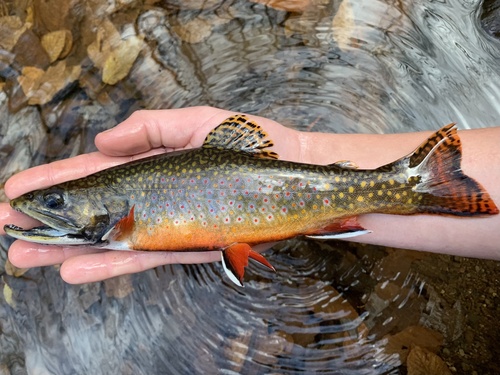
(c) Cody Cromer, some rights reserved (CC BY-NC), uploaded by Cody Cromer · cc-by-nc
Brook trout
Sign in to saveAlso known as Salvelinus fontinalis, specklebelly, mud trout, square-tail, speckled trout
species of fish
OverviewAI-generated
The brook trout, scientifically named *Salvelinus fontinalis*, is a species within the genus *Salvelinus*. It belongs to the family Salmonidae and the order Salmoniformes. The organism is classified under the class Teleostei and the phylum Chordata, with an authority citation of (Mitchill, 1814). Its taxonomic status is accepted.
This fish inhabits marine, brackish, and freshwater environments. It is also referred to by the common names brook charr, puronieriä, siven americký, and bronforel. The IUCN Red List assessed its conservation status as Least Concern in 2024.
Synthesized by Vinony from 25 facts across 5 sources: Wikidata, IUCN Red List, iNaturalist, WoRMS, Vinony graph. Generated from structured data (not the Wikipedia text) and checked against those facts — may still contain errors.
Species
Least Concernbrook charr
Species
- PhylumChordata
- ClassTeleostei
- OrderSalmoniformes
- FamilySalmonidae
Maximum longevity: 24 years (wild) Observations: Environmental factors impact greatly on the lifespan of these animals (Das 1994).
via IUCN
Wikidata facts
- Instance of
- taxon
- Parent taxon
- Salvelinus
- Image
- Brook Trout Salvelinus fontinalis 2900px.jpg
Show 6 more facts
- Commons category
- Salvelinus fontinalis
- taxon rank
- species
- taxon name
- Salvelinus fontinalis
- Commons gallery
- Salvelinus fontinalis
- taxon common name
- pstrąg źródlany
- IUCN conservation status
- Least Concern
via Wikidata · CC0
~23 min read
Encyclopedic overview
The brook trout (Salvelinus fontinalis) is a species of freshwater fish in the char genus Salvelinus of the salmon family Salmonidae native to Eastern North America in the United States and Canada. Two ecological forms of brook trout have been recognized by the US Forest Service. One ecological form is long-lived potamodromous populations in Lake Superior known as coaster trout or coasters. The second ecological form is the short-living predaceous anadromous populations which are found in northern lakes and coastal rivers from Long Island to Hudson Bay, which are referred to as salters. In parts of its range, it is also known as the eastern brook trout, speckled trout, brook char (or charr), squaretail, brookie, or mud trout, among others. Adult coaster brook trout are capable of reaching sizes over 2 feet in length and weigh up to 6.8 kg (15 lb), whereas adult salters average between 6 and 15 inches in length and weigh between 0.5 and 2.3 kg (1 and 5 lb). The brook trout is characterized by its distinctive olive-green body with yellow and blue-rimmed red spots, white and black edged orange fins, and dorsal vermiculation. The diet of the brook trout is restrictive to the season and location of the fish, but will typically consist of terrestrial and aquatic insects, fry, crustaceans, zooplankton, and worms.
Throughout history, non-native brook trout have been transplanted beyond its native borders, where it has spread across North America and much of the world. These brook trout have been introduced since the 1800s by means of artificial propagation and aquaculture in hope of promoting fishery resources. Through this transplantation, brook trout have been observed to affect native populations by outcompeting, preying upon, and hybridizing with many native aquatic species. This invasive nature via human-mediated introductory has led to their classification in the list of the top 100 globally invasive species.
Excerpted from Wikipedia’s “Brook trout” article, available under the CC BY-SA 4.0 licence.