File:Sucre_blanc_cassonade_complet_rapadura.jpg · Wikimedia Commons · See Wikimedia Commons
brown sugar
Sign in to saveAlso known as cassonade, soft brown sugar, brown caster sugar
form of sucrose
Key facts
- Energy
- 380 kcal (1,600 kJ)
- Carbohydrates
- 98 g
- Sugars sucrose glucose
- 97 g 95 g 1 g
- Dietary fiber
- 0 g
- Fat
- 0 g
- Protein
- 0.1 g
- Vitamins
- Quantity Percentage of Daily Value</span>"}]]}'> %DV
- Niacin b 3
- 1% 0.11 mg
- Pantothenic acid b 5
- 3% 0.132 mg
- Vitamin b 6
- 2% 0.041 mg
- Folate b 9
- 0% 1 μg
- Minerals
- Quantity Percentage of Daily Value</span>"}]]}'> %DV
- Calcium
- 6% 83 mg
- Copper
- 5% 0.047 mg
- Iron
- 4% 0.71 mg
- Magnesium
- 2% 9 mg
- Manganese
- 3% 0.064 mg
- Phosphorus
- 0% 4 mg
via Wikipedia infobox
Nutrition · Open Food Facts
Typical values per 100 g · averaged across 101 products
- Energy
- 316 kcal
- Fat
- 0 g
- — of which saturates
- 0 g
- Carbohydrates
- 83.5 g
- — of which sugars
- 70.3 g
- Fibre
- 0 g
- Protein
- 0 g
- Salt
- 0.08 g
via Open Food Facts · ODbL
Wikidata facts
- Instance of
- food
- Image
- Brown sugar examples.JPG
Show 3 more facts
- color
- brown
- Commons category
- Brown sugar
- exact match
- purl.obolibrary.org/obo/ENVO_00003971
Sources (2)
via Wikidata · CC0
~13 min read
Encyclopedic overview
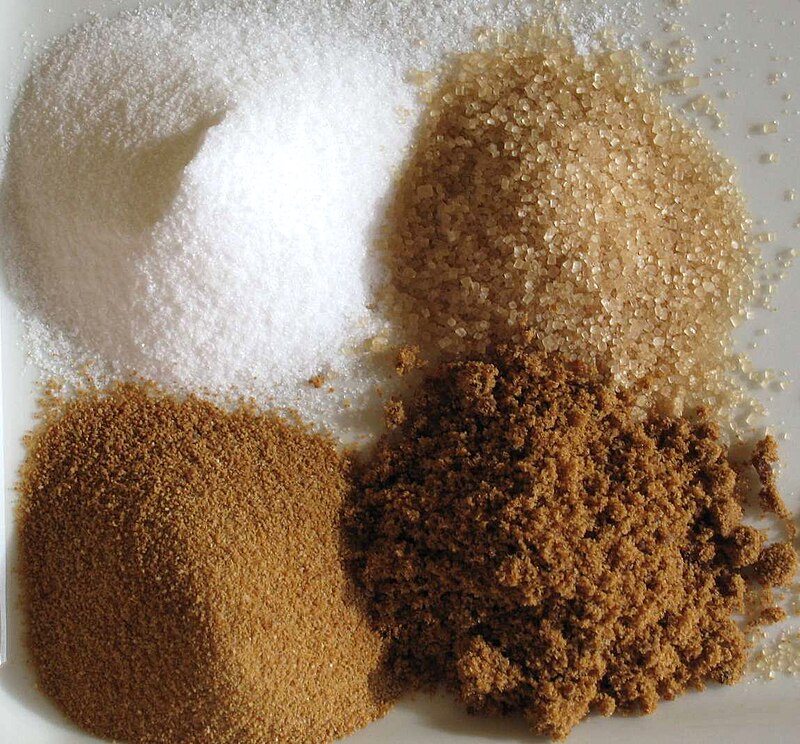
Clockwise from top left: White refined, unrefined, brown, and unprocessed cane sugars Brown sugar crystals
Brown sugar is a sucrose sugar product with a distinctive brown color due to the presence of molasses. It is either an unrefined or partially refined soft sugar consisting of sugar crystals with some residual molasses content, or produced by the addition of molasses to refined white sugar. Brown sugar is 98% carbohydrates (95% as sucrose), containing no dietary fiber or fat, and negligible protein and micronutrient content.
Excerpted from Wikipedia’s “brown sugar” article, available under the CC BY-SA 4.0 licence.