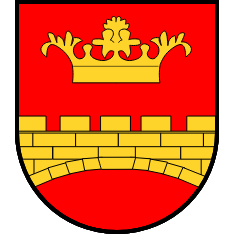
Official website (http://www.bruckneudorf.eu/)
Bruckneudorf
Sign in to saveBruckneudorf () is a small town in the district of Neusiedl am See in the federal state of Burgenland in Austria, neighbouring Bruck an der Leitha ("Leitha Bridge"). Its name means bridge new village, whereas the Hungarian version means royal bridge, and the royal refers to King Francis I. Historically and geographically, Bruckneudorf represents the extension of the Austrian town of Bruck an der Leitha over the Austrian border into Hungary. This border, symbolised by the river Leitha, separated the Austrian Empire from the Kingdom of Hungary (Cisleithania and Transleithania). Its main current
Key facts
- Settlement.elevation_m
- 150
- Settlement.name
- Bruckneudorf
- Settlement.settlement_type
- Municipality
- Settlement.image_skyline
- Gemeindeamt 5904 in A-2460 Bruckneudorf.jpg
- Settlement.image_caption
- Municipal office
- Settlement.image_shield
- AUT Bruckneudorf COA.svg
- Settlement.shield_size
- 80x110px
- Settlement.pushpin_map
- Austria
- Settlement.pushpin_mapsize
- 270
- Settlement.pushpin_map_caption
- Location within Austria
- Settlement.map_caption
- Location within Neusiedl am See district
- Settlement.subdivision_type
- Country
- Settlement.subdivision_name
- Austria
- Settlement.subdivision_type1
- State
- Settlement.subdivision_name1
- Burgenland
- Settlement.subdivision_type2
- District
- Settlement.subdivision_name2
- Neusiedl am See
- Settlement.parts_style
- para
via Wikipedia infobox
Official website
Großgemeinde Bruckneudorf-Kaisersteinbruch - Großgemeinde Bruckneudorf-Kaisersteinbruch
Bruckneudorf (ungarisch Királyhida, Bruckújfalu, Bruck-Újfalu; auch Bruckneudorf-Kaisersteinbruch) ist eine Gemeinde mit 3069 Einwohnern (Stand 1. Jänner 2024) im Burgenland., Bruckneudorf (ungarisch Királyhida, Bruckújfalu, Bruck-Újfalu; auch Bruckneudorf-Kaisersteinbruch) ist eine Gemeinde mit 3069 Einwohnern (Stand 1. Jänner 2024) im Burgenland.
bruckneudorf.eu →Das archäologische Museum befindet sich am Gemeindeamt im 1. Stock. Es widmet sich den Kelten, Römern und Awaren in Bruckneudorf, ausgestellt werden aufsehenerregende Funde archäologischer Grabungen, die zwischen 2005 und 2022 im Umfeld der römischen Palastanlage („Kaiservilla“ ) durchgeführt wurden.
Read more on their site →Excerpt from the official site · 4,327 chars · not written by Vinony
Wikidata facts
- Instance of
- human settlement
- Official name
- Bruckneudorf
- Country
- Austria
- Located in
- Neusiedl am See District
- Population
- 3026
- Area
- 36.67
- Elevation
- 150
- Time zone
- UTC+02:00
- Official website
- www.bruckneudorf.eu
- Image
- Kaiser-Franz-Joseph Denkmal, Bruckneudorf 02.jpg
- Dialing code
- 0 21 62
- Licence plate code
- ND
Show 4 more facts
- Commons category
- Bruckneudorf
- email address
- mailto:[email protected]
- postal code
- 2460
- P8168
- Gmina Raszków
Sources (6)
via Wikidata · CC0
~2 min read
Encyclopedic overview
6 sectionsContents
- History
- Climate
- Population
- Economy and infrastructure
- Transport
- References
Bruckneudorf () is a small town in the district of Neusiedl am See in the federal state of Burgenland in Austria, neighbouring Bruck an der Leitha ("Leitha Bridge"). Its name means bridge new village, whereas the Hungarian version means royal bridge, and the royal refers to King Francis I. Historically and geographically, Bruckneudorf represents the extension of the Austrian town of Bruck an der Leitha over the Austrian border into Hungary. This border, symbolised by the river Leitha, separated the Austrian Empire from the Kingdom of Hungary (Cisleithania and Transleithania). Its main current national significance derives from the Bruckneudorf military exercise ground of the Austrian federal army. Currently it is also the site of Bruck an der Leitha railway station, an important railway station near the borders with Hungary and Slovakia, a stop for nearly all the international trains that pass through it.
== History == Together with the rest of Burgenland, the municipality was in Hungary (under the name of German West Hungary) until 1920/21. From 1898, although a largely German speaking area, it was required to take the Hungarian name of Királyhida as part of the Hungarian language policy of the national government in Budapest. After World War I, under the treaties of St. Germain and Trianon, German West Hungary was transferred to Austria (see History of Burgenland). In Roman times the area was already densely populated, and Villa Bruckneudorf, one of the most important Roman villas to be discovered in Eastern Austria, is a few kilometres to the east.
Excerpted from Wikipedia’s “Bruckneudorf” article, available under the CC BY-SA 4.0 licence.
On the map
2 mapped locations