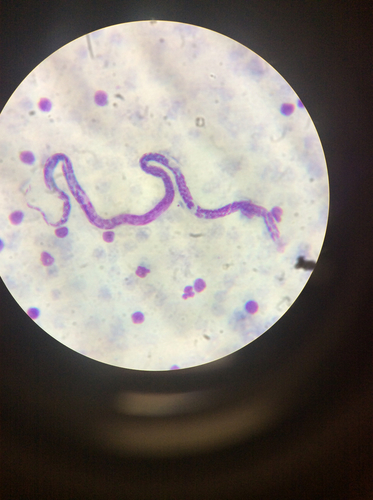
(c) Laura Mahecha (SaracuraGcb), all rights reserved, uploaded by Laura Mahecha (SaracuraGcb)
Brugia
Sign in to saveBrugia is a genus for a group of small roundworms. They are among roundworms that cause the parasitic disease filariasis. Specifically, of the five species known, Brugia malayi and Brugia timori cause lymphatic filariasis in humans; and Brugia pahangi and Brugia patei infect domestic cats, dogs and other animals. Brugia buckleyi specifically infects the Indian hare (Lepus nigricollis singhala). They are transmitted by the bite of mosquitos.
Species
GENUS
- KingdomAnimalia
- PhylumNematoda
- ClassChromadorea
- OrderRhabditida
- FamilyOnchocercidae
via GBIF
Museum specimens
- Specimen records
- 14
- With media
- 1
- Family
- Onchocercidae
- Collections
- USNM, NHMUK
- Recorded in
- United States, Guyana, Kenya
Research
3,284 papers- Current Status of the Diagnosis of Brugia spp. Infections.Pathogens (Basel, Switzerland) · 2024
- Zoonotic Brugia infections in North and South America.The American journal of tropical medicine and hygiene · 1989
- Anthelmintic resistance and homeostatic plasticity (Brugia malayi).Scientific reports · 2021
- Lymphatic filariasis and Brugia timori: prospects for elimination.Trends in parasitology · 2004
- The genome of Brugia malayi - all worms are not created equal.Parasitology international · 2009
via PubMed
Wikidata facts
- Instance of
- taxon
- Parent taxon
- Onchocercidae
- Image
- Brugia malayi.JPG
Show 3 more facts
- taxon name
- Brugia
- taxon rank
- genus
- Commons category
- Brugia
Sources (1)
via Wikidata · CC0
~4 min read
Encyclopedic overview
5 sectionsContents
- Discovery
- Description
- Life cycle
- References
- External links
Brugia is a genus for a group of small roundworms. They are among roundworms that cause the parasitic disease filariasis. Specifically, of the five species known, Brugia malayi and Brugia timori cause lymphatic filariasis in humans; and Brugia pahangi and Brugia patei infect domestic cats, dogs and other animals. Brugia buckleyi specifically infects the Indian hare (Lepus nigricollis singhala). They are transmitted by the bite of mosquitos.
==Discovery==
Excerpted from Wikipedia’s “Brugia” article, available under the CC BY-SA 4.0 licence.