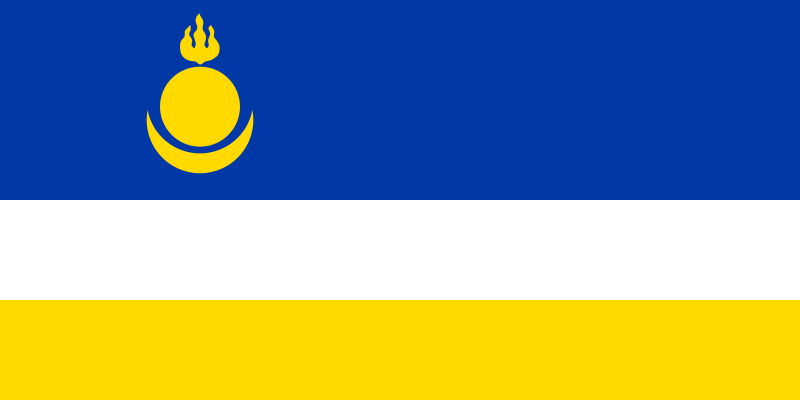
File:Flag_of_Buryatia.svg · Wikimedia Commons · See Wikimedia Commons
Buryats
Sign in to saveThe Buryats are a Mongolic ethnic group native to southeastern Siberia who speak the Buryat language. They are one of the two largest indigenous groups in Siberia, the other being the Yakuts. The majority of the Buryats today live in their titular homeland, the Republic of Buryatia, a federal subject of Russia which sprawls along the southern border and partially straddles Lake Baikal. Smaller groups of Buryats also inhabit Ust-Orda Buryat Okrug (Irkutsk Oblast) and the Agin-Buryat Okrug (Zabaykalsky Krai) which are to the west and east of Buryatia respectively as well as northeastern Mongolia
The Buryats are a Mongolic ethnic group native to southeastern Siberia who speak their own language and represent one of the region's two largest indigenous populations. They primarily live in the Republic of Buryatia, a Russian federal region along Lake Baikal, with smaller communities scattered across nearby areas of Siberia and northeastern Mongolia.
AI-generated from the Wikipedia summary — may contain errors.
Key facts
- Ethnic group.pop1
- 460,053
- Ethnic group.pop2
- 295,273
- Ethnic group.group
- Buryats
- Ethnic group.native_name
- буряадburyaad
- Ethnic group.native_name_lang
- Buryat
- Ethnic group.flag
- Flag of Buryatia.svg
- Ethnic group.flag_caption
- Flag of Buryatia
- Ethnic group.image
- Buryat wrestling 01.jpg
- Ethnic group.caption
- A Buryat wrestling match during the Altargana Festival
- Ethnic group.population
- 556,000
- Ethnic group.pop3
- 74,746
- Ethnic group.pop4
- 65,590
- Ethnic group.pop5
- 43,661
- Ethnic group.pop6
- 10,000
- Ethnic group.ref6
- –70,000
- Ethnic group.langs
- Buryat (L1);Russian, Mongolian
- Ethnic group.rels
- Buddhism, Orthodox Christianity, Mongolian shamanism
- Ethnic group.related
- Other Mongolic peoples and Indigenous peoples of Siberia
via Wikipedia infobox
Wikidata facts
- Instance of
- ethnic group
- Subclass of
- Mongolic peoples
- Languages spoken
- Buryat
- Native language
- Buryat
- Religion
- shamanism
- Country
- Mongolia
- Population
- 43661
- Image
- Selenginskie buryaty.jpg
Show 2 more facts
- Commons category
- Buryat people
- topic's main category
- Category:Buryat people
Sources (3)
via Wikidata · CC0
~31 min read
Encyclopedic overview
24 sectionsContents
- History
- Culture and traditions
- Relationship with nature
- Kinship and marriage
- Religion
- Shamanism (Tengrism)
- Buddhism
- Other religions
- Subsistence
- Traditional medicine
- Cuisine
- Genetics
- Mitochondrial DNA haplogroups
- Y-chromosome DNA haplogroups
- Nuclear DNA genetic history
- Subgroups
- Major tribes
- Other tribes
- Notable people
- See also
- Notes
- References
- Further reading
- External links
The Buryats are a Mongolic ethnic group native to southeastern Siberia who speak the Buryat language. They are one of the two largest indigenous groups in Siberia, the other being the Yakuts. The majority of the Buryats today live in their titular homeland, the Republic of Buryatia, a federal subject of Russia which sprawls along the southern border and partially straddles Lake Baikal. Smaller groups of Buryats also inhabit Ust-Orda Buryat Okrug (Irkutsk Oblast) and the Agin-Buryat Okrug (Zabaykalsky Krai) which are to the west and east of Buryatia respectively as well as northeastern Mongolia and Inner Mongolia, China. Traditionally, they formed the major northern subgroup of the Mongols.
Buryats share many customs with other Mongolic peoples, including nomadic herding, and erecting gers for shelter. Today the majority of Buryats live in and around Ulan-Ude, the capital of the Buryat Republic, although many still follow a more traditional lifestyle in the countryside. They speak a central Mongolic language called Buryat. UNESCO's 2010 edition of the ''Atlas of the World's Languages in Danger classifies the Buryat language as "severely endangered".
Excerpted from Wikipedia’s “Buryats” article, available under the CC BY-SA 4.0 licence.