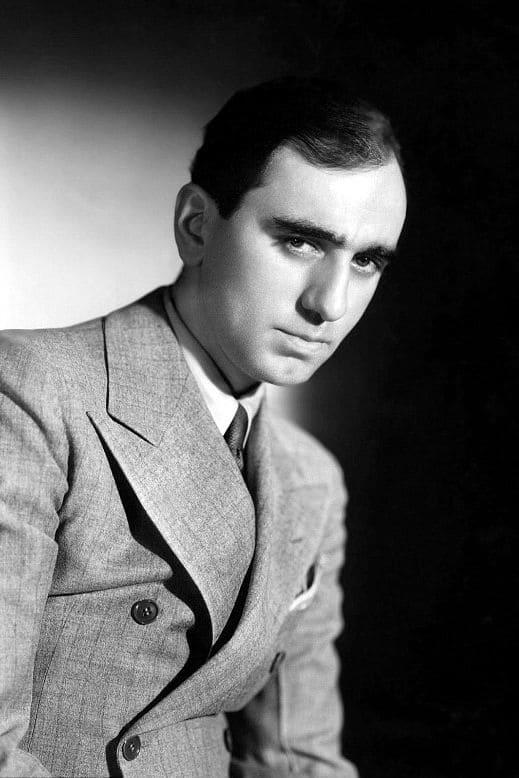
Profile via TMDB · Courtesy of TMDB
Busby Berkeley
Sign in to saveAlso known as Berkeley William Enos
American film director and musical choreographer (1895-1976)
OverviewAI-generated
Busby Berkeley was an American film director, choreographer, actor and theatrical director, born in Los Angeles on 29 November 1895. He began his career in 1901 and worked until 1971, and was nominated for the Academy Award for Best Dance Direction.
Berkeley was married to Esther Muir and later to Merna Kennedy. He died in Palm Springs on 14 March 1976 and was buried at Desert Memorial Park.
Synthesized by Vinony from 23 facts across 2 sources: Wikidata, TMDb. Generated from structured data (not the Wikipedia text) and checked against those facts — may still contain errors.
Film & TV
Los Angeles, California, USA
From Wikipedia, the free encyclopedia. Busby Berkeley (November 29, 1895 – March 14, 1976) was a highly influential Hollywood movie director and musical choreographer. Berkeley was famous for his elaborate musical production numbers that often involved complex geometric patterns. Berkeley's works used large numbers of showgirls and props as fantasy elements in kaleidoscopic on-screen…
Known for
- You Must Remember This: The Warner Bros. Story — Self (archive footage)2008
- Busby Berkeley: A Journey with a Star — Self (archive footage)2007
- 42nd Street: From Book to Screen to Stage — Self (archive footage)2006
- Busby Berkeley: Going Through the Roof — Self (archive footage)2003
- That's Dancing! — Self (archive footage)1985
- Brother, Can You Spare a Dime? — Self (archive footage)1975
- The Phynx — Busby Berkeley1970
- Omnibus — Self1967
- We Must Have Music — Himself1942
- A Trip Thru a Hollywood Studio — Himself (uncredited)1935
via TMDB
Key facts
- Born
- Berkeley William Enos , ( 1895-11-29 ) November 29, 1895, Los Angeles, California , U.S.
- Died
- March 14, 1976 (1976-03-14) (aged 80), Palm Desert, California , U.S.
- Resting place
- Desert Memorial Park , Cathedral City, California
- Occupations
- Film director choreographer
- Years active
- 1927–1971
- Mother
- Gertrude Berkeley
via Wikipedia infobox
Wikidata facts
- Instance of
- human
- Gender
- male
- Citizenship
- United States
- Place of birth
- Los Angeles
- Place of death
- Palm Springs
- Spouse
- Merna Kennedy
- Occupation
- director
- Languages spoken
- English language
- Native language
- English language
- Image
- Busby Berkeley Portrait.jpg
Show 11 more facts
- Commons category
- Busby Berkeley
- date of birth
- 1895-11-29
- date of death
- 1976-03-14
- place of burial
- Desert Memorial Park
- related category
- Category:Films directed by Busby Berkeley
- start of work period
- 1901-00-00
- name in native language
- Busby Berkeley
- writing language
- English language
- end of work period
- 1971-00-00
- nominated for
- Academy Award for Best Dance Direction
- topic has template
- Template:Busby Berkeley
Sources (9)
via Wikidata · CC0
~11 min read
Encyclopedic overview
Berkeley William Enos (November 29, 1895 – March 14, 1976), known professionally as Busby Berkeley, was an American film director and musical choreographer, best known for his collaboration with Warner Brothers in the early to mid-1930s. Berkeley devised elaborate musical production numbers that often involved complex geometric patterns. His work used large numbers of showgirls and props as fantasy elements in kaleidoscopic on-screen performances.
Early life
Excerpted from Wikipedia’s “Busby Berkeley” article, available under the CC BY-SA 4.0 licence.