Encyclopedia of Life · EOL (see source)
Cactus Wren
Sign in to saveAlso known as Campylorhynchus brunneicapillus
Desert adapted bird of United States and Mexico
Species
Least ConcernDer Kaktuszaunkönig (Campylorhynchus brunneicapillus) ist eine im Südwesten der USA und in Mexiko vorkommende Art aus der Vogelfamilie der Zaunkönige (Troglodytidae). Er ist der Staatsvogel des US-Bundesstaats Arizona.[1] Inhaltsverzeichnis 1 Beschreibung 1.1 Aussehen 1.2 Stimme und Gesang 2 Verbreitung und Lebensraum 3 Lebensweise 4 Fortpflanzung 4.1 Nestbau 4.2 Brut und Jungenaufzucht 5 Gefährdung 6 Unterarten 7 Etymologie und Forschungsgeschichte 8 Literatur 9 Weblinks 10 Einzelnachweise 11 Anmerkungen Beschreibung Aussehen Der Kaktuszaunkönig gehört mit einer Gesamtlänge von 18 bis 22 Zentimetern zu den größten Vertretern der Zaunkönige. Der Schwanz wird meist hochgestellt. Der spitze, leicht gebogene Schnabel ist im oberen Teil schwarzbraun, im unteren Teil gelblich gefärbt. Die Iris des Auges ist schwarzbraun. Bei adulten Tieren ist der Oberkopf rotbraun bis haselnussbraun gefärbt mit deutlichem weißen Überaugenstreif. Das Kinn ist weißlich, die Kehle schwärzlich. Brust- und Bauchseiten sind cremefarben bis hell orange-gelb und mit schwarzbraunen Flecken gemustert. Das übrige Gefieder ist bräunlich und mit vielen unregelmäßig verteilten weißen Flecken überzogen. Die Flügelspa
via IUCN
Wikidata facts
- Instance of
- taxon
- Parent taxon
- Campylorhynchus
- Image
- Campylorhynchus brunneicapillus 20061226.jpg
Show 8 more facts
- taxon rank
- species
- IUCN conservation status
- Least Concern
- Commons category
- Campylorhynchus brunneicapillus
- taxon name
- Campylorhynchus brunneicapillus
- Commons gallery
- Campylorhynchus brunneicapillus
- taxon common name
- garrincha-dos-catos
- short name
- C. brunneicapillus
- taxon range
- Arizona
via Wikidata · CC0
~30 min read
Encyclopedic overview
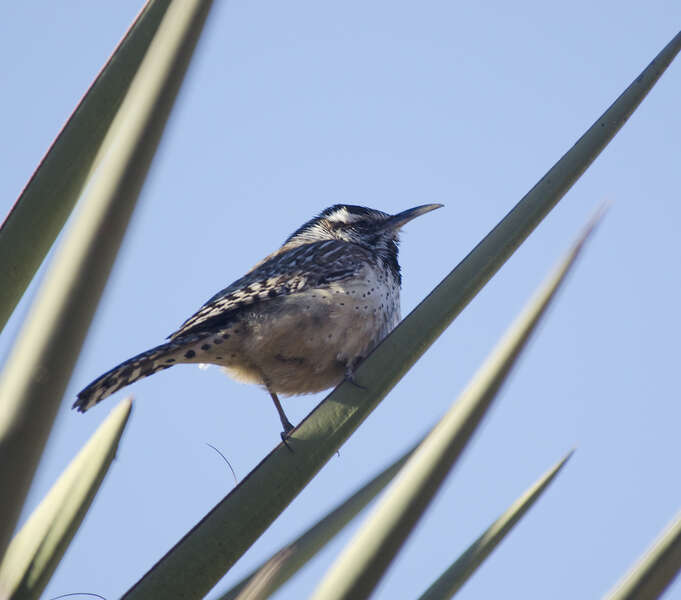
The cactus wren (Campylorhynchus brunneicapillus) is a species of wren that is endemic to the deserts of the southwestern United States and northern and central Mexico. It is the state bird of Arizona, and the largest wren in the United States. Its plumage is brown, with black and white spots as markings. It has a distinctive white eyebrow that sweeps to the nape of the neck. The chest is white, whereas the underparts are cinnamon-buff colored. Both sexes appear similar. The tail, as well as flight feathers, are barred in black and white. Their song is a loud raspy chirrup; akin in the description of some ornithologists to the sound of a car engine that will not start. It is well-adapted to its native desert environment, and the birds can meet their water needs from their diet which consists chiefly of insects, but also of some plant matter. The cactus wren is a poor flier and generally forages for food on the ground. Ornithologists generally recognize seven subspecies, with the exact taxonomy under dispute.
Its common name derives from their frequenting desert cactus plants such as the saguaro and cholla, building nests, roosting, and seeking protection from predators among them. Its bulky and globular nests are constructed of plant material and lined with feathers. They do not migrate; instead, they establish and defend the territories around their nests where they live all year-round. It lives in pairs, or as family groups from late spring through winter. Pairing among cactus wrens is monogamous; in each breeding season, the males chiefly build nests, the females incubate eggs, and both parents feed the young.
Excerpted from Wikipedia’s “Cactus Wren” article, available under the CC BY-SA 4.0 licence.