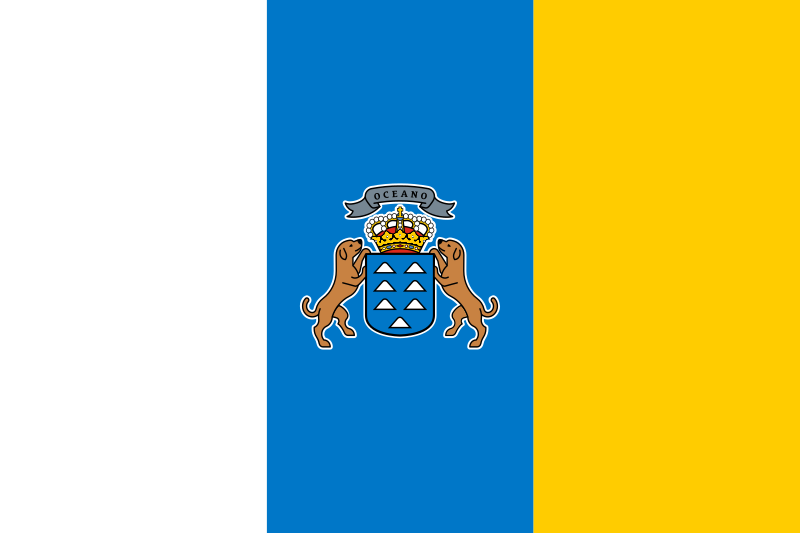
File:Flag_of_the_Canary_Islands.svg · Wikimedia Commons · See Wikimedia Commons
Canary Islands
Sign in to saveAlso known as Canaries, the Canaries, Islas Canarias, Canarias, Canariae Insulae
autonomous community of Spain, and archipelago in the Atlantic Ocean
The Canary Islands are an archipelago of Spanish islands located in the Atlantic Ocean that form an autonomous community of Spain. They matter as an important part of Spanish territory and serve as a significant geographic and cultural bridge between Europe and Africa.
AI-generated from the Wikipedia summary — may contain errors.
Wikidata facts
- Official name
- Islas Canarias
- Demonym
- Canárach
- Country
- Spain
- Located in
- Spain
- Contains
- Santa Cruz de Tenerife Province
- Capital
- Las Palmas de Gran Canaria
- Official language
- Spanish
- Currency
- euro
- Population
- 2228862
- Area
- 7447
- Body of water
- Atlantic Ocean
- Head of government
- Ángel Víctor Torres Pérez
- Legislature
- Canarian Parliament
- Anthem
- Himno de Canarias
- Highest point
- Teide
- Official website
- www.gobiernodecanarias.org
- Image
- Canary Islands (6630087415).jpg
- Electrical plug type
- Schuko
- Mains voltage
- 230
- Coat of arms
- coat of arms of Canary Islands
Show 18 more facts
- Commons category
- Canary Islands
- topic's main category
- Category:Canary Islands
- Commons gallery
- Islas Canarias
- category for films shot at this location
- Category:Films shot in the Canary Islands
- category for people who died here
- Category:Deaths in the Canary Islands
- category for people born here
- Category:Births in the Canary Islands
- category of associated people
- Category:People from the Canary Islands
- inception
- 1982-08-10
- described by source
- Pauly–Wissowa
- replaces
- Province of Canary Islands
- native label
- Islas Canarias
- related category
- Category:Canary Islands-related lists
- P11012
- infinity
- on focus list of Wikimedia project
- Wikipedia:Vital articles/Level/4
- P12749
- Cappadocia
- topic's main Wikimedia portal
- Q13426069
- driving side
- right
- lowest point
- North Atlantic Ocean
Sources (8)
via Wikidata · CC0
~40 min read
Encyclopedic overview
The Canary Islands (/kəˈnɛəri/ ; Spanish: Canarias [kaˈnaɾjas] ) or Canaries are an archipelago in the Atlantic Ocean and the southernmost autonomous community of Spain, located about 100 kilometres (60 mi) off the northwest coast of Africa. The archipelago has a population of approximately 2.27 million inhabitants, making it the most populous overseas special territory of the European Union.
The seven main islands, listed from largest to smallest by area, are Tenerife, Fuerteventura, Gran Canaria, Lanzarote, La Palma, La Gomera, and El Hierro. The only other inhabited island is La Graciosa, which is administratively dependent on Lanzarote. The archipelago also includes numerous smaller islands and islets, such as Alegranza, Isla de Lobos, Montaña Clara, Roque del Oeste, and Roque del Este, as well as various rocks, including Garachico and Anaga. Historically, the island chain was referred to as "the Fortunate Isles". The Canary Islands are the southernmost and westernmost region of Spain as well as the largest and most populous archipelago of Macaronesia. They are also the largest and most populated archipelago in Spain. Owing to their strategic location, the Canary Islands have long been considered a link between Africa, Europe, and the Americas.
Excerpted from Wikipedia’s “Canary Islands” article, available under the CC BY-SA 4.0 licence.
Gallery (12)
On the map
Available in 167 languages
- Español
- Français
- Deutsch
- 中文
- 日本語
- Русский
- Português
- Italiano
- العربية
- हिन्दी
- Afrikaans
- Albanian
- Albanian
- Amharic
- Aragonese
- Armenian
- Arpitan
- Assamese
Show 148 more
- Asturian
- azb
- Azerbaijani
- Bahasa Indonesia
- Bangla
- Bashkir
- Basque
- bat_smg
- Bavarian
- be_x_old
- Belarusian
- Betawi
- Bosnian
- Breton
- Bulgarian
- Buriat
- Burmese
- Catalan
- Cebuano
- Central Kurdish
- Chechen
- Cornish
- Corsican
- Crimean Tatar
- Croatian
- Czech
- dag
- Danish
- Egyptian Arabic
- Esperanto
- Estonian
- Extremaduran
- Faroese
- Fiji Hindi
- Filipino
- Finnish
- Gagauz
- Galician
- gcr
- Georgian
- Greek
- Gujarati
- Haitian Creole
- Hakka Chinese
- Hausa
- Hawaiian
- Hebrew
- Hungarian
- Icelandic
- Ido
- Inari Sami
- Interlingua
- Interlingue
- Irish
- Jamaican Creole English
- Javanese
- Kabardian
- Kabyle
- Kazakh
- Kurdish
- Kyrgyz
- Ladino
- Latin
- Latvian
- Ligurian
- Limburgish
- Lingua Franca Nova
- Lithuanian
- lld
- Lower Sorbian
- Luxembourgish
- Macedonian
- Malagasy
- Malay
- Malayalam
- Manx
- Māori
- Marathi
- Mazanderani
- Mingrelian
- Mongolian
- nds_nl
- Neapolitan
- Nederlands
- Northern Frisian
- Northern Sami
- Northern Sotho
- Norwegian
- Norwegian Nynorsk
- Obolo
- Occitan
- Old English
- Ossetic
- Papiamento
- Piedmontese
- Polski
- Quechua
- roa_tara
- Romanian
- Sardinian
- Saterland Frisian
- Scots
- Scottish Gaelic
- Serbian
- Serbian (Latin)
- Shan
- Sicilian
- simple
- Sinhala
- Slovak
- Slovenian
- Southern Sotho
- Standard Moroccan Tamazight
- Sundanese
- Svenska
- Swahili
- Tachelhit
- Tamil
- Tatar
- Telugu
- Tiếng Việt
- Türkçe
- Udmurt
- Ukrainian
- Upper Sorbian
- Urdu
- Uzbek
- Venetian
- Volapük
- Walloon
- Waray
- Welsh
- Western Frisian
- Western Mari
- Western Panjabi
- Wolof
- Wu Chinese
- Xhosa
- Yakut
- Yiddish
- Yoruba
- Zaza
- zh_min_nan
- zh_yue
- Zulu
- فارسی
- ไทย
- 한국어
via Wikidata sitelinks · CC0