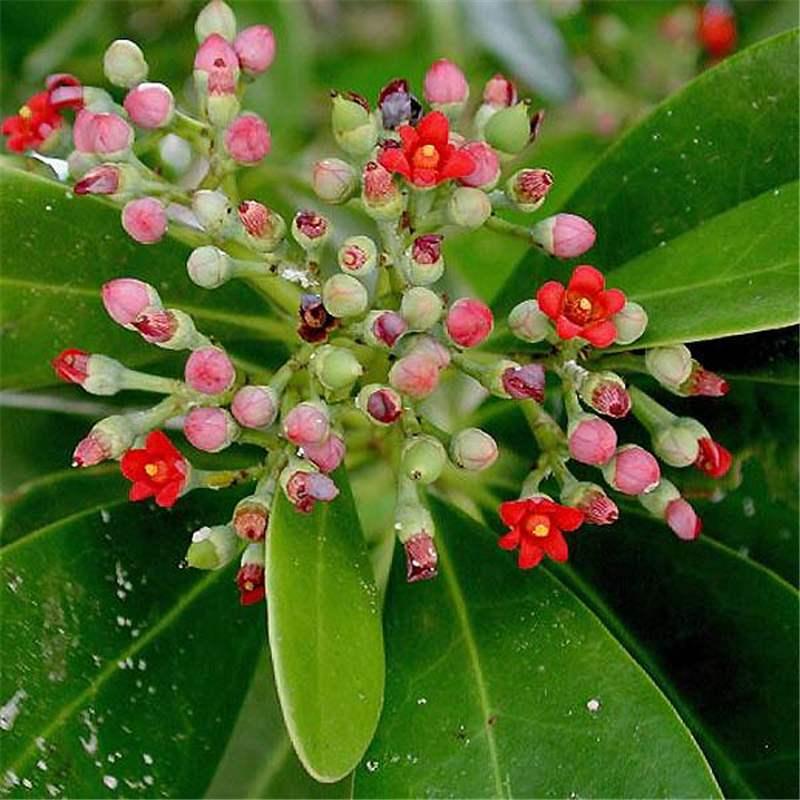
Canella winterana · Kew POWO · Kew Plants of the World Online
Canella winterana
Sign in to saveCanella is a monospecific genus containing the species Canella winterana, a tree native to the Caribbean, south-eastern Mexico, southern Florida, and Venezuela. Its bark is used as a spice similar to cinnamon, giving rise to the common names cinnamon bark, wild cinnamon, and white cinnamon. ==Description== Flowers perfect, regular; sepals 3, imbricated, persistent; petals 5, imbricated; stamens monadelphous. Fruit baccate, indehiscent, 2 to 4-seeded.
Species
Least ConcernSPECIES
- KingdomPlantae
- PhylumTracheophyta
- ClassMagnoliopsida
- OrderCanellales
- FamilyCanellaceae
Common Name: pepper cinnamon
via GBIF · IUCN · Kew POWO
Museum specimens
- Specimen records
- 963
- With media
- 669
- Family
- Canellaceae
- Collections
- CIHS-UAC, CICY, CCBA-FMVZ-UADY, UNICACH, SEMAHN, INECOL
- Recorded in
- Mexico, Cuba
Wikidata facts
- Instance of
- taxon
- Image
- Canella winterana Guadeloupe.JPG
Show 8 more facts
- taxon name
- Canella winterana
- taxon rank
- species
- Commons category
- Canella winterana
- Commons gallery
- Canella winterana
- taxon common name
- wild cinnamon
- IUCN conservation status
- Least Concern
- short name
- C. winterana
Sources (1)
via Wikidata · CC0
~5 min read
Encyclopedic overview
5 sectionsContents
- Description
- Name
- Distribution
- References
- External links
Canella is a monospecific genus containing the species Canella winterana, a tree native to the Caribbean, south-eastern Mexico, southern Florida, and Venezuela. Its bark is used as a spice similar to cinnamon, giving rise to the common names cinnamon bark, wild cinnamon, and white cinnamon. ==Description== Flowers perfect, regular; sepals 3, imbricated, persistent; petals 5, imbricated; stamens monadelphous. Fruit baccate, indehiscent, 2 to 4-seeded.
A tree, with scaly aromatic bark, stout ashy gray branchlets conspicuously marked with large orbicular leaf-scars. Leaves petiolate, alternate, destitute of stipules, penniveined, entire, pellucid-punctate, coriaceous. Flowers arranged in a many-flowered subcorymbose terminal or subterminal panicle composed of several dichotomously branched cymes from the axis of the upper leaves or of minute caducous bracts. Sepals suborbiculate, concave, coriaceous, erect, their margins ciliate. Petals hypogynous, in a single row on the slightly convex receptacle, oblong, concave, rounded at the extremity, fleshy, twice the length of the sepals, white or rose-colored. Stamens about twenty, hypogynous, the filaments connate into a tube crenulate at the summit, and slightly extended above the linear anthers, which are adnate to its outer face, and longitudinally two-valved. Ovary free, included in the androecium, cylindrical or oblong-conical, one-celled, with two parietal placentas, few-ovuled; style short, fleshy, the summit two or three-lobed, stigmatic; ovules arcuate, horizontal or descending, imperfectly anatropous, attached by a short funiculus. Fruit globular or slightly ovate, fleshy, minutely pointed with the base of the persistent style. Seeds reniform, suspended; testa thick, crustaceous, shining black; tegmen soft, membranaceous. Embryo curved, near the summit of the copious oleo-fleshy albumen, its radicle next the hilum; cotyledons oblong.
Excerpted from Wikipedia’s “Canella winterana” article, available under the CC BY-SA 4.0 licence.