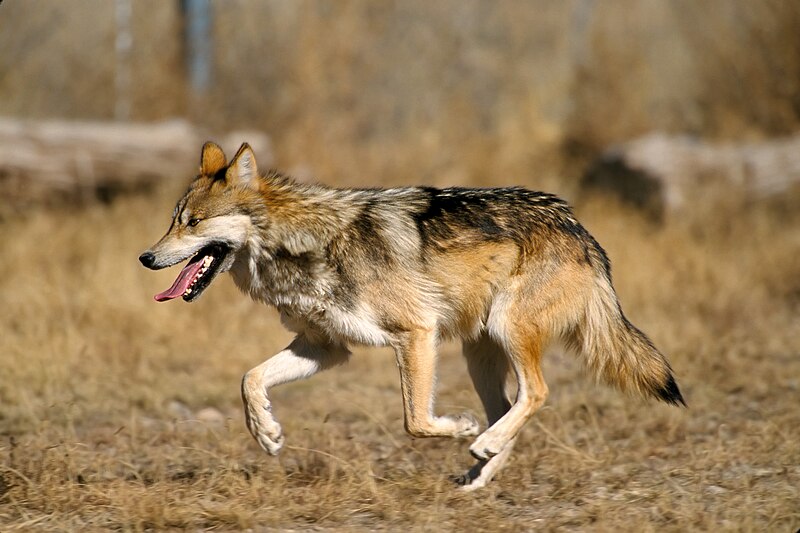
File:Mexican_Wolf_2_yfb-edit_1.jpg · Wikimedia Commons · See Wikimedia Commons
OverviewAI-generated
Canis lupus baileyi is a subspecies of the gray wolf, Canis lupus. It belongs to the kingdom Animalia, phylum Chordata, class Mammalia, order Carnivora, and family Canidae. As a carnivore, its main food sources include Cervidae, rabbits and hares, Sus scrofa, and American bison.
The taxon range for this subspecies includes the United States and Canada. According to the IUCN Red List, its status was assessed as Least Concern in 2023. Records of this organism are held by institutions such as MSU, MVZ, USNM, UCLA, and MSB, with occurrences documented in Mexico and the United States.
Synthesized by Vinony from 25 facts across 6 sources: Wikidata, GBIF, IUCN Red List, Gbif Occ, iDigBio, Vinony graph. Generated from structured data (not the Wikipedia text) and checked against those facts — may still contain errors.
Species
Least ConcernSUBSPECIES
- KingdomAnimalia
- PhylumChordata
- ClassMammalia
- OrderCarnivora
- FamilyCanidae
Canis lupus baileyi Le Loup du Mexique (Canis lupus baileyi), ou Loup gris mexicain, est la plus rare et la plus génétiquement distincte des sous-espèces du Loup gris en Amérique du Nord. Il mesure entre 1,2 et 1,5 mètre de long pour 0,8 mètre au garrot et a un poids de 27 à 37 kilogrammes. Originellement présent dans les espaces arides du Sud-Ouest des Etats-Unis et au Nord du Mexique, le loup du Mexique avait quasiment disparu en liberté dans les années 1970. Il demeure la sous-espèce de Canis lupus la plus menacée dans l'hémisphère occidental.
via GBIF · IUCN
Museum specimens
- Specimen records
- 2,232
- With media
- 75
- Family
- Canidae
- Collections
- MSU, MVZ, USNM, UCLA, MSB, CHAS
- Recorded in
- Mexico, United States
Wikidata facts
- Instance of
- taxon
- Parent taxon
- Canis lupus
- Image
- Mexican wolf lounging.jpg
Show 7 more facts
- taxon rank
- subspecies
- Commons category
- Canis lupus baileyi
- Commons gallery
- Canis lupus baileyi
- taxon name
- Canis lupus baileyi
- taxon range
- Canada
- has characteristic
- carnivore
- main food source
- Sus scrofa
Sources (1)
via Wikidata · CC0
~34 min read
Encyclopedic overview
The Mexican wolf (Canis lupus baileyi), also known as the lobo mexicano (or, simply, lobo) is a subspecies of gray wolf (C. lupus) native to eastern and southeastern Arizona and western and southern New Mexico (in the United States) and fragmented areas of northern Mexico. Historically, the subspecies ranged from Southern California south into Baja California, east through the Sonora and Chihuahua Deserts and into West Texas.
Its ancestors were likely among the first gray wolves to enter North America after the extinction of the Beringian wolf, as indicated by its southern range and basal physical and genetic characteristics. Though once held in high regard in Pre-Columbian Mexico, Canis lupus baileyi became the most endangered gray wolf subspecies in North America, having been extirpated in the wild during the mid-1900s through a combination of hunting, trapping, poisoning and the removal of pups from dens, mainly out of fear, by livestock herders and ranch owners. After being listed officially under the Endangered Species Act in 1976, both the United States and Mexico collaborated to capture all lobos remaining in the wild. This extreme preventative measure would end up forestalling their imminent extinction; five wild Mexican wolves (four males and one pregnant female) were captured, alive, in Mexico between 1977 and 1980. Once settled in captive rescue centers, this group of wolves would prove vital in starting a captive breeding program. Thanks to these preemptive measures, captive-bred Mexican wolves were released into recovery areas in Arizona and New Mexico beginning in 1998 in an effort to recolonize the animals' historical range.
Excerpted from Wikipedia’s “Canis lupus baileyi” article, available under the CC BY-SA 4.0 licence.