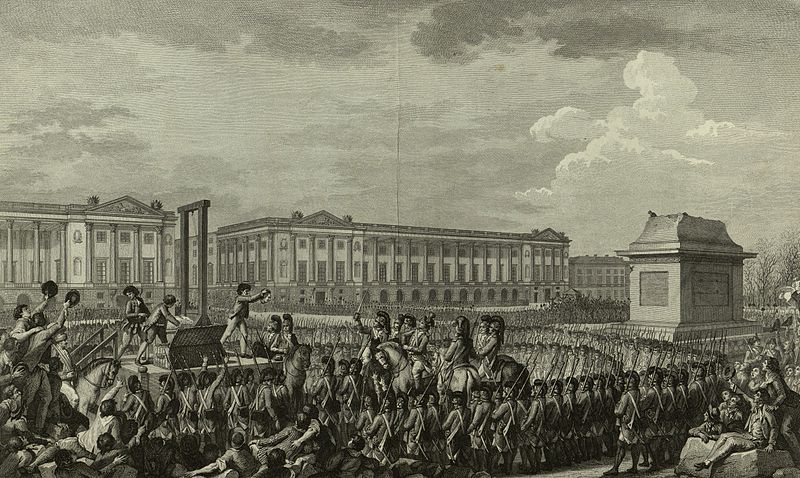
File:Execution_of_Louis_XVI.jpg · Wikimedia Commons · See Wikimedia Commons
capital punishment
Sign in to saveAlso known as death sentence, death punishment, sentenced to death, death penalty, execution, judicial homicide, state-sanctioned execution
legal process whereby a person is put to death by the state as a punishment for an actual or supposed crime
Capital punishment is when the government executes a person as punishment for a crime they committed or are accused of committing. It matters because it raises serious questions about justice, human rights, and whether governments should have the power to take someone's life.
AI-generated from the Wikipedia summary — may contain errors.
Research
1,514 papers- Anesthesiologists and Capital Punishment.ReviewAnesthesiology clinics · 2024Rockoff MA, Van Cleve W, Van Norman GADOI: 10.1016/j.anclin.2024.02.007
- On capital punishment.Journal of the National Medical Association · 1989Jordan HW
- Capital punishment and anatomy: history and ethics of an ongoing association.ReviewClinical anatomy (New York, N.Y.) · 2008Hildebrandt SDOI: 10.1002/ca.20571
- [Capital punishment].Tidsskrift for den Norske laegeforening : tidsskrift for praktisk medicin, ny raekke · 2000Varvin S
- Physicians, medical ethics, and capital punishment.ReviewThe Journal of clinical ethics · 2005Murphy TF
- Capital sentencing and neuropsychiatry.ReviewBehavioral sciences & the law · 2024Brakel SJ, Tucker DEDOI: 10.1002/bsl.2643
- Racial disparity in capital punishment and its impact on family members of capital defendants.ReviewJournal of evidence-based social work · 2013Schweizer JDOI: 10.1080/15433714.2011.581549
- Issues surrounding lethal injection as a means of capital punishment.ReviewPharmacotherapy · 2008Romanelli F, Whisman T, Fink JLDOI: 10.1592/phco.28.12.1429
via PubMed
Wikidata facts
- Instance of
- manner of death
- Subclass of
- divine retribution
- Image
- Beheadingchina2.jpg
Show 8 more facts
- has effect
- execution
- described by source
- Pauly–Wissowa
- Commons category
- Death penalty
- topic's main category
- Category:Capital punishment
- on focus list of Wikimedia project
- Wikipedia:Vital articles/Level/4
- practiced by
- executioner
- P8168
- sodium tungstate
- topic has template
- Template:Capital punishment
Sources (6)
via Wikidata · CC0
~40 min read
Encyclopedic overview
Execution of Louis XVI Capital punishment, also known as the death penalty and formerly called judicial homicide, is the state-sanctioned killing of a person as punishment for actual or supposed misconduct. The sentence ordering that an offender be punished in such a manner is called a death sentence, and the act of carrying out the sentence is an execution. A prisoner who has been sentenced to death and awaits execution is condemned and is commonly referred to as being "on death row". Etymologically, the term capital (lit. 'of the head', derived via the Latin capitalis from caput, "head") refers to execution by beheading, but executions are carried out by many methods.
Crimes that are punishable by death are known as capital crimes, capital offences, or capital felonies, and vary depending on the jurisdiction, but commonly include serious crimes against a person, such as murder, assassination, mass murder, child murder, aggravated rape, terrorism, aircraft hijacking, war crimes, crimes against humanity, and genocide, along with crimes against the state such as attempting to overthrow government, treason, espionage, sedition, and piracy. Also, in some cases, acts of recidivism, aggravated robbery, and kidnapping, in addition to drug trafficking, drug dealing, and drug possession, are capital crimes or enhancements. However, states have also imposed punitive executions for an expansive range of conduct, for political or religious beliefs and practices, for a status beyond one's control, or without employing any significant due process procedures. Judicial murder is the intentional and premeditated killing of an innocent person by means of capital punishment. For example, the executions following the show trials in the Soviet Union during the Great Purge of 1936–1938 were an instrument of political repression.
Excerpted from Wikipedia’s “capital punishment” article, available under the CC BY-SA 4.0 licence.
Gallery (12)
Available in 144 languages
- Español
- Français
- Deutsch
- 中文
- 日本語
- Русский
- Português
- Italiano
- العربية
- हिन्दी
- Afrikaans
- Albanian
- Albanian
- Angika
- Aragonese
- Armenian
- Assamese
- Asturian
Show 125 more
- azb
- Azerbaijani
- Bahasa Indonesia
- Balinese
- Bangla
- Bashkir
- Basque
- bat_smg
- be_x_old
- Belarusian
- Bosnian
- Breton
- btm
- Bulgarian
- Buriat
- Burmese
- Catalan
- cdo
- Central Kurdish
- Chechen
- Chuvash
- Croatian
- Czech
- Danish
- Egyptian Arabic
- Esperanto
- Estonian
- Extremaduran
- Faroese
- Fiji Hindi
- Filipino
- Finnish
- fiu_vro
- Galician
- gcr
- Georgian
- Greek
- Guarani
- Haitian Creole
- Hausa
- Hebrew
- Hungarian
- Icelandic
- Ido
- Iloko
- Irish
- Jamaican Creole English
- Kalmyk
- Kannada
- Kanuri
- Kara-Kalpak
- Karachay-Balkar
- Kazakh
- kbp
- Kurdish
- Kyrgyz
- Latin
- Latvian
- Limburgish
- Lithuanian
- Lombard
- Low German
- Luxembourgish
- Macedonian
- Malay
- Malayalam
- Marathi
- Minangkabau
- Mingrelian
- Mongolian
- Moroccan Arabic
- Nederlands
- Nepali
- Norwegian
- Norwegian Nynorsk
- Occitan
- Ossetic
- Papiamento
- Pashto
- Piedmontese
- Polski
- Punjabi
- Quechua
- Romanian
- Rusyn
- Sardinian
- Scots
- Serbian
- Serbian (Latin)
- Sicilian
- simple
- Sindhi
- Sinhala
- Slovak
- Slovenian
- Somali
- Svenska
- Swahili
- Tajik
- Talysh
- Tamil
- Tatar
- Telugu
- Tiếng Việt
- Toki Pona
- Türkçe
- Ukrainian
- Urdu
- Uzbek
- Venetian
- Waray
- Welsh
- West Flemish
- Western Frisian
- Western Panjabi
- Wu Chinese
- Yakut
- Yiddish
- Zaza
- zh_classical
- zh_min_nan
- zh_yue
- فارسی
- ไทย
- 한국어
via Wikidata sitelinks · CC0