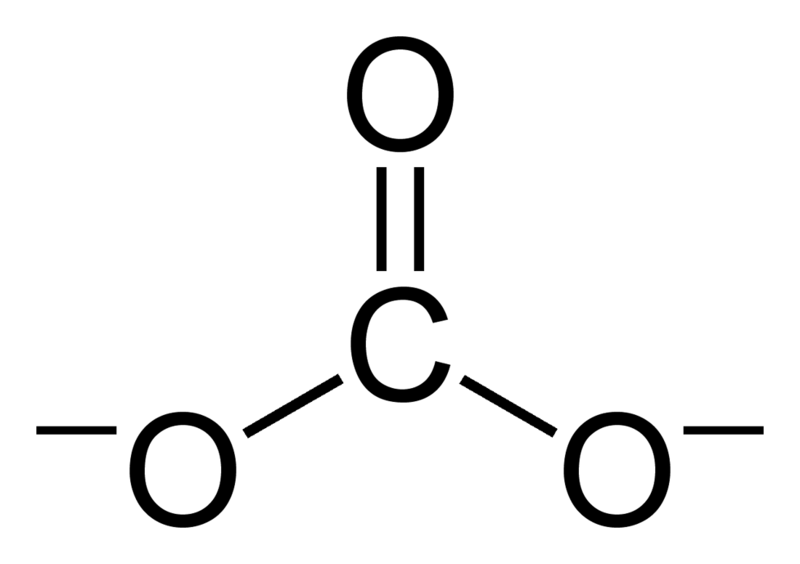
File:Carbonate-ion-localised-2D.png · Wikimedia Commons · See Wikimedia Commons
carbonate
Sign in to saveAlso known as carbonates
A carbonate is a salt of carbonic acid, (), characterized by the presence of the carbonate ion, a polyatomic ion with the formula CO32–. The word "carbonate" may also refer to a carbonate ester, an organic compound containing the carbonate group .
A carbonate is a type of salt that contains a carbonate ion (CO₃²⁻), and the term can also refer to organic compounds with a similar chemical structure. Carbonates are important because they appear widely in nature—in rocks, minerals, and shells—and have many practical uses in industry and everyday products.
AI-generated from the Wikipedia summary — may contain errors.
Wikidata facts
- Subclass of
- chemical compound
- Has part
- oxygen
- Image
- Carbonate.svg
Show 5 more facts
- topic has template
- Template:Carbonates
- Commons category
- Carbonates
- topic's main category
- Category:Carbonates
- different from
- carbon trioxide
- on focus list of Wikimedia project
- Wikipedia:Vital articles/Level/4
via Wikidata · CC0
~8 min read
Encyclopedic overview
9 sectionsContents
- Structure and bonding
- Chemical properties
- Organic carbonates
- Buffer
- Carbonate salts
- Presence outside Earth
- See also
- References
- External links
A carbonate is a salt of carbonic acid, (), characterized by the presence of the carbonate ion, a polyatomic ion with the formula CO32–. The word "carbonate" may also refer to a carbonate ester, an organic compound containing the carbonate group .
The term is also used as a verb, to describe carbonation: the process of raising the concentrations of carbonate and bicarbonate ions in water to produce carbonated water and other carbonated beverageseither by the addition of carbon dioxide gas under pressure or by dissolving carbonate or bicarbonate salts into the water.
Excerpted from Wikipedia’s “carbonate” article, available under the CC BY-SA 4.0 licence.
Gallery (16)
Available in 65 languages
- Español
- Français
- Deutsch
- 中文
- 日本語
- Русский
- Português
- Italiano
- العربية
- हिन्दी
- Afrikaans
- Armenian
- Asturian
- azb
- Azerbaijani
- Bahasa Indonesia
- Bangla
- Basque
Show 46 more
- Bosnian
- Bulgarian
- Catalan
- Chuvash
- Czech
- Danish
- Esperanto
- Estonian
- Finnish
- Galician
- Greek
- Hebrew
- Hungarian
- Irish
- Kannada
- Kazakh
- Kyrgyz
- Latvian
- Macedonian
- Malay
- Nederlands
- Northern Frisian
- Norwegian
- Norwegian Nynorsk
- Polski
- Punjabi
- Romanian
- Serbian
- Serbian (Latin)
- simple
- Slovak
- Slovenian
- Svenska
- Swahili
- Tamil
- Tiếng Việt
- Türkçe
- Ukrainian
- Uzbek
- Wu Chinese
- zh_classical
- zh_min_nan
- zh_yue
- فارسی
- ไทย
- 한국어
via Wikidata sitelinks · CC0