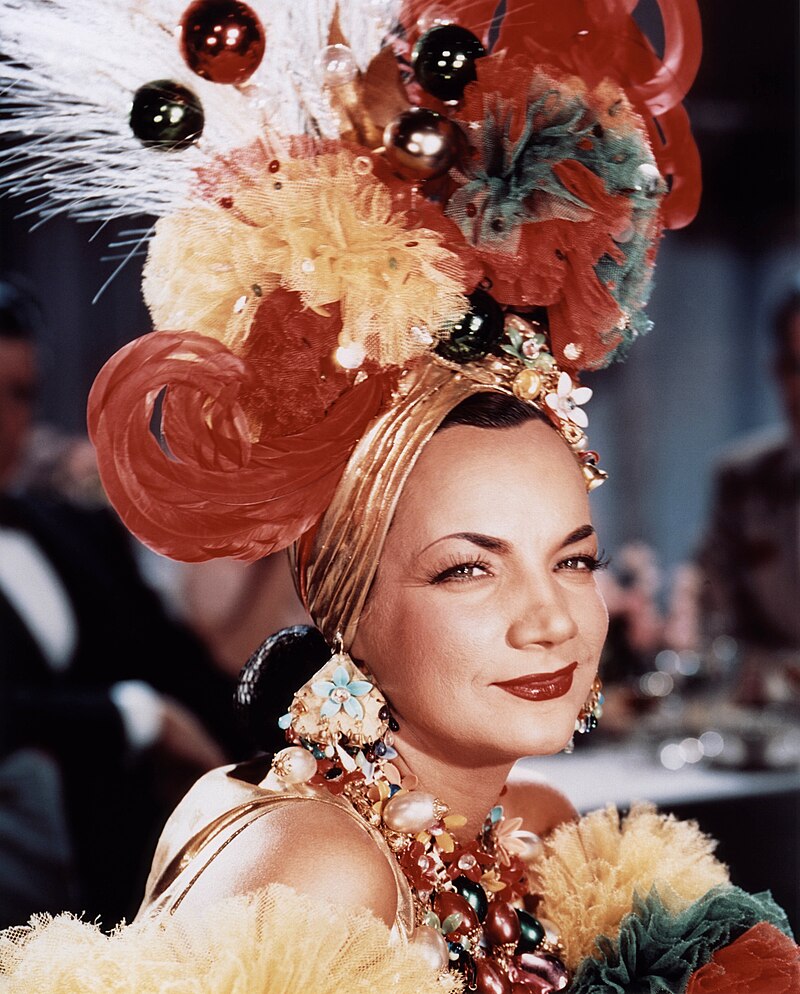
File:Carmen_Miranda_in_That_Night_in_Rio_(1941).jpg · Wikimedia Commons · See Wikimedia Commons
Carmen Miranda
Sign in to saveAlso known as Maria do Carmo Miranda da Cunha
Brazilian singer (1909–1955)
OverviewAI-generated
Carmen Miranda was a female actor, singer, and dancer of Portuguese and Brazilian citizenship. Born in Marco de Canaveses, Portugal, on February 9, 1909, she possessed green eyes and brown hair. Her vocal range included mezzo-soprano and contralto types. She began her work period in 1928 and continued until 1955. She was affiliated with RCA Records and is associated with tags such as samba, Brazilian, and Latin music.
Miranda died from a myocardial infarction in Beverly Hills, Los Angeles, on August 5, 1955. Her manner of death was natural causes. She is buried at Cemitério de São João Batista. Her notable affiliations include a star on the Hollywood Walk of Fame and the Order of Cultural Merit from Brazil. She had a sibling named Aurora Miranda.
Synthesized by Vinony from 35 facts across 6 sources: Wikidata, MusicBrainz, Last.fm, Firecrawl, TMDb, Vinony collections. Generated from structured data (not the Wikipedia text) and checked against those facts — may still contain errors.
Film & TV
Marco de Canaveses, Portugal
Maria do Carmo Miranda da Cunha GOIH • OMC (Marco de Canaveses, February 9, 1909 – Beverly Hills, August 5, 1955), known professionally as Carmen Miranda, was a Portuguese-born Brazilian singer, dancer, and actress who attained fame in Brazil and the US in the 1930s. Best known to American audiences as "the lady in the tutti-frutti hat" due to her signature headdresses made of fruits, she was the…
Known for
- Proust Palimpsesto: Pastiches e Misturas — Dorita (archive footage) (uncredited)2026
- 3 Obás de Xangô — Self (archive footage)2025
- Dorival Caymmi - Um Homem de Afetos — Self (archive footage)2024
- I Can't Give You Anything But Love: The Jimmy McHugh Story — Self (archive footage)2024
- Nas Ondas de Dorival Caymmi — Self (archive footage)2024
- Garoto - Vivo Sonhando — Self (archive footage)2020
- Dê Lembranças a Todos — Self (archive footage)2018
- Rio 50 Degrees: Carry on CaRIOca — Self (archive footage)2014
- Naked Eye — Self (archive footage)2014
- Vito — Self (archive)2011
via TMDB
Music · MusicBrainz
- Type
- Person
- Gender
- Female
- Country
- Brazil
- Active from
- 1909
- Active to
- 1955
Discography
via MusicBrainz · CC0
Listeners · Last.fm
- Listeners
- 97,326
- Total plays
- 861,426
Tags
Maria do Carmo Miranda da Cunha (February 9 1909, Marco de Canaveses, Portugal — August 5, 1955, Beverly Hills, California), widely known as Carmen Miranda, was a Portuguese-Brazilian singer, dancer, Hollywood actress and performer of international fame. Her artistic career took place in Brazil and the United States between the 1930s and 1950s. She was considered by Rolling Stone magazine as the 15th greatest voice in Brazilian music, and is an international icon and symbol of Brazil abroad. <
Official website
Home - Carmen Miranda
carmenmiranda.com.br →Link to the official site · 9,549 chars · not written by Vinony
Wikidata facts
- Instance of
- human
- Gender
- female
- Citizenship
- Brazil
- Place of birth
- Marco de Canaveses
- Place of death
- Los Angeles
- Occupation
- dancer
- Languages spoken
- Portuguese
- Native language
- Portuguese
- Eye colour
- green
- Hair colour
- brown hair
- Genre
- traditional pop
- Instrument
- voice
- Record label
- RCA Records
- Official website
- carmenmiranda.com.br
- Image
- Carmen Miranda 1941.JPG
- Residence
- Los Angeles
- Voice type
- contralto
Show 16 more facts
- Commons category
- Carmen Miranda
- date of birth
- 1909-02-09
- date of death
- 1955-08-05
- topic's main category
- Category:Carmen Miranda
- Commons gallery
- Carmen Miranda
- name in native language
- Carmen Miranda
- place of burial
- Cemitério de São João Batista
- manner of death
- natural causes
- cause of death
- myocardial infarction
- pseudonym
- Carmen Miranda
- start of work period
- 1928-00-00
- end of work period
- 1955-00-00
- birth name
- María do Carmo Miranda da Cunha
- first family name in Portuguese name
- Miranda
- name
- Carmen Miranda
- nickname
- Carmen Miranda
via Wikidata · CC0
~40 min read
Encyclopedic overview
Maria do Carmo Miranda da Cunha (9 February 1909 – 5 August 1955), known professionally as Carmen Miranda ( Portuguese pronunciation: [ˈkaʁmẽj miˈɾɐ̃dɐ]), was a Portuguese-born Brazilian singer, dancer, and actress. Nicknamed "the Brazilian Bombshell," she was known for her signature fruit hat outfits that she wore in her American films.
As a young woman, Miranda designed clothes and hats in a boutique before making her debut as a singer, recording with composer Josué de Barros in 1929. Miranda's 1930 recording of "Taí (Pra Você Gostar de Mim)", written by Joubert de Carvalho, catapulted her to stardom in Brazil as the foremost interpreter of samba.
Excerpted from Wikipedia’s “Carmen Miranda” article, available under the CC BY-SA 4.0 licence.