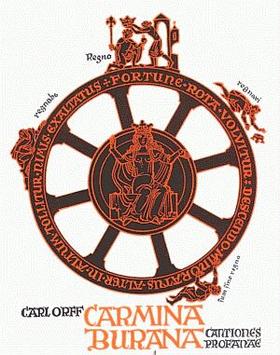
File:Fortuna_Wheel.jpg · Wikimedia Commons · See Wikimedia Commons
Carmina Burana
Sign in to saveAlso known as Carmina Burana by Carl Orff, Carmina Burana by Orff
cantata by Carl Orff
Key facts
- Language
- Latin Middle High German Old French
- Based on
- 24 poems from Carmina Burana
- Premiere
- 8 June 1937 ( 1937-06-08 ) , Oper Frankfurt
via Wikipedia infobox
Wikidata facts
- Named after
- Carmina Burana
- Based on
- Carmina Burana
- Composer
- Carl Orff
- Librettist
- Carl Orff
Show 8 more facts
- Commons category
- Carmina Burana by Carl Orff
- date of first performance
- 1937-06-08
- language of work or name
- Old French
- location of first performance
- Oper Frankfurt
- different from
- Catulli Carmina
- form of creative work
- concerto
- title
- Carmina Burana: Cantiones profanae cantoribus et choris cantandae comitantibus instrumentis atque imaginibus magicis
- number of parts of this work
- 25
Sources (3)
via Wikidata · CC0
~18 min read
Encyclopedic overview
Carmina Burana is a cantata composed in 1935 and 1936 by Carl Orff, based on 24 poems from the medieval collection Carmina Burana. Its full Latin title is Carmina Burana: Cantiones profanae cantoribus et choris cantandae comitantibus instrumentis atque imaginibus magicis ("Songs of Beuern: Secular songs for singers and choruses to be sung together with instruments and magical images"). It was first performed by the Oper Frankfurt on 8 June 1937. It is part of Trionfi, a musical triptych that also includes Catulli Carmina and Trionfo di Afrodite. The first and last sections of the piece are called "Fortuna Imperatrix Mundi" ("Fortune, Empress of the World") and start with "O Fortuna".
The autograph manuscript of the work is preserved in the Bavarian State Library, and was issued in a facsimile edition by Schott Music.
Excerpted from Wikipedia’s “Carmina Burana” article, available under the CC BY-SA 4.0 licence.