
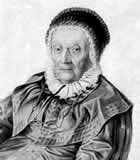
File:1829_Melchior_Gommar_Tieleman,_Ölgemälde_Caroline_Herschel_Hannover.tif · Wikimedia Commons · See Wikimedia Commons
Caroline Herschel
Sign in to saveAlso known as C. Herschel, Caroline Lucretia Herschel, Lucretia Herschel, Caroline (Lucretia) Herschel
German-British astronomer (1750-1848)
Caroline Herschel was a German-British astronomer who lived from 1750 to 1848 and made significant contributions to astronomy during a time when few women worked in science. She matters because she demonstrated that women could conduct rigorous scientific research and made discoveries that advanced the field of astronomy.
AI-generated from the Wikipedia summary — may contain errors.
Described at
Caroline Lucretia Herschel was the first woman to receive full recognition in the field of astronomy. She grew up in Hanover, the only girl among five surviving children of the military musician Isaak
fembio.org →Caroline Lucretia Herschel was the first woman to receive full recognition in the field of astronomy. She grew up in Hanover, the only girl among five surviving children of the military musician Isaak Herschel and his wife Anna Ilse Herschel. Against the wishes of her mother, who would have preferred her to be a seamstress, Caroline, like her brothers, received musical training and became a concert singer. When she was 22 she followed her brother Friedrich Wilhelm Herschel (her elder by twelve years) to England, where he was an organist and conductor in the elegant city of Bath. He needed her as his housekeeper, but also gave her the opportunity to appear as a soloist in his concerts. Soon she had gained the position of first singer, assumed a managerial role in the chorus and received offers to perform in other cities. She would surely have had a great musical career had she not followed her brother's passion for astronomy. Without doubt this was an unusual family, these Herschels from Hanover, among whom great gifts, even double talents (music and astronomy) were apparently the rule: Alexander, also a musician, served as well as an astronomer in brother Wilhelm's family business of studying the skies. In addtition to running the household and her appearances as a singer, Caroline now devoted herself to astronomy; for example she helped Wilhelm produce reflecting telescopes. Her main duty consisted in grinding and polishing the mirrors – a task that required absolute accuracy. Besides such practical activites however, she occupied herself with astronomical theory. She mastered algebra and formulas for calculation and conversion as a basis for observing the stars and measuring astronomical distances. The great breakthrough came for Caroline Herschel in 1781, the year the planet Uranus was discovered, which her brother had found more or less by chance when surveying the stars. This discovery led to his international fame: in addition to numerous honors he was offered a position as royal astronomer to the court at Windsor which he gratefully accepted. Now he was able to dedicate himself entirely to his true passion. In 1822, a few short weeks after her brother's death, Caroline Herschel returned to her home city of Hanover, which she had left as a young woman almost fifty years earlier. The world's most important scientists sought her out in her simple house on Marktstraße. She was awarded numerous honors – for example in 1828 the gold medal of the Royal Astronomical Society, of which she was named an honorary member in 1835. In 1838 the Royal Irish Academy of Sciences in Dublin appointed the 88-year-old Caroline Herschel to its number. And in 1846, at the age of 96, she was awarded, on behalf of the King of Prussia, the gold medal of the Prussian Academy of Sciences. None of the comets she discovered was named after her, but a crater of the moon bears the name Caroline Herschel. Buttmann, Günther. 1961. Wilhelm Herschel: Leben und Werk. Große Naturforscher, Band 24. Stuttgart. Wissenschaftl. Verlagsges. Feyl, Renate. 1991. “Caroline Herschel (1750-1848): Aufbruch in die nicht gewollte Selbständigkeit”, in: Schroeder, Hiltrud. Hg. 1991. Sophie & Co.: Bedeutende Frauen Hannovers. Hannover. Fackelträger. S. 45-56. Helle, Christiane. 2000. Die Sternguckerin: Leben und Werk der Astronomin Caroline Herschel. Ein Feature mit Hannelore Hoger und anderen SprecherInnen. 1 CD. Audio Verlag, Dav. If you hold the rights to one or more of the images on this page and object to its/their appearance here, please contact Fembio.
Excerpt from a page describing this subject · 16,338 chars · not written by Vinony
Wikidata facts
- Instance of
- human
- Gender
- female
- Citizenship
- Kingdom of Hanover
- Place of birth
- Hanover
- Place of death
- Hanover
- Occupation
- violinist
- Employer
- United Kingdom
- Languages spoken
- German
- Student of
- William Herschel
- Field of work
- astronomy
- Image
- 1829 Melchior Gommar Tieleman, Ölgemälde Caroline Herschel Hannover.tif
- Residence
- England
Show 12 more facts
- member of
- Royal Astronomical Society
- relative
- John Frederick William Herschel
- Commons category
- Caroline Herschel
- date of birth
- 1750-03-16
- date of death
- 1848-01-09
- name in native language
- Caroline Lucretia Herschel
- archives at
- Harry Ransom Center
- ethnic group
- Germans
- maintained by WikiProject
- WikiProject Mathematics
- P12749
- Bruno Labbadia
- birth name
- Caroline Lucretia Herschel
via Wikidata · CC0
~24 min read
Encyclopedic overview
Caroline Lucretia Herschel (/ˈhɜːrʃəl, ˈhɛərʃəl/ HUR-shəl, HAIR-shəl, German: [kaʁoˈliːnə ˈhɛʁʃl̩]; 16 March 1750 – 9 January 1848) was a German astronomer, whose most significant contributions to astronomy were the discoveries of several comets, including the periodic comet 35P/Herschel–Rigollet, which bears her name. She was the younger sister of astronomer William Herschel, with whom she worked for most of her career.
She was the first known professional female astronomer, and the first woman to receive a salary as a scientist, and the first woman in England to hold a government position. She was also the first woman to publish scientific findings in the Philosophical Transactions of the Royal Society, to be awarded a Gold Medal of the Royal Astronomical Society (1828), and to be named an honorary Member of the Royal Astronomical Society (1835, with Mary Somerville). She was named an honorary member of the Royal Irish Academy (1838). The King of Prussia presented her with a gold medal for Science on the occasion of her 96th birthday (1846).
Excerpted from Wikipedia’s “Caroline Herschel” article, available under the CC BY-SA 4.0 licence.
Gallery (5)
Available in 65 languages
- Español
- Français
- Deutsch
- 中文
- 日本語
- Русский
- Português
- Italiano
- العربية
- Afrikaans
- Albanian
- Armenian
- Asturian
- azb
- Azerbaijani
- Bahasa Indonesia
- Basque
- Bosnian
Show 46 more
- Catalan
- Central Kurdish
- Croatian
- Czech
- Egyptian Arabic
- Esperanto
- Estonian
- Finnish
- Galician
- Georgian
- Greek
- Hausa
- Hebrew
- Hungarian
- Icelandic
- Interlingua
- Kazakh
- Latvian
- Luxembourgish
- Malay
- Malayalam
- Maltese
- Manx
- Mingrelian
- Nederlands
- Norwegian
- Norwegian Nynorsk
- Pashto
- Polski
- Romanian
- Scottish Gaelic
- Serbian
- simple
- Slovak
- Slovenian
- Svenska
- Tamil
- Tiếng Việt
- Türkçe
- Ukrainian
- Welsh
- Wu Chinese
- Zaza
- zh_yue
- فارسی
- 한국어
via Wikidata sitelinks · CC0