Described at
Isn't she just Misunderstood? The Casio Loopy!
Imagine asking Julius Caesar to review the arcade game Galaga. He lacks the knowledge of space that even children have today, and certainly can’t recognize a...
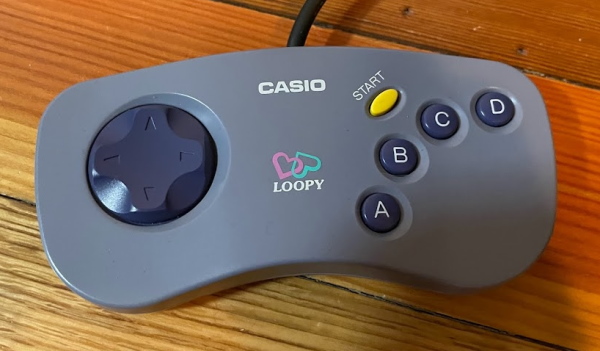
nicole.express →Imagine asking Julius Caesar to review the arcade game Galaga . He lacks the knowledge of space that even children have today, and certainly can’t recognize a spaceship; he keeps going on about how using arrows against bugs is a waste of a perfectly good arrow. Even the high score concept is foreign to a man who doesn’t know about the modern arabic numerals, and anyway, he gets way too interested when you happen to mention a CRT monitor’s discharge could kill a man. Would you really learn anything useful about Galaga from his review? And what is the point of this thought? Nothing, totally irrelevant. Let’s talk about the Casio Loopy! Casio is of course a big name in electronics, but they’ve not shown up on this blog at all before. They made some MSX computers, and the Casio PV-1000 and PV-2000 consoles in the early 80’s, but the Loopy has pretty much nothing to do with those. The Casio Loopy’s controller is a pretty simple affair; amusingly, the layout may be better for Neo Geo games than SNK’s own Neo Geo CD pad, with the face buttons laid out in a semicircle. But sadly you wouldn’t want to play King of Fighters ‘97 on this; the buttons don’t feel great, with very little travel. For the Loopy, though, they get the job done and it’s comfortable in the hand. The system has just one controller slot. This slot on the front is where the printer outputs. The printer is, as we’ll see, kind of the whole point of the Loopy. The printer prints small stickers, or as the console calls them, “seals”. So, let’s take this girl apart. It’s just held together by cross-head screws on the bottom; somewhat oddly, as the cartridges do use the infamous “Gamebit” security screws. Near the CPU we can also see a Sony CXA1645M RGB encoder. This creates the composite video output, which just goes to an RCA plug on the back. The smaller circuitboard is just for power regulation, and it has the actual RCA jacks for audio and video. Interestingly, the power supply that came with the Loopy outputs 24V DC, which is quite a bit higher than most game consoles of the period. The games are cartridge-based. This is a bit of a surprise, as this came out the year after the launch of CD-based consoles like the Sony PlayStation, the NEC PC-FX , and the Sega Saturn. This may have been a cost-saving move for the main console; the game consoles not only contain the game ROM, but also the SRAM used to save the game (there is a battery soldered to the opposite side of the PCB). So what kind of games did the Casio Loopy have? According to a Eurogamer interview, Loopy engineers Tetsuya Hayashi and Kunihiro Matsubara state that they didn’t originally design the console with women in mind; the goal was to provide a unique experience with the stickers. Since young girls liked to play with stickers, that became the target later as the launch lineup was drawn up. By the time commercials were made, the target audience was clear. Dream Change is a dress-up game. It’s pretty clear to see what the appeal of this game is to the target audience; you get to choose outfits for your character. It’s not just a sandbox; your outfit can be judged by the game, and meeting the requirements allows you to take your model to various settings. Here, I’m told that I need to do a better job coordinating between heavy and light. At least he’s smiling while doing so. But enough talk. Let’s print a sticker. I’ve got a whole unused new old stock package of sticker stock for the Loopy. Now, the fact that these are so still easily attainable may be a bad sign for the Loopy’s success, but hey, it doesn’t know that. The print goes pretty fast; you can tell that it prints in color as it has to pull the sticker back in and out for each layer. Let’s take a quick look at a 1200dpi scan from my struggling Canon scanner. Forgiving the fadedness, which is from the scanner as we’ll see better colors in the photo below, it looks pretty good; this close up, you can even see detail that the Framemeister
Excerpt from a page describing this subject · 13,162 chars · not written by Vinony
Wikidata facts
- Subclass of
- home video game console
- Has part
- thermal printer
- Follows
- PV-1000
- Manufacturer
- Casio
- Image
- Casio-Loopy-Console-Set.png
Show 6 more facts
- described at URL
- blog.adafruit.com/2021/12/17/the-90s-console-that-printed-stickers-the-casio-loopy-vintage-consoles-nicole_express
- Commons category
- Casio Loopy
- publication date
- 1995-10-19
- intended public
- girl
- discontinuation date
- 1998-12-00
- price
- 25000
via Wikidata · CC0